 Home Loan
What to Do When Home Loan Interest Rates Go Up
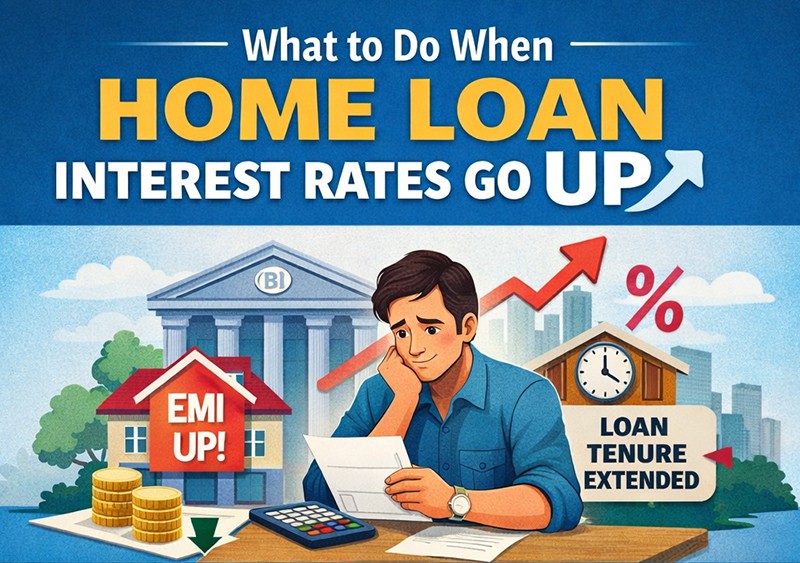
When home loan interest rates start climbing, anyone with a floating-rate loan feels the pinch. Basically, if the Reserve Bank of India hikes its repo rate—the rate it sets for banks—your lender usually follows suit and bumps up the interest on your home loan. Out of the blue, you're facing either heftier monthly payments or a stretched-out repayment period, contingent on your lender's specific adjustments.
So, what now? You can either concede and shell out the extra cash, or you can strategize to tilt the situation in your direction.
How Do Rising Rates Hit Your Loan?
Home loans in India often hinge on an external benchmark, with the repo rate being the most frequently used.
If the Reserve Bank of India decides to raise this rate, your lender will then modify the interest rate on your loan, as specified in the terms of your loan agreement.
In reality, this leads to one of two scenarios:
- Your EMI goes up but your loan period stays the same, or
- Your EMI stays the same but your loan tenure stretches out.
Lenders often go with the second option—they extend the tenure instead of raising your monthly payment. It seems easier for borrowers but ends up costing you more in interest over time.
Let’s break it down. Imagine you have a ₹50 lakh home loan at 8% over 20 years. If the rate jumps to 9%, your EMI rises from about ₹41,822 to ₹44,986—that’s ₹3,164 extra every month. If your lender stretches the tenure instead, you’ll pay a lot more interest in total.
What Can You Do When Rates Rise?
1. Make part-prepayments. If you have some extra cash—a bonus, matured investment, tax refund—use it to pay down your principal. This cuts down the interest you’ll pay and can shorten your loan period, without cranking up your EMI.
2. Increase your EMI. If you've seen a bump in your income since you took out the loan, think about asking your lender to adjust your monthly payment upwards. Paying more each month can help you stay on track with the original schedule and ultimately save you money on interest, rather than letting the loan term stretch out.
3. Do a balance transfer. If you find a lender with a significantly lower rate, switching your loan might reduce both your monthly payment and the overall interest you'll pay. This strategy is most effective in the early stages of your loan, when a large portion of your payment is applied to interest. However, it's essential to do the calculations. Processing fees, legal expenses, and any penalties imposed by your current lender can quickly offset your potential savings.
Switch to a fixed rate. Fixed-rate loans shrug off repo rate changes. If you think rates will keep rising, locking in a fixed rate means your EMI stays predictable. The catch? Fixed rates usually start out higher, and you won't benefit if rates drop later.
What Should You Skip?
Don’t keep extending your loan tenure forever—it’s the easiest option, but also the most expensive in the long run. Keep an eye on your loan statement and ask your lender for details: How much principal is left? What’s the new interest rate? How long are you stuck paying after each reset?
Conclusion
Floating-rate home loans go up and down with the market—it’s just how they work. The smart play is to track when your rates change, look at how much extra interest you’re facing, and take action—whether that’s prepaying, upping your EMI, or switching lenders. Small steps early on save you a lot more than big changes made late.
Support Our Journalism
We cannot do without you.. your contribution supports unbiased journalism
IBNS is not driven by any ism- not wokeism, not racism, not skewed secularism, not hyper right-wing or left liberal ideals, nor by any hardline religious beliefs or hyper nationalism. We want to serve you good old objective news, as they are. We do not judge or preach. We let people decide for themselves. We only try to present factual and well-sourced news.
Support objective journalism for a small contribution.