How Inflation Is Destroying Your Health Insurance Coverage Silently
In the shifting economic landscape of 2026, many families are realising that their financial security is being eroded from an unexpected corner.
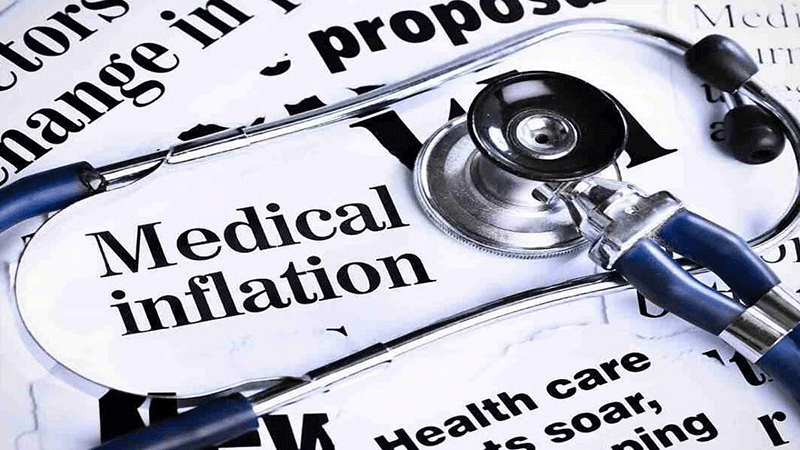
While we often track the prices of fuel, groceries, and housing, there is a "silent destroyer" working behind the scenes to deplete your savings: medical inflation. Currently, India is witnessing medical inflation rates of approximately 11% to 14%, significantly outpacing the general Consumer Price Index (CPI). This gap means that the medical health coverage you purchased just three years ago might now be insufficient to cover even a standard surgical procedure.
Understanding how inflation impacts your protection is the first step toward securing your future. If you aren't actively engaging in health insurance planning, you may find yourself underinsured at the exact moment you need help the most.
The Stealthy Erosion of Your Sum Insured
When you buy a health policy, you select a "Sum Insured", say, ₹10 Lakhs. In your mind, that is a substantial safety net. However, inflation acts like a leak in that net. What cost ₹5 lakh in 2022 for a cardiac procedure or advanced oncology treatment could easily touch ₹8 lakh in 2026.
This phenomenon effectively shrinks your medical health coverage without changing the numbers on your policy document. You still have ₹10 lakh of protection on paper, but its "purchasing power" in a hospital setting has diminished. Without the best health coverage that accounts for these rising costs, a single hospitalisation can lead to significant out-of-pocket expenses, defeating the very purpose of having insurance.
Why Standard Policies Are Falling Short?
For decades, a "standard" policy was often defined by a ₹5 lakh sum insured and basic hospitalisation benefits. In 2026, these products are not just outdated; they are a financial liability. Most traditional policies were designed for an era where medical costs were stable. Today, several factors are driving the surge:
Technological Advancements
Today, procedures like robotic-assisted surgeries for oncology or cardiology have become the norm rather than the exception. While these technologies improve recovery times, they come with a price tag that standard medical health coverage simply isn't built to handle. Robotic surgeries and precision medicine offer better outcomes but come with a premium price tag.
Administrative Costs
Higher operational costs for hospitals are passed directly to the patient. Many standard plans cap room rent at 1% of the sum insured. If you have a ₹5 lakh plan, your room rent is capped at ₹5,000. In most Tier-1 private hospitals today, even a semi-private room starts at ₹8,000. If you stay in that room, the insurer won't just ask you to pay the ₹3,000 difference; they will proportionately reduce your entire bill, including surgeon fees and medicine, by the same ratio. This can result in you paying 40% of the total claim out of your own pocket, even if you have the best health coverage on paper.
Chronic Disease Surge
Medicines have moved toward specialised drugs, such as GLP-1 medications for chronic management and advanced biologics. Traditional plans frequently categorise these as "investigational" or cap their coverage at a measly ₹50,000. Without modern healthcare coverage planning, you are essentially holding a shield that only protects you from 20th-century risks while living in a 21st-century world. The rise in lifestyle-related ailments requires long-term, expensive management.
If your current medical health coverage doesn't include features like "inflation protection" or "unlimited restoration", you are essentially gambling with your savings. Effective health protection planning requires looking beyond just the premium; it requires looking at how the policy grows with the economy.
The Core Pillars of Modern Health Insurance Planning
To combat the silent diminishment of your benefits, your health insurance planning must be dynamic, as you cannot afford a “set it and forget it” approach in 2026. Here are the three pillars you should focus on.
Evaluating the sum insured annually is essential, as the most common mistake is sticking with a low sum insured because “we are a healthy family.” In the current climate, a family of four should ideally look at a base cover of at least ₹20 lakhs to ₹25 lakhs, and relying on a basic ₹5 lakh plan is no longer considered the best health coverage strategy, but rather a recipe for a financial crisis.
Utilising super top-ups can be a practical solution if increasing your base plan feels too expensive, as a “Super Top-Up” is a way to enhance your medical health coverage by acting as an extra layer of protection that kicks in once your base sum is exhausted, often at a fraction of the cost of a new policy.
Choosing the right partner is equally important, as the insurer you select determines the quality of your care, and you need a partner that not only provides a policy but also offers a comprehensive health ecosystem, which is where Niva Bupa Health Insurance stands out as a market leader.
Common Mistakes to Avoid in 2026
Even with the best health coverage, certain mistakes can leave you vulnerable:
Ignoring Room Rent Caps
Many old policies cap room rent at 1% of the sum insured. In modern private hospitals, a decent room often exceeds these limits, leading to "proportionate deductions" that can eat up 30% of your total claim. While a ₹5,000 cap might have been manageable five years ago, in 2026, even a standard private room in a metropolitan hospital can easily cost ₹10,000 to ₹15,000. Many policyholders assume they can simply pay the "extra" ₹5,000 out of pocket.
Overlooking Modern Treatments:
As medical technology accelerates, the line between "experimental" and "standard" care has blurred. By the year 2026, medical procedures like oral chemotherapy, robot surgeries and stem cell therapy will be a non-rare practice since they provide a greater chance of success and a shorter length of stay. However, if your health insurance planning hasn't been updated recently, your policy may still list these under "investigational" procedures, which are either excluded or severely capped. Neglecting this detail means you might be forced to choose an invasive, older surgical method simply because your insurance won't cover the modern, minimally invasive alternative.
Neglecting Preventive Care:
To overcome medical inflation, there is no better solution than to avoid going to the hospital. In health insurance planning, the main focus should be on policies that include annual check-ups, teleconsultations, and wellness incentives since they help in identifying lifestyle diseases such as hypertension or early-stage diabetes before it results in costly hospitalisation. Some companies, such as Niva Bupa Health Insurance, even have what they call Wellness Points, which can be used to discount your renewal premiums and, in effect, reward you for keeping yourself healthy.
Conclusion
Inflation is unavoidable, but its effects on your way of life need not be. As we navigate the complexities of 2026, the definition of the best health coverage has evolved. It’s not just about paying for a hospital stay. It’s about making sure your health insurance truly protects the money you've worked hard to save from increasing medical costs.
If you plan your family health insurance carefully and pick a good provider like Niva Bupa Health Insurance, you can relax knowing your family's future is secure. Don't wait until you have a medical emergency to find out your coverage isn't good enough. Review your policy at this moment, think about the inflation rate, and upgrade to a plan that really protects your money.
Support Our Journalism
We cannot do without you.. your contribution supports unbiased journalism
IBNS is not driven by any ism- not wokeism, not racism, not skewed secularism, not hyper right-wing or left liberal ideals, nor by any hardline religious beliefs or hyper nationalism. We want to serve you good old objective news, as they are. We do not judge or preach. We let people decide for themselves. We only try to present factual and well-sourced news.
Support objective journalism for a small contribution.