 Tech War
Caught in tech crossfire? Economic survey flags risks for India as US-China rivalry deepens
India faces mounting geopolitical and economic risks as the United States and China intensify their confrontation over technology, trade, and strategic resources, the Economic Survey 2025–26 has warned.
The Survey argues that New Delhi must urgently recalibrate its global economic posture and strive for “strategic indispensability” or risk being marginalised in a world increasingly organised around artificial intelligence, semiconductors, and critical minerals.
According to the Survey, the global economic order is undergoing a structural shift that leaves little room for fence-sitting.
Nations that fail to embed themselves deeply within future-facing value chains may find their strategic relevance sharply diminished.
Rise of ‘Pax Silica’ and end of old order
At the heart of this transformation is what the Survey terms “Pax Silica,” a US-led framework aimed at consolidating dominance across the entire AI and advanced technology ecosystem.
This includes securing access to energy, rare earth elements, chip fabrication capabilities, cloud infrastructure, and foundational software models.
The Survey describes this shift as the definitive end of the oil-and-steel era.
In its place emerges a new order where “compute” power—control over data, algorithms, and processing capacity—becomes the principal determinant of national strength and geopolitical influence.
Washington and Beijing redraw global tech map
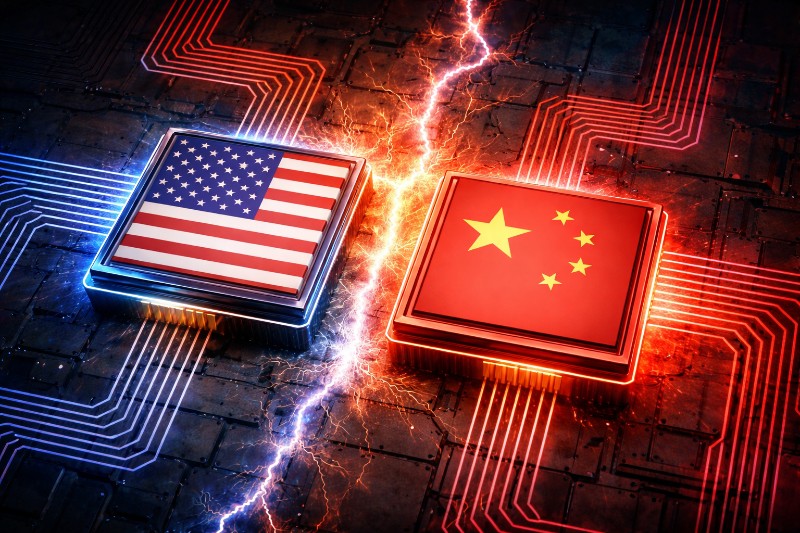
The United States has moved aggressively to reshape global technology flows by imposing stringent export controls that limit China’s access to advanced semiconductors, chipmaking equipment, and related technologies.
These measures are designed to slow Beijing’s progress in critical sectors such as artificial intelligence and high-performance computing.
China, in response, has weaponised its dominance over rare earths and permanent magnets, essential inputs for advanced manufacturing, clean energy technologies, and defence systems.
Beijing has also expanded the use of its “Unreliable Entities List,” targeting foreign firms it perceives as acting against its national interests.
The Survey stresses that these actions represent more than tactical trade measures.
They signal a decisive move away from efficiency-driven globalisation towards politically motivated economic decision-making.
Strategic rivalry replaces economic pragmatism
The Economic Survey characterises the current phase of US-China relations as a full-blown strategic rivalry.
Both powers are increasingly willing to absorb economic costs to secure long-term technological and geopolitical advantages, even if that means fragmenting global supply chains.
In this environment, trade and investment decisions are no longer neutral market outcomes but instruments of statecraft.
The Survey cautions that this shift fundamentally alters the rules governing global commerce.
China’s internal pressures and export push
The Survey also highlights China’s domestic economic challenges, pointing to persistent deflationary pressures, weak consumer demand, and a prolonged property sector downturn.
As internal growth drivers falter, Beijing has leaned more heavily on manufacturing exports to sustain economic momentum.
In a notable policy move, China launched a Free Trade Port initiative in Hainan in December 2025.
The experiment aims to ease customs procedures and liberalise investment norms, allowing China to mitigate external trade frictions while sustaining export competitiveness.
America’s 'exclusive' tech alliance takes shape
While China seeks workarounds, the United States is moving quickly to consolidate a closed, trusted technology bloc.
Through Pax Silica, Washington is building alliances with like-minded nations to create secure and geopolitically aligned AI and semiconductor supply chains.
The Survey warns that in this emerging ecosystem, power will increasingly reside with countries that control advanced materials, semiconductor fabrication, and critical digital interfaces.
Strategic relevance will depend on whether nations can offer capabilities that others cannot easily replace.
Why India cannot afford strategic comfort
For India, the Survey delivers a stark message.
Continuing as a back-office economy or remaining dependent on foreign digital infrastructure carries significant long-term risks. India must embed itself in global value chains through unique, high-value products and services that make it indispensable to multiple partners.
This, the Survey argues, requires building deep domestic innovation capacity, reducing reliance on external digital systems, and securing positions in critical technology segments.
Failure to act decisively could leave India vulnerable in a world increasingly defined by technology denial, strategic leverage, and exclusionary alliances.
As the US-China rivalry accelerates, the Economic Survey makes clear that strategic neutrality alone will not shield India. Relevance, resilience, and indispensability will.
Support Our Journalism
We cannot do without you.. your contribution supports unbiased journalism
IBNS is not driven by any ism- not wokeism, not racism, not skewed secularism, not hyper right-wing or left liberal ideals, nor by any hardline religious beliefs or hyper nationalism. We want to serve you good old objective news, as they are. We do not judge or preach. We let people decide for themselves. We only try to present factual and well-sourced news.
Support objective journalism for a small contribution.