


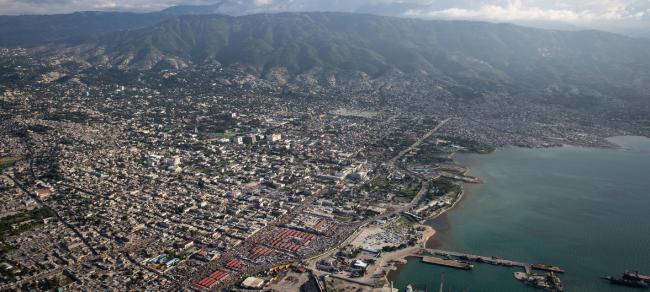
Is Haiti better prepared for disasters, 9 years on from the 2010 earthquake?
New York, Jan 13 (IBNS):Half a capital city destroyed, 220,000 reported dead and 1 million residents displaced. This was the toll of the 2010 Haiti earthquake, which struck on 12 January, 9 years ago.
Staff at the UN Mission in Haiti were also affected, and there were 102 UN casualties, including the Secretary-General’s Special Envoy, Hédi Annabi and his deputy, Luiz Carlos da Costa. It was the “biggest single loss of life in the history of UN Peacekeeping,” the then-President of the UN Staff Union, Stephen Kisambira, said at the time.
One of the survivors was Sophie Boutaud de la Combe, today the head of communications for the UN Mission for Justice in Haiti (MINUJUSTH), who was seven months pregnant at the time and just a few days away from home leave. She had been in the headquarters of MINUJUSTH’s predecessor, the UN Stabilisitation Mission in Haiti (MINUSTAH), when the quake hit.
The building completely collapsed, but Boutaud de la Combe managed to escape through a collapsed wall. For many hours, she and her surviving colleagues searched through the rubble, looking for anyone still trapped under the building. Two days later, she reluctantly left Haiti, a situation she describes as “a trauma,” her instinct being to help the UN and the people of Haiti. She eventually returned to the country in 2013, happy to be able to play a part in the rebuilding of the country, and honour her lost colleagues with her work.
9 years after the earthquake, the situation in Haiti is very different. The government, says Boutaud de la Combe, is now much better prepared for similar natural disasters. “A few months ago there was an earthquake in the north of the country. The state was prepared and they sent their people to support those affected, without MINUJUSTH involvement. It was not a major earthquake, but now the population knows how to react. And most importantly, we hear regularly how important it is to build better, to build strongly in case an earthquake would hit, not to endanger the people.”
MINUJUSTH/Leonora Baumann
Support Our Journalism
We cannot do without you.. your contribution supports unbiased journalism
IBNS is not driven by any ism- not wokeism, not racism, not skewed secularism, not hyper right-wing or left liberal ideals, nor by any hardline religious beliefs or hyper nationalism. We want to serve you good old objective news, as they are. We do not judge or preach. We let people decide for themselves. We only try to present factual and well-sourced news.
Support objective journalism for a small contribution.


