


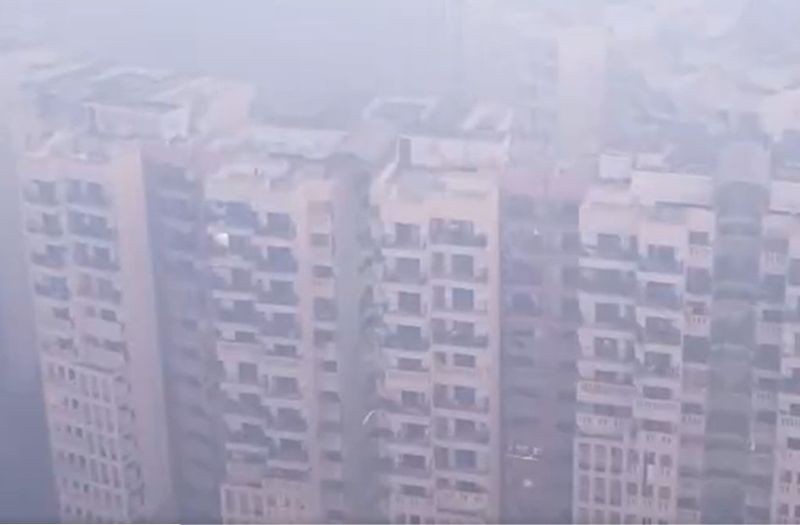
Delhi suffocates under severe smog as cold wave tightens grip
Residents of the national capital woke up to hazardous air quality on Sunday as a thick layer of toxic smog combined with dense fog enveloped large parts of Delhi, pushing pollution levels into the ‘severe’ category.
The situation was further aggravated by a sharp dip in temperatures, prompting the India Meteorological Department (IMD) to issue a cold wave alert for several areas.
According to IMD data, Delhi’s primary weather station at Safdarjung recorded a minimum temperature of 4.4 degrees Celsius on Saturday, while Ayanagar registered 4.9 degrees Celsius.
Several other parts of the city experienced temperatures below the 5-degree Celsius mark, indicating intensified winter conditions.
#WATCH | Delhi: A thick layer of smog engulfs the national capital. Drone visuals from AIIMS.
— ANI (@ANI) January 18, 2026
Restrictions under GRAP-IV have been reimposed in Delhi-NCR as the air quality deteriorates pic.twitter.com/LXuGFvMxap
In its latest bulletin, the IMD forecast a partly cloudy sky for the day, with moderate fog at many places and dense fog at isolated locations during the morning hours.
The maximum temperature is expected to hover between 21 and 23 degrees Celsius, while the minimum may remain between 4 and 6 degrees Celsius.
Meanwhile, Delhi’s air quality continued to deteriorate sharply. Data from the Central Pollution Control Board (CPCB) showed the city’s 24-hour average AQI at 437 at 6:30 a.m., categorising it as ‘severe’.
Several monitoring stations reported AQI readings above 450, placing them in the ‘severe+’ category.
#WATCH | Delhi | A layer of toxic smog engulfs the national capital. Visuals from the Janpath Road. GRAP 4 invoked in the national capital. pic.twitter.com/wcTzm0T2V3
— ANI (@ANI) January 18, 2026
Areas including Wazirpur, Sonia Vihar, Rohini, RK Puram, Punjabi Bagh, Patparganj, North Campus, Nehru Nagar, Mundka, Jawaharlal Nehru Stadium, Dwarka Sector 8, Chandni Chowk, Burari Crossing, Bawana, Ashok Vihar, and Anand Vihar recorded extremely hazardous air quality levels.
The IMD also issued a nowcast warning for fog due to significantly reduced visibility across multiple locations. In response, Indira Gandhi International Airport issued a passenger advisory, stating that Low Visibility Procedures were in place.
While flight operations remained largely normal, passengers were advised to check with their respective airlines for real-time updates.
The combined impact of severe air pollution, dense fog, and cold wave conditions has raised serious health concerns, particularly for children, the elderly, and individuals with respiratory ailments.
Authorities said the situation is being closely monitored as harsh winter conditions continue to intensify across the region.
Support Our Journalism
We cannot do without you.. your contribution supports unbiased journalism
IBNS is not driven by any ism- not wokeism, not racism, not skewed secularism, not hyper right-wing or left liberal ideals, nor by any hardline religious beliefs or hyper nationalism. We want to serve you good old objective news, as they are. We do not judge or preach. We let people decide for themselves. We only try to present factual and well-sourced news.
Support objective journalism for a small contribution.


