


Hair Structure Explained: Roots, Follicles & Growth Cycle
Most people think hair loss is just about the hair they can see. But what's actually happening is much deeper — literally. Understanding how hair is built, where it grows from, and why it sometimes stops can change the way you think about every strand on your head.
The Anatomy of a Hair Strand
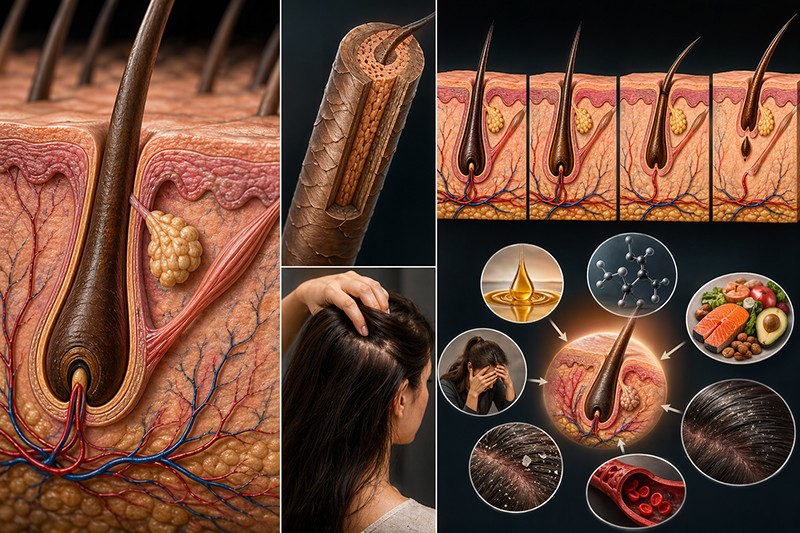
Hair looks simple from the outside — a thin strand that grows from your scalp. But it's made up of distinct layers, each with a specific job.
The outermost layer is called the cuticle. It's made of overlapping, scale-like cells that protect the inner layers. When the cuticle is healthy, it lies flat, and hair looks smooth and shiny. When it's damaged — from heat, chemicals, or rough handling — those scales lift, and hair becomes frizzy, dull, and prone to breakage.
Beneath the cuticle is the cortex, which makes up the bulk of the hair strand. This is where keratin proteins are tightly packed together, giving hair its strength and elasticity. The cortex also contains melanin, the pigment that gives your hair its color.
At the very center of some hair strands is the medulla — a soft, loosely packed core. Not all hair has a medulla, and its exact role isn't fully understood, but it's more commonly found in thicker, coarser hair types.
What a Hair Follicle Actually Does
The follicle is where everything begins. It's a tunnel-shaped structure embedded in the scalp, and it's far more complex than most people realize.
Each follicle contains a hair bulb at its base. The bulb houses rapidly dividing cells called matrix cells — these are what actually produce the hair strand. As these cells multiply, they push older cells upward, and those cells harden and die, forming the hair shaft you see growing out of your scalp.
The follicle is also connected to a sebaceous gland, which produces sebum — the natural oil that keeps both the scalp and the hair strand moisturized. Just below the skin's surface, a small muscle called the arrector pili attaches to the follicle. It's the muscle responsible for "goosebumps."
What matters most for hair health is that the follicle is alive and active. A healthy follicle produces healthy hair. A damaged or shrunken follicle produces thin, weak hair — or nothing at all.
The Four Stages of the Hair Growth Cycle
Hair doesn't grow continuously. It goes through a cycle, and understanding this cycle explains a lot about why hair falls out, why it grows back, and why sometimes it doesn't.
- Anagen (Growth Phase): This is the active growth phase, lasting anywhere from 2 to 7 years. About 85–90% of your hair is in this phase at any given time. The longer the anagen phase, the longer your hair can grow.
- Catagen (Transition Phase): A short phase lasting about 2–3 weeks. The follicle shrinks, and the hair stops growing. The strand detaches from its blood supply.
- Telogen (Resting Phase): The follicle rests for around 3 months. The old hair stays in place while a new hair begins forming underneath.
- Exogen (Shedding Phase): The old hair falls out — naturally, often during washing or brushing. Losing 50–100 hairs a day during this phase is completely normal.
Problems occur when too many follicles enter the resting phase too early, or when the anagen phase shortens over time. This is what happens in conditions like androgenetic alopecia.
What Disrupts the Growth Cycle
Several internal and external factors can push follicles into an early resting phase or slow down new growth.
- Hormonal imbalances, especially elevated DHT (dihydrotestosterone), can cause follicles to shrink progressively
- Nutritional deficiencies — iron, zinc, biotin, and protein are all essential for matrix cell activity
- Chronic stress triggers a condition called telogen effluvium, where large numbers of hairs shift to the resting phase simultaneously
- Scalp inflammation, often caused by dandruff or seborrheic dermatitis, can interfere with follicle function
- Poor blood circulation reduces the oxygen and nutrient supply reaching the hair bulb
These aren't isolated problems. In most cases of significant hair loss, multiple factors are working together.
Why Root Cause Matters More Than You Think
Here's the thing — most hair care products work at the surface level. They condition the strand, reduce breakage, or make hair appear fuller. But they don't address what's happening inside the follicle or what's disrupting the growth cycle.
This is why the same shampoo or oil that works for one person does nothing for another. Hair loss is rarely one-size-fits-all. Approaches like traya hair treatment focus on identifying the specific root causes driving hair loss for each individual — whether it's hormonal, nutritional, stress-related, or a combination — rather than applying a generic fix.
Understanding your hair's structure and growth cycle is the first step in asking better questions about why loss is happening and what might actually help.
Final Thoughts
Hair is more than something that sits on your head. It's a biological system — one that responds to what's happening inside your body, not just what you put on it externally. The follicle produces, the growth cycle regulates, and when something goes wrong deeper in the body, the hair is often one of the first places it shows up.
If you're dealing with thinning or excessive shedding, the most useful question isn't "what product should I try?" It's "what's actually going on in my body?" That shift in thinking tends to lead to answers that actually last.
Support Our Journalism
We cannot do without you.. your contribution supports unbiased journalism
IBNS is not driven by any ism- not wokeism, not racism, not skewed secularism, not hyper right-wing or left liberal ideals, nor by any hardline religious beliefs or hyper nationalism. We want to serve you good old objective news, as they are. We do not judge or preach. We let people decide for themselves. We only try to present factual and well-sourced news.
Support objective journalism for a small contribution.


