


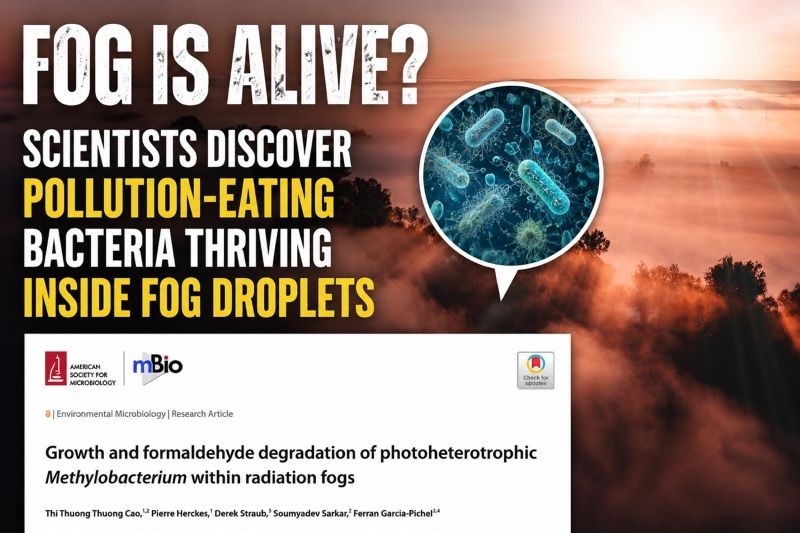
Did you know fog contains bacteria that can eat pollutants and clean the air? New study reveals
Tempe, United States: In a breakthrough study that could redefine how scientists understand the atmosphere, researchers at Arizona State University have discovered that fog droplets are not merely suspended water particles drifting through the air but can function as active microscopic ecosystems filled with living bacteria capable of removing atmospheric pollutants.
The study, published in the journal mBio in May 2026, reveals that radiation fogs contain dense populations of metabolically active bacteria, particularly Methylobacterium species, which can break down toxic air pollutants such as formaldehyde.
Fog may be more alive than scientists imagined
The research emerged from a multi-year investigation led by scientists from Arizona State University and Susquehanna University in the United States.
Researchers analyzed 32 separate radiation fog events over two years in Pennsylvania, studying how microbial communities behaved before, during, and after fog formation.
The study’s lead researcher, Thi Thuong Thuong Cao, who conducted the work during her PhD at ASU, focused on two key questions: which bacteria are present in fog, and whether they are truly active inside the droplets.
“If they are growing, then the droplets are a habitat. That’s a mindset change,” said Ferran Garcia-Pichel, co-author of the study and director of the ASU Biodesign Center for Fundamental and Applied Microbiomics.
Genomics reveals the hidden capabilities of fog bacteria
Assistant research scientist Soumyadev Sarkar, one of the study's co-authors, highlighted the importance of linking microbial physiology to genomics for understanding atmospheric microbial life.
“The genome of an organism has every secret, and it was exciting to support the observations from the physiological studies with the genomics of Methylobacterium strains, revealing their potential for formaldehyde assimilation through the serine cycle and a possible photoheterotrophic lifestyle supported by bacteriochlorophyll synthesis,” Dr. Sarkar said.
Researchers found that although fewer than 1% of fog droplets individually contain bacteria, the total microbial load across fog water is astonishingly high.
According to Garcia-Pichel, bacterial concentrations in fog water can rival those found in oceans and lakes, with even a tiny amount of fog water containing millions of bacterial cells.
Discovery may influence climate science and water safety
The implications of the discovery extend beyond atmospheric science. Fog harvesting is increasingly being explored as a sustainable source of freshwater in water-scarce regions worldwide.
However, the researchers caution that fog water contains large numbers of living pathogenic bacteria and may require treatment before human use.
The findings could also influence future climate and atmospheric chemistry models, as scientists begin to recognize that microbial activity inside fog droplets may actively shape atmospheric processes.
Support Our Journalism
We cannot do without you.. your contribution supports unbiased journalism
IBNS is not driven by any ism- not wokeism, not racism, not skewed secularism, not hyper right-wing or left liberal ideals, nor by any hardline religious beliefs or hyper nationalism. We want to serve you good old objective news, as they are. We do not judge or preach. We let people decide for themselves. We only try to present factual and well-sourced news.
Support objective journalism for a small contribution.


