 Economic Survey
Economic Survey shows Indian agricultural sector is a success story
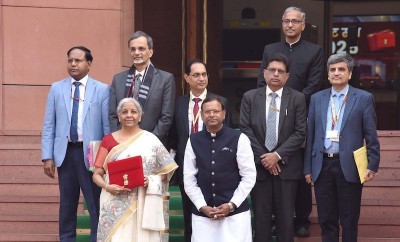
India has come a long way from being a food deficit and importing country in the 1960’s to being a net exporter of agricultural products, highlights The Economic Survey 2023-24, tabled by the Union Finance and Corporate Minister Nirmala Sitharaman in Parliament on Monday.
The need of the hour is to move from basic food security to nutritional security , points out the Survey.
The Survey further notes that, we need more pulses, millet, fruits and vegetables, milk, meat and their demand is growing faster than that of basic staples.
So, farm sector policies should align more with a ‘demand-driven food system’ that is more nutritious and aligned with Nature’s resource endowments, suggests the Survey.
The Economic Survey elaborates five policy recommendations that governments can take to ensure that the markets function in the interest of the farmer.
The first step talks about not banning futures or options at the first sign of price spikes.
The intelligent regulatory design of such markets can obviate the need for bureaucratic interference in the futures market for agricultural commodities, adds the Survey.
The second recommendation by the Survey talks about invoking export bans only under exceptional circumstances and allowing domestic consumers to substitute, especially if the agricultural commodities in question are not essential consumption items such as foodgrains. “Farmers should be allowed to benefit from higher international prices”, states the Survey.
As the third step, the Survey talks about re-examining the inflation-targeting framework. It says that India’s inflation targeting framework should consider targeting inflation, excluding food.
“Higher food prices are, more often, not demand-induced but supply-induced. It is worth exploring whether India’s inflation targeting framework should target the inflation rate excluding food,” notes the Survey.
The Survey further notes that hardships caused by higher food prices for poor and low-income consumers can be handled through direct benefit transfers or coupons for specified purchases valid for appropriate durations
The fourth recommendation talks about the need for increasing the Total Net Irrigated Area.
Several states are well below the national average and India’s irrigation efficiency is only 30-40 percent for surface water and 50-60 per cent for groundwater, points out the Survey. The Survey highlights the need for better water utilisation farming practices and technologies like drip and fertigation.
The fifth and final suggestion by the Survey is about making farming consistent with climate considerations. Grains such as rice and sugarcane are water-guzzling crops and cultivation of paddy gives rise to methane emissions. The time has come to promote crop-neutral incentive structures, says the Survey.
Agriculture is at the confluence of three of the greatest challenges of the 21st century – sustaining food and nutrition security, adaptation and mitigation of climate change, and sustainable use of critical resources such as water, energy, and land, highlights the Survey. The Survey notes that although agriculture and allied sectors hold significant potential for gainful employment, India is yet to fully exploit the potential of agriculture to contribute to economic growth and employment generation.
The agricultural sector requires a serious structural transformation due to challenges posed by water scarcity and climate change adds the Survey.
The surge in agricultural employment in COVID years due to reverse migration, the decline in the growth rate of value addition in agriculture in FY24, and an extremely hot summer in the Northwestern and central regions of the country in the summer of 2024 with rising water stress and energy consumption make a serious and honest stock-taking of India’s farm sector policies imperative, concludes the Survey.
Support Our Journalism
We cannot do without you.. your contribution supports unbiased journalism
IBNS is not driven by any ism- not wokeism, not racism, not skewed secularism, not hyper right-wing or left liberal ideals, nor by any hardline religious beliefs or hyper nationalism. We want to serve you good old objective news, as they are. We do not judge or preach. We let people decide for themselves. We only try to present factual and well-sourced news.
Support objective journalism for a small contribution.