September 25, 2026 08:56 am (IST)

Follow us:


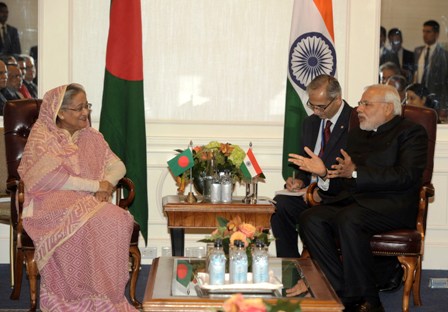
Modi speaks to Hasina after historic land swap bill clearance
New Delhi, May 8 (IBNS) As Parliament on Thursday passed the constitutional amendment bill to clear a historic land agreement with Bangladesh and resolve a long standing border problem, Prime Minister Narendra Modi spoke to his Bangladesh counterpart Seikh Hasina and conveyed his greetings to her.
Modi also personally thanked Congress leader Sonia Gandhi in the Lok Sabha.
In a series of tweets, Modi said the bill would contribute to a stable and peaceful boundary.
"Spoke to Bangladesh PM Sheikh Hasina and conveyed my greetings to the people of Bangladesh on this landmark occasion," a tweets on the handle @narendramodi read.
"This would contribute to a stable & peaceful boundary, better management & coordination of the border & will lead to enhanced security as well. The Amendment passed ensures a permanent settlement of land boundary with Bangladesh & resolution of long-pending boundary issues."
He said the passage of the Constitution (One Hundred and Nineteenth Amendment) Bill, 2013 was a "historic milestone" in India-Bangladesh relations. He also thanked the various political parties for supporting its passage.
"My thanks to all the political parties for their cooperation, as also to the states of Assam, Meghalaya, Mizoram, Tripura & West Bengal. This reflects the collective will of the nation to build constructive relations with our neighbors."
The bill was unanimously passed by the Rajya Sabha on Wednesday, while the Lok Sabha gave its nod to the legislation on Thursday.
Under the arrangement, enclaves will be exchanged between the two countries, giving effect to an agreement reached between India and Bangladesh on May 16, 1974 on acquiring and transfer of territories.
Nearly 160 enclaves exist scattering about on either side of the border even after the partition in 1947. The oddly distributed enclaves caused decades hardship and sufferings for the inhabitants in most cases surrounded by the land of a foreign country.
There are 51 Bangladeshi enclaves with about 15,000 people within states like Meghalaya, Tripura and West Bengal.
With the new agreement, these enclaves will become part of India and the people here have the option to relocate to Bangladesh if they prefer.
Across the border, there are about 100 enclaves that now transfer officially to be a part of Bangladesh. The government has reversed an earlier decision to exclude Assam from the agreement.
Foreign affairs minister Sushma Swaraj admitted that the government was only following what had been started by Manmohan Singh regime and that BJP had opposed the bill initially.
The house greeted Swaraj for the historic agreement and she assured that it would solve many problems.
Foreign affairs minister Sushma Swaraj admitted that the government was only following what had been started by Manmohan Singh regime and that BJP had opposed the bill initially.
The house greeted Swaraj for the historic agreement and she assured that it would solve many problems.
Support Our Journalism
We cannot do without you.. your contribution supports unbiased journalism
IBNS is not driven by any ism- not wokeism, not racism, not skewed secularism, not hyper right-wing or left liberal ideals, nor by any hardline religious beliefs or hyper nationalism. We want to serve you good old objective news, as they are. We do not judge or preach. We let people decide for themselves. We only try to present factual and well-sourced news.
Support objective journalism for a small contribution.
Latest Headlines
Rahul Gandhi calls Gyanesh Kumar ‘deshdrohi', demands his resignation; BJP hits back
Thu, Sep 24 2026
‘How does anti-incumbency disappear?’: Rahul Gandhi targets Modi, Shah in fresh ‘vote chori’ attack, demands Gyanesh Kumar’s resignation
Thu, Sep 24 2026
Nandigram bypoll shock: Calcutta HC shields Congress candidate Milan Pradhan in 2007 case, but will he walk free?
Thu, Sep 24 2026
‘Resign in 48 hours or face nationwide agitation’: CJP’s ultimatum to Gyanesh Kumar over SIR row
Thu, Sep 24 2026