Loud Threat, No Legal Legs: Why Mamdani Cannot Arrest Netanyahu During His UN New York Visit
New York's new mayor is making global headlines with inflammatory claims about arresting a foreign head of state. But the law — and the facts — tell a very different story.
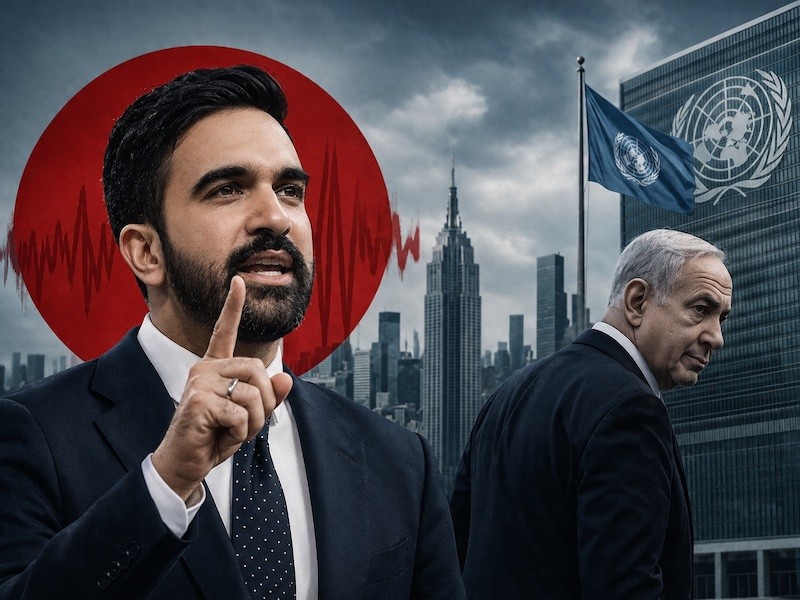
New York City Mayor Zohran Mamdani has a talent for saying things that travel far and fast. His latest statement — that he would consider arresting Israeli Prime Minister Benjamin Netanyahu should the latter visit New York for the United Nations General Assembly — has dominated international headlines, provoked outrage in Washington and Tel Aviv, and earned him considerable applause in certain corners of the internet.
It has also earned him something else: the uncomfortable scrutiny of whether he is a serious executive of the world's most consequential city, or a politician using one of the world's most visible offices as a megaphone for identity politics.
The short answer, on the legal question at least, is unambiguous. He cannot arrest Netanyahu. Not now, not under any configuration of existing law. And Mamdani himself, to his credit, has half-acknowledged this — telling reporters he would not "rewrite laws" to make it happen, an admission that rather undercuts the gravity of the original threat.
Here is why, precisely, the arrest talk is legal theatre.
The United States federal government has not recognised the jurisdiction of the International Criminal Court and is not a signatory to the Rome Statute. The ICC's warrant for Netanyahu — issued in November 2024 — carries no binding force within American borders.
Federal law explicitly prohibits local authorities from executing ICC warrants or any foreign arrest orders that contradict federal foreign policy. Under the UN Headquarters Agreement, visiting heads of state attending United Nations proceedings are additionally shielded by diplomatic immunity. A New York City mayor, in the constitutional architecture of the United States, has approximately zero authority over any of this. Foreign policy is a federal prerogative. Full stop.
Mamdani said he would not rule out an arrest. The law ruled it out for him.
A pattern of inflammatory claims
What makes this episode worth examining beyond its legal absurdity is that it is not an isolated moment of political theatre. It is part of a consistent pattern.
Since his unexpected rise to the mayoralty — having previously served as a New York State Assembly member — Mamdani has made a series of claims that have drawn sharp rebuttals from fact-checkers, foreign governments and diplomatic observers alike.
Among the most egregious: Mamdani has repeatedly asserted, in speeches and public appearances, that the Muslim population in Gujarat was "wiped out" — a claim that conflates the horrific communal violence of 2002, in which over a thousand people were killed (the majority Muslim), with a claim of mass demographic erasure that the data simply does not support.
Gujarat's Muslim population, according to India's own census data, continued to grow in the decades following 2002. The violence was real, the accountability inadequate, the grief legitimate — but the characterisation Mamdani deploys is a factual distortion that serves rhetorical purposes rather than the cause of historical accuracy.
His repeated attacks on Prime Minister Narendra Modi have followed a similar template: real grievances about civil liberties and minority rights in India — concerns shared by credible human rights organisations — inflated into claims that cannot withstand evidentiary scrutiny. The conflation of serious criticism with hyperbolic assertion is a disservice to both the facts and the communities whose suffering is being invoked.
On Gaza and Netanyahu, Mamdani has been consistently and publicly vocal — which is his right. Reasonable people hold serious views on the conduct of Israel's military campaign in Gaza, and the ICC's decision to issue arrest warrants for Netanyahu and former Defence Minister Yoav Gallant reflects a growing international legal consensus worth engaging seriously. None of that is in dispute.
What is in dispute is whether a city mayor grandstanding about an arrest he knows he cannot execute is advancing the cause of Palestinian rights or simply advancing his own political profile.
The polarising mayor and what he represents
Mamdani, the son of Ugandan-Indian academic Mahmood Mamdani, is a democratic socialist who swept to the mayoralty on a wave of progressive enthusiasm, becoming the first Muslim and first South Asian to hold the office. His supporters see him as a transformative figure. His critics — and they span ideological lines — see something more troubling: a leader whose instinct for provocation frequently outpaces his grasp of governance.
The Netanyahu statement is a case study. By floating the arrest idea, Mamdani achieves several things simultaneously: he energises his base, he generates international coverage, he positions himself as a moral voice on Gaza, and he pays no political cost because he has already hedged the claim into meaninglessness.
But there are costs, even if they are not immediately visible. New York City hosts the United Nations. It is the diplomatic crossroads of the world. When its mayor makes statements about arresting foreign heads of state on legally illiterate grounds, it creates friction with the federal government, complicates the city's relationship with the diplomatic community, and raises questions about whether the mayor understands — or cares about — the institutional constraints of the office he holds.
That is not a small thing. New York needs a mayor, not a commentator.
Mamdani may be, as his admirers insist, the future of progressive urban politics in America. He is young, articulate, clearly intelligent, and speaks to constituencies that have long felt unheard.
But intelligence and articulateness are not substitutes for accuracy, and the willingness to make claims — about Gujarat, about Modi, about Netanyahu — that are either factually contested or legally nonsensical suggests a politician still more comfortable with the microphone than with the weight of the office behind it.
The arrest of Benjamin Netanyahu will not happen in New York. American federal law will not permit it. Diplomatic immunity will not permit it. The ICC's jurisdiction does not extend here. Mamdani knows all of this.
Which makes the question worth asking: if you know you cannot do it, and you say you will consider it anyway, what exactly are you doing?
The answer is politics. And in a city of eight million people with eight million urgent needs, that particular brand of politics has a cost.
Support Our Journalism
We cannot do without you.. your contribution supports unbiased journalism
IBNS is not driven by any ism- not wokeism, not racism, not skewed secularism, not hyper right-wing or left liberal ideals, nor by any hardline religious beliefs or hyper nationalism. We want to serve you good old objective news, as they are. We do not judge or preach. We let people decide for themselves. We only try to present factual and well-sourced news.
Support objective journalism for a small contribution.