 Terrorism
Disgraceful Act: Defacing Mahatma Gandhi’s statue in Washington is an affront to peace
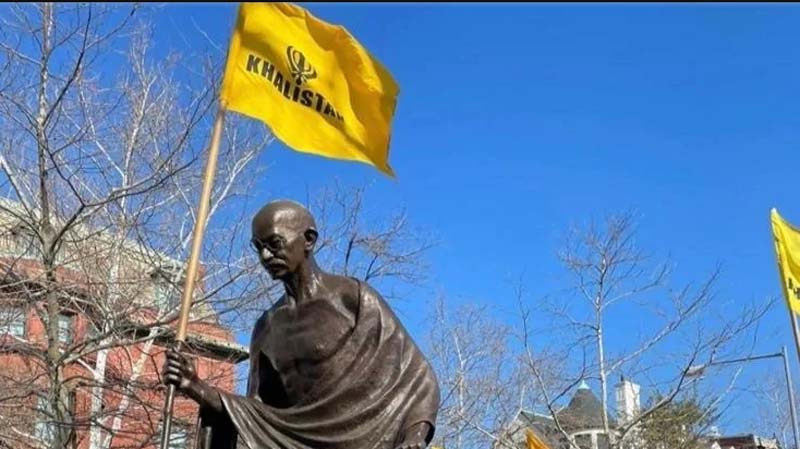
On October 1st, a shocking and disgraceful act took place in Washington, D.C., as Khalistan extremists desecrated the statue of Mahatma Gandhi, draping it in Khalistan flags and symbols of separatism.
This attack on a global symbol of peace and non-violence is not only an insult to Gandhi’s legacy but also to the values of tolerance and respect that the United States itself stands for.
While free speech is a cornerstone of American democracy, acts of hate and desecration like this should not be tolerated, and the deafening silence from the U.S. government is deeply troubling.
Mahatma Gandhi’s statue stands as a reminder of the power of peaceful resistance, tolerance, and universal brotherhood. His teachings inspired the American civil rights movement, influencing figures like Dr. Martin Luther King Jr., and his message resonates around the world as a force for unity, not division. The actions of the Khalistan extremists in Washington are not merely disrespectful to a bronze statue—they are an affront to the principles Gandhi stood for and an attempt to sow discord in international relations between India and the United States.
The extremist Khalistan movement, which seeks a separate Sikh state in India, has long been a source of tension, particularly in the Indian state of Punjab. While peaceful dissent and advocacy for regional autonomy have their place in any democracy, the methods employed by these extremists—who often resort to violence, intimidation, and acts like the one in Washington—cannot be condoned. Draping a statue of a global icon of peace in the flags of a separatist movement is an act of provocation, one intended to inflame tensions rather than foster dialogue. It’s an abuse of the very freedoms that the U.S. proudly offers its citizens and visitors.
What’s more concerning is the apparent passivity from the U.S. government in responding to this incident. The United States has always championed itself as a defender of human rights and a promoter of international peace. Yet, when extremists desecrate a statue of Gandhi—who symbolizes those very ideals—on American soil, there is an inexplicable silence. Is this what free speech has come to mean in America? That hate speech, divisive rhetoric, and public desecration are permissible under the banner of freedom? Free speech is essential, but it must be accompanied by responsibility, especially when it crosses the line into acts of hate and disrespect.
It is critical to distinguish between peaceful protest and violent or hateful actions disguised as free speech. Allowing groups with separatist or extremist agendas to engage in acts of desecration without consequence sends the wrong message: that hate, under the guise of free expression, is acceptable. If the U.S. turns a blind eye to such actions, it risks undermining its moral standing as a leader in promoting peace, justice, and human rights around the world.
Furthermore, the silence from the U.S. sends a disheartening signal to India, one of its key allies. The defacement of Gandhi’s statue, a symbol of Indian values and global peace, in the heart of the American capital, is more than a domestic issue—it is an international affront. By failing to strongly condemn this act, the U.S. risks alienating India and undermining the strong diplomatic relationship between the two democracies.
The U.S. government needs to speak out, firmly and unequivocally, against the defacement of Mahatma Gandhi’s statue. This isn’t just about safeguarding a statue; it’s about defending the values of peace and non-violence, principles that are central to Gandhi’s teachings and to the very fabric of American democracy. Acts of desecration like this must not be tolerated under any pretext. Extremist ideologies that promote hatred and division have no place in civil discourse, and the United States must stand firm in its rejection of such acts.
(Image and text courtesy: Khalsavox.com)
Support Our Journalism
We cannot do without you.. your contribution supports unbiased journalism
IBNS is not driven by any ism- not wokeism, not racism, not skewed secularism, not hyper right-wing or left liberal ideals, nor by any hardline religious beliefs or hyper nationalism. We want to serve you good old objective news, as they are. We do not judge or preach. We let people decide for themselves. We only try to present factual and well-sourced news.
Support objective journalism for a small contribution.