 Basic Structure Doctrine
CJI calls basic structure doctrine 'north star', guiding light, days after Vice-President Dhankhar criticises it
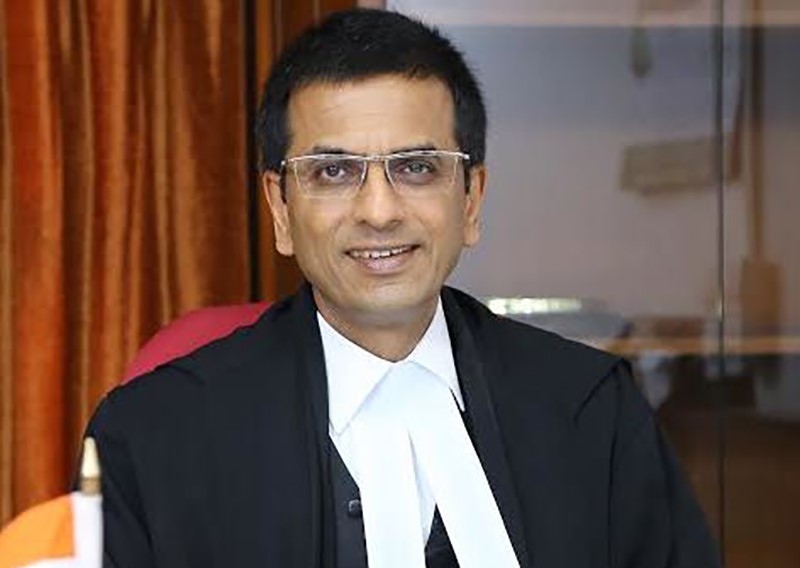
Mumbai: Days after Vice-President Jagdeep Dhankhar questioned the basic structure doctrine, the Chief Justice of India (CJI) D Y Chandrachud said it was “like the north star,” providing invaluable guidance for the interpretation of the Constitution here and elsewhere, media reports said.
“The basic structure of our Constitution, like the north star,” CJI Chandrachud said, “guides and gives certain direction to the interpreters and implementers of the Constitution when the path ahead is convoluted,” reported The Indian Express.
The doctrine was laid down by the Supreme Court in the 1973 Kesavananda Bharati case.
The CJI was delivering the 18th Nani Palkhivala Memorial lecture on “Traditions and transitions: Palkhivala’s legacy in an interconnected world” at Tata Theatre, National Central for Performing Arts (NCPA), Mumbai, Saturday.
The event was organised by Nani A Palkhivala Memorial Trust in association with Bombay Bar Association.
The CJI further elaborated saying that “the basic structure or the philosophy of our Constitution is premised on the supremacy of the Constitution, rule of law, separation of powers, judicial review, secularism, federalism, freedom and the dignity of the individual and the unity and integrity of the nation.”
“From time to time, we require people like Nani (Palkhivala) to hold candles in their steady hands to light the world around us,” the CJI said. “Nani told us that our Constitution has a certain identity that cannot be altered,” he added.
Renowned jurist Nani Palkhivala represented Swami Kesavananda Bharati in the Supreme Court.
Kesavananda Bharati had filed a writ petition challenging Kerala’s 1969 land reforms.
The case led to the Supreme Court’s landmark decision that outlined the basic structure of the Constitution which maintained Parliament’s authority to amend the Constitution but not its basic structure or foundational principles.
“Whenever a legal idea is transported from another jurisdiction, it ends up undergoing a transformation in its identity dependent on local requirements. After India adopted it, the doctrine migrated to our neighbouring countries including Nepal, Bangladesh and Pakistan,” CJI Chandrachud said.
“Different formulations of the basic structure doctrine have now emerged in South Korea, Japan, certain Latin American countries and African countries as well. The migration, integration and formulation of the doctrine of basic structure in constitutional democracies across continents is a rare success story of the diffusion of legal ideas of the world.”
“Nonetheless, the larger picture of legal culture and local dimensions of law, which are dictated by the local context, should never be obfuscated. Law is always grounded in social realities,” the CJI said.
Last month, Vice-President Jagdeep Dhankhar had called the Supreme Court’s order striking down the NJAC Act–a “severe compromise” of parliamentary sovereignty and disregard of the “mandate of the people,” according to the report.
The vice-president while presiding over the winter session of Rajya Sabha had also said that Parliament, being the custodian of the “ordainment of the people”, was duty-bound to “address the issue” and expressed confidence that “it will do so”.
Support Our Journalism
We cannot do without you.. your contribution supports unbiased journalism
IBNS is not driven by any ism- not wokeism, not racism, not skewed secularism, not hyper right-wing or left liberal ideals, nor by any hardline religious beliefs or hyper nationalism. We want to serve you good old objective news, as they are. We do not judge or preach. We let people decide for themselves. We only try to present factual and well-sourced news.
Support objective journalism for a small contribution.