 Bangladesh
Bangladesh’s Endless Persecution of Minorities
There is no end to the persecution of religious minorities, particularly Hindus, in Bangladesh. The crisis peaked during the interim administration led by Dr Muhammad Yunus.
The arrival of a Bangladesh Nationalist Party (BNP) government under Tarique Rahman in February this year has brought little relief. On the contrary, a recent report by the Human Rights Congress for Bangladesh Minorities (HRCBM) suggests that the monthly killing of minorities has risen sharply.
According to HRCBM, 116 minorities were killed in seven months between June and December 2025 during the Yunus administration.
In its latest report, The Persecution Continues: Minority Communities Under Sustained Attack in Bangladesh, the organisation documented 100 cases of “murder and mysterious death” in just four months between January and April 2026.
A closer look at the figures indicates that the average monthly death toll rose from around 16 during the Yunus period to 25 under the BNP government.
“Attacks against minority communities continue to occur across rural and urban regions alike, affecting religious institutions, family homes, women and girls, Indigenous communities, and economically vulnerable households.
The recurrence of similar patterns of violence across multiple districts demonstrates that these incidents cannot be dismissed as isolated local disputes or ordinary criminal acts,” the report observed.
The advocacy group identified 505 incidents across 62 of Bangladesh’s 64 districts.
These fell into six broad categories: kidnapping and physical assault (144), property attacks including land grab, arson and looting (132), murder and mysterious deaths (100), attacks on temples and other acts of religious vandalism (95), sexual violence including rape and gang rape (28), and accusations of blasphemy (six).
“The continuation of attacks despite political transition raises urgent concerns regarding Bangladesh’s ability to ensure equal protection, rule of law, and fundamental human rights for vulnerable minority populations,” the report warned.
Over the decades, atrocities against minorities have become deeply normalised in Bangladesh.
The communal pogroms of 1946, a year before Partition, set the tone for what followed. Since then, the region has witnessed recurring cycles of persecution, displacement and institutional abandonment of Hindus and other minorities.
During the East Pakistan period, major communal violence erupted in 1950, 1964 and 1971. Independent Bangladesh saw successive waves of attacks in 1989, 1990, 2001, 2004, 2012, 2015, 2021, 2024, 2025 and now again in 2026.
As Islamisation gathered momentum over the past three decades, the ground steadily shifted against minorities. Investigations into communal violence routinely stall, prosecutions collapse, and victims’ families face intimidation and neglect.
The situation deteriorated dramatically after the overthrow of the Sheikh Hasina government in August 2024. The Yunus administration witnessed relentless attacks on Hindus and other minority communities.
The murder of factory worker Dipu Chandra Das became one of the defining symbols of that period. Das was allegedly stripped naked, hanged from a tree and burnt alive.
The brutality of the incident sent shockwaves across the minority community and reinforced fears that extremist violence was once again gaining ground.
Yet killings represent only one aspect of the persecution faced by minorities in Bangladesh.
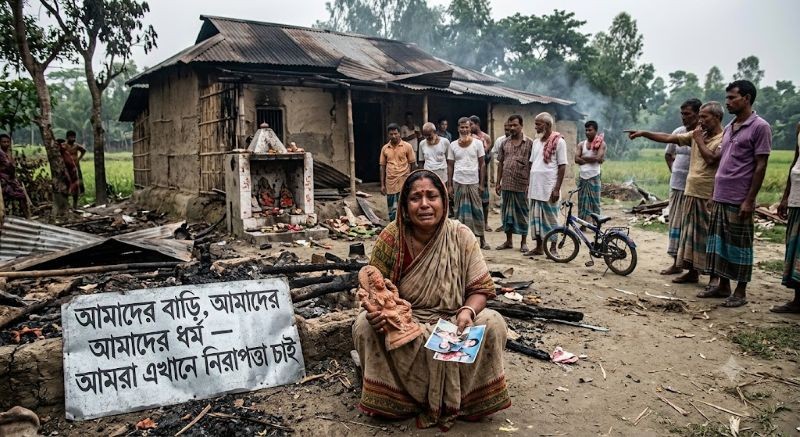
A far wider campaign unfolds through rape, extortion, land grab, arson, destruction of temples, and systematic looting of minority-owned homes and businesses. Much of the sexual violence goes unreported because of fear, stigma and the absence of institutional protection.
The demographic consequences are visible. Large numbers of Hindus and Buddhist Chakmas continue to migrate to neighbouring India.
The minority population, estimated at around 30 per cent in 1946, has now fallen to below eight per cent. This dramatic decline reflects not merely demographic change but decades of insecurity and recurring communal pressure.
Given this historical backdrop, the sustained rise in persecution is alarming. Apologists in Bangladesh often attribute the violence to the broader deterioration of law and order after Hasina’s fall.
Indeed, the sharp rise in the recovery of unidentified bodies from rivers, along with increasing incidents of child rape and murder, points to a wider collapse of public security. Reports tracking organised crime also indicate a surge in criminal activities over the past two years.
However, poor law and order also provides convenient cover for targeted attacks on vulnerable communities.
There is little doubt that Bangladesh is witnessing sustained violence against Hindus. In a chilling reminder of the Dipu Chandra Das case, a Hindu priest was recently found dead after reportedly being stripped naked and hanged.
The incident revived memories of the murders of several Hindu priests and minority activists by Islamist groups during 2015-16.
Bangladesh today stands at a critical crossroads. Unless the state demonstrates both the will and the capacity to protect minorities, prosecute offenders and restore public confidence, the cycle of fear and displacement will continue.
The persistence of such violence threatens not only the survival of minority communities, but also the secular and pluralistic foundations on which Bangladesh was originally envisioned.
Support Our Journalism
We cannot do without you.. your contribution supports unbiased journalism
IBNS is not driven by any ism- not wokeism, not racism, not skewed secularism, not hyper right-wing or left liberal ideals, nor by any hardline religious beliefs or hyper nationalism. We want to serve you good old objective news, as they are. We do not judge or preach. We let people decide for themselves. We only try to present factual and well-sourced news.
Support objective journalism for a small contribution.