Left Behind, Failed in School, Forgotten: The White Working Class Crisis Britain Cannot Ignore Anymore
As a landmark inquiry lays bare a generation of educational failure, a Telegraph investigation exposes job schemes closed to white applicants, and demographic projections warn of a white British minority by 2063—these are questions polite society can no longer avoid. IBNS reports
There is a town in the English Midlands — it could be any of a dozen — where the steel mill closed thirty years ago and never came back. Where the high street is half empty, the school results are among the worst in the county, and a significant portion of the young men have simply stopped looking for work.
The people who live there are, overwhelmingly, white and working class. And for a very long time, they have felt like the one group in Britain it was acceptable to ignore.
That silence is beginning to crack. Loudly.
The Numbers That Can No Longer Be Dismissed
A landmark independent inquiry, the most extensive of its kind in recent years, published its final findings this week — and the numbers it contains should unsettle any government, regardless of stripe.
According to Public First, as of 2025, just 36 percent of white British pupils on free school meals achieve a Grade 4 or above in English and Maths GCSE, compared with 72 percent of non-free school meal pupils—a gap the inquiry terms the "white working class disadvantage gap."
The Public First inquiry, which has been running since the summer of 2025, goes further. Only 48 percent of white working class children reach a good level of development by age five, compared with 75 percent of white British middle class children. The education system, the inquiry concludes bluntly, is not set up to serve white working class children and families.
Nick Harrison, CEO of the Sutton Trust, said the inquiry "lays bare the cost of leaving whole communities behind," noting that white working class children "continue to have some of the lowest educational outcomes of any ethnic group in England, while those growing up in post-industrial and coastal communities also face significantly lower earnings as adults."
The earnings data is particularly stark. White working class women earned 41 percent below the national average, carry the largest gender pay gap compared to other ethnicities, and earn 35 percent less than their Indian peers. These are not marginal disparities. They are structural.
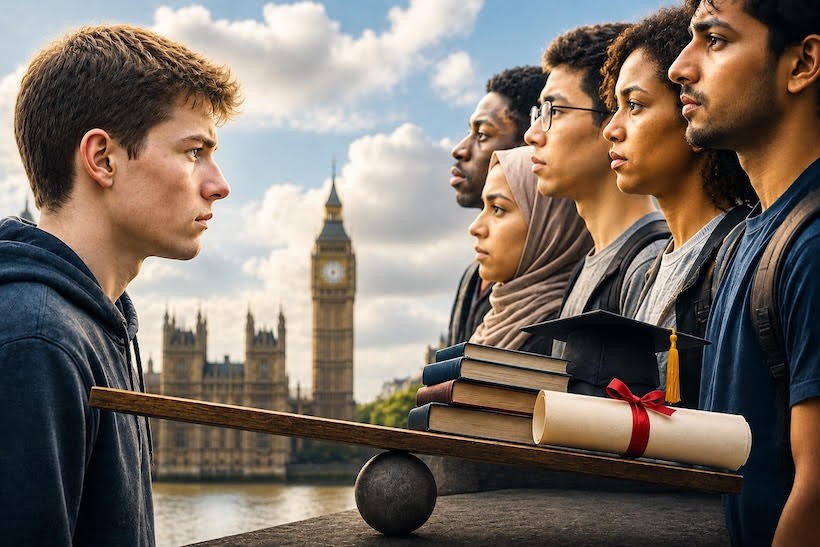
 A quiet classroom, a changing campus, and the widening debate over identity, opportunity and belonging. Photo: ChatGPT Recreation
Locked Out of the Jobs Market Too
Education is only part of the picture. A Telegraph investigation this week exposed what critics are calling institutionalised discrimination in the other direction. Multiple local authorities have been found directing taxpayer money into employment programmes closed to white jobseekers. In Sheffield, the Labour and Green-led city council runs a £340,000 Pathways to Work project offering "targeted employment support for ethnic minority groups," drawing funding from the Department for Work and Pensions' Economic Inactivity Trailblazer plus the £2.6 billion UK Shared Prosperity Fund.
In April 2025, West Yorkshire Police operated a system where BAME candidates could apply year-round for constable roles while white British and Eastern European applicants were restricted to specific recruitment windows. Westminster City Council advertised an executive assistant role stating it would use positive action to appoint a candidate from a "Global Majority" background. The National Audit Office — funded by the taxpayer — ran an internship scheme limiting eligibility to female applicants, those of black heritage, or from lower socio-economic backgrounds.
The right-wing press has called this "two-tier Britain." The liberal press has largely called it necessary correction for historical inequalities. Both are, in part, right. And that is exactly what makes this conversation so explosive and so necessary.
A Demographic Reckoning
Into this combustible mix, The Telegraph has added another figure that has sent shockwaves through the political establishment. White British people, currently 73 percent of the population, are projected to decline to 57 percent by 2050 before slipping into a minority by 2063.
Whether one views that projection with alarm or equanimity depends almost entirely on where one sits politically — but the projection itself is now a fact in the public conversation, and ignoring it only fuels the narrative of those who want to exploit it.
Reform UK, which has made demographic anxiety its central electoral proposition, has been the primary political beneficiary. But the shift is no longer confined to the fringes.
Prime Minister Mette Frederiksen's Social Democrats in Denmark have hardened their line on Islamic visibility in public life, including calls to extend the face-veil ban to schools and universities and remove prayer rooms from campuses. The centre-left, across Europe, is reading the same political weather.
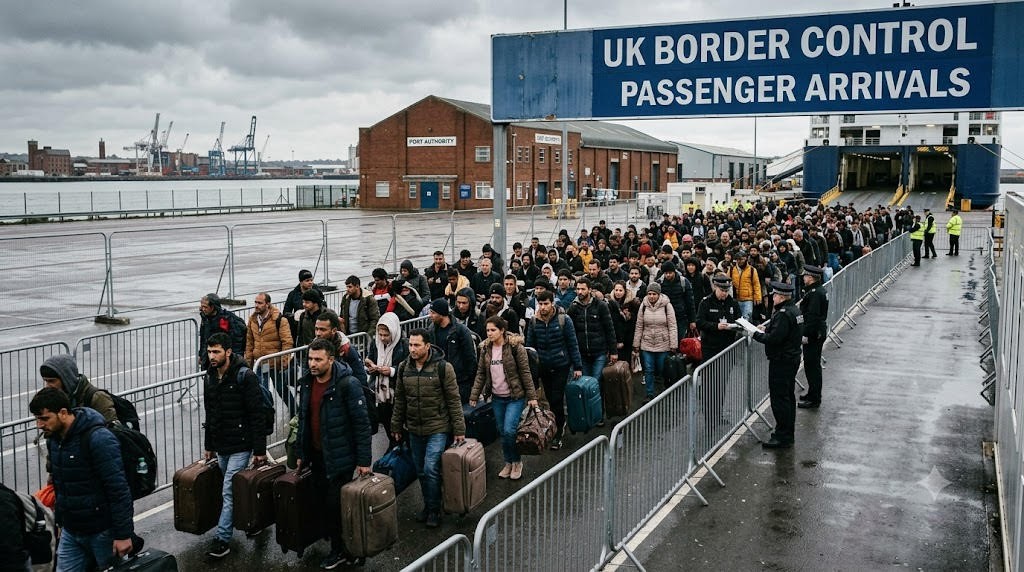 Rising immigration numbers continue to fuel deep discontent across the UK. Photo: Gemini AI Generated
The Islamism Question
Woven through all of this is a thread that liberal commentators tread around with particular care, and that right-wing commentators sometimes weaponise without nuance: the question of Islamism, integration, and public space.
Polling by Hope Not Hate finds that 44 percent of the British public now believe Islam poses a threat to Western civilisation, 37 percent believe areas of the UK are under the control of Sharia law, and six in ten believe Muslim communities should be doing more to stop Islamist extremism and integrate into British society.
These numbers, whatever one makes of them, represent a hardening of attitudes that neither dismissal nor outrage can simply wish away.
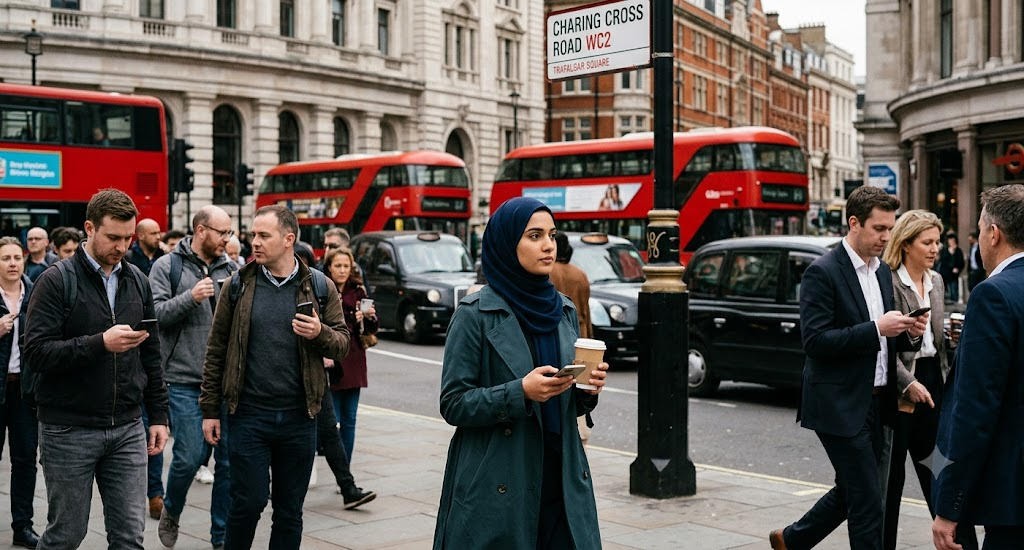 A section of Britons now believe Islam poses a threat to Western civilisation. Photo: Gemini AI Generated
The grooming gang scandals in Rotherham and Oldham, the 2017 Islamist terror attacks, and the attack of a woman and her two children in Clapham by an Afghan asylum seeker in February 2024 fed into broader anxieties — culminating in the nationwide riots of August 2024 following the murder of three girls in Stockport, described as "the largest outbreak of far-right rioting and disorder in the post-war period."
In Parliament, voices from the left have warned that inflammatory rhetoric has "normalised Islamophobia to the extent that it is now open season on British Muslims," with over 40 percent of all recorded religious hate crimes targeting British Muslims. Both things can be true simultaneously — and that is the difficulty at the heart of this debate.
Who Is Responsible? An Uncomfortable Question
Here is where the story becomes genuinely complex, and where honest journalism demands more than a single villain.
The white working class did not design the immigration policies of the Blair years, which brought millions to Britain faster than any infrastructure — schools, housing, NHS — could reasonably absorb. They did not set the university admissions policies that increasingly favoured diversity targets. They did not choose deindustrialisation, or the shift to a service economy that left former mining and manufacturing towns structurally redundant. These were decisions made largely by a highly educated, largely metropolitan, largely insulated political class — including, it must be said, working class politicians who had climbed out and forgotten to look back.
But the white working class is not without agency in its own story either. Educator Sir John Townsley, writing in The Telegraph, noted that blame lies not just with government and society, but with "the families in question" for perpetuating a "culture of low expectations" and placing "no value whatsoever on education," warning that without "radical change" and "generational" planning, the country is headed for "further disaster."
The Public First inquiry is more measured, finding that white working class underachievement is not the result of low aspiration or individual failure, but reflects a wider set of systemic challenges — early gaps in educational development, weaker relationships between families and schools, lower sense of belonging, higher absence, and too few credible routes into further study, training and work.
The Sutton Trust's Harrison put it plainly: "This is not about setting one disadvantaged group against another. Disadvantaged young people from Black Caribbean backgrounds are just as unlikely to become top earners. Ultimately, this isn't about ethnicity in isolation. It's about the interaction between disadvantage and place, entrenched poverty, communities that have been left behind, and too few routes to good jobs and better lives."
The Political Tinderbox
What is undeniable is that the political consequences of decades of neglect are now arriving all at once, and they are not pretty. Reform UK is polling in the high twenties. The Conservatives are fighting for relevance. Labour is caught between its traditional working class base and its increasingly diverse urban coalition.
Slogans like "Stop the boats" and "We want our country back" — which accompanied the physical violence of August 2024 — were, as Hope Not Hate noted, "popularized by mainstream politicians and the media" long before they became street chants.
The UK government's April 2026 social cohesion paper attempts a course correction, introducing an "Earned Settlement" system under which settlement will no longer be an automatic entitlement but gained through demonstrated contribution — economic activity, long-term compliance and alignment with British values. It is a significant policy shift, dressed in the language of fairness rather than restriction. Whether it arrives too late to matter politically is another question entirely.
A Nation at a Crossroads
Britain has been here before — at moments when immigration, identity, economic anxiety and cultural change collide faster than institutions can manage. What is different this time is the data. The evidence of white working class educational failure is now overwhelming, peer-reviewed, and undeniable. The evidence of employment schemes that exclude white applicants is now documented. The demographic projections are now published. The anger in former industrial towns is now an electoral force.
None of this means that immigrants built Britain's current problems. Many of the hardest-working, best-integrated communities in Britain are communities of South Asian, African and Caribbean heritage — people who arrived with nothing and built everything.
That fact does not disappear because another fact — that some communities did not integrate, that some institutional policies overcompensated in ways that bred resentment — is also true.
The country that produced the NHS, the welfare state, and the most successful multicultural democracy in modern history is now asking whether it got something badly wrong along the way. The honest answer is: yes, in several directions at once.
The white working class did not ask to be left behind. They were left behind. Fixing that is not a betrayal of diversity — it is a prerequisite for it.
Support Our Journalism
We cannot do without you.. your contribution supports unbiased journalism
IBNS is not driven by any ism- not wokeism, not racism, not skewed secularism, not hyper right-wing or left liberal ideals, nor by any hardline religious beliefs or hyper nationalism. We want to serve you good old objective news, as they are. We do not judge or preach. We let people decide for themselves. We only try to present factual and well-sourced news.
Support objective journalism for a small contribution.