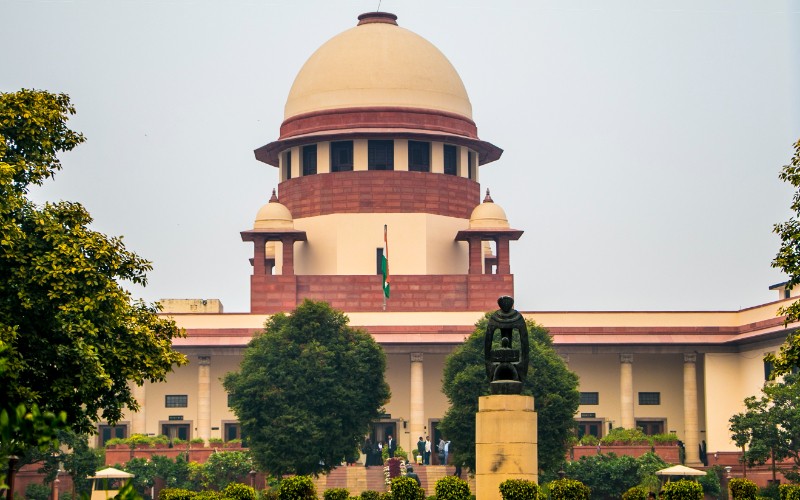
 Supreme Court
24-hour deadline to produce accused before magistrate begins from detention, not 'formal arrest': Supreme Court
New Delhi/IBNS: The Supreme Court has ruled that the constitutional 24-hour deadline for producing an accused person before a judicial magistrate starts from the moment of detention, rather than the time of formal arrest.
The court held that detention and arrest are effectively the same for the purpose of this constitutional safeguard, as both involve restricting an individual's personal liberty.
Rejecting any attempt to distinguish between the two, the Supreme Court observed that “any attempt to draw an artificial distinction between detention and arrest is constitutionally unsustainable”.
It also criticised several high courts for drawing such a distinction and clarified that the obligation to produce an accused before the nearest magistrate within 24 hours begins as soon as the person is first detained.
Detention and arrest cannot be separated
The court emphasised that the constitutional protection governing the production of an accused before a magistrate cannot be limited to the period following a formal arrest.
Its ruling makes clear that authorities must calculate the 24-hour period from the point at which a person's liberty is first restricted through detention.
The timing of the subsequent formal arrest does not determine when the constitutional deadline begins.
The Supreme Court's observation challenges interpretations that treat detention and formal arrest as separate stages for calculating the time available to bring an accused before a judicial magistrate.
Fundamental rights take priority over special laws
In another significant observation, the Supreme Court held that the fundamental rights of an accused person must take precedence over provisions contained in special laws when courts consider delays in trial and applications for bail.
The court referred to conflicting judicial decisions on bail in cases registered under special legislation, including the Unlawful Activities (Prevention) Act (UAPA), the Narcotic Drugs and Psychotropic Substances (NDPS) Act and the Prevention of Money Laundering Act (PMLA).
It said the constitutional rights of an accused must receive priority in such matters, reinforcing the importance of fundamental rights when courts examine restrictions imposed under special statutes.
'Special laws must follow constitutional principles'
The Supreme Court further observed that special laws cannot determine how the Constitution should be interpreted.
Instead, it said, legislation enacted for specific offences or circumstances must itself be interpreted in accordance with constitutional principles.
The court's observations address the relationship between special statutory provisions and the fundamental rights guaranteed by the Constitution, particularly in matters involving personal liberty, prolonged detention and access to bail.
Support Our Journalism
We cannot do without you.. your contribution supports unbiased journalism
IBNS is not driven by any ism- not wokeism, not racism, not skewed secularism, not hyper right-wing or left liberal ideals, nor by any hardline religious beliefs or hyper nationalism. We want to serve you good old objective news, as they are. We do not judge or preach. We let people decide for themselves. We only try to present factual and well-sourced news.
Support objective journalism for a small contribution.