Reviving memories: A retrospective on G.C. Chakravarty, an artist the world forgot
Former Indian President Dr S. Radhakrishnan was impressed ‘by the originality of his conceptions and the neatness of execution', yet few remember this Bengali artist who once exhibited alongside Jamini Roy, Gopal Ghose, and D. P. Roy Chowdhury.
As I glanced through the illustrated catalogue, I was struck by an old watercolour that seemed too contemporary in its context.
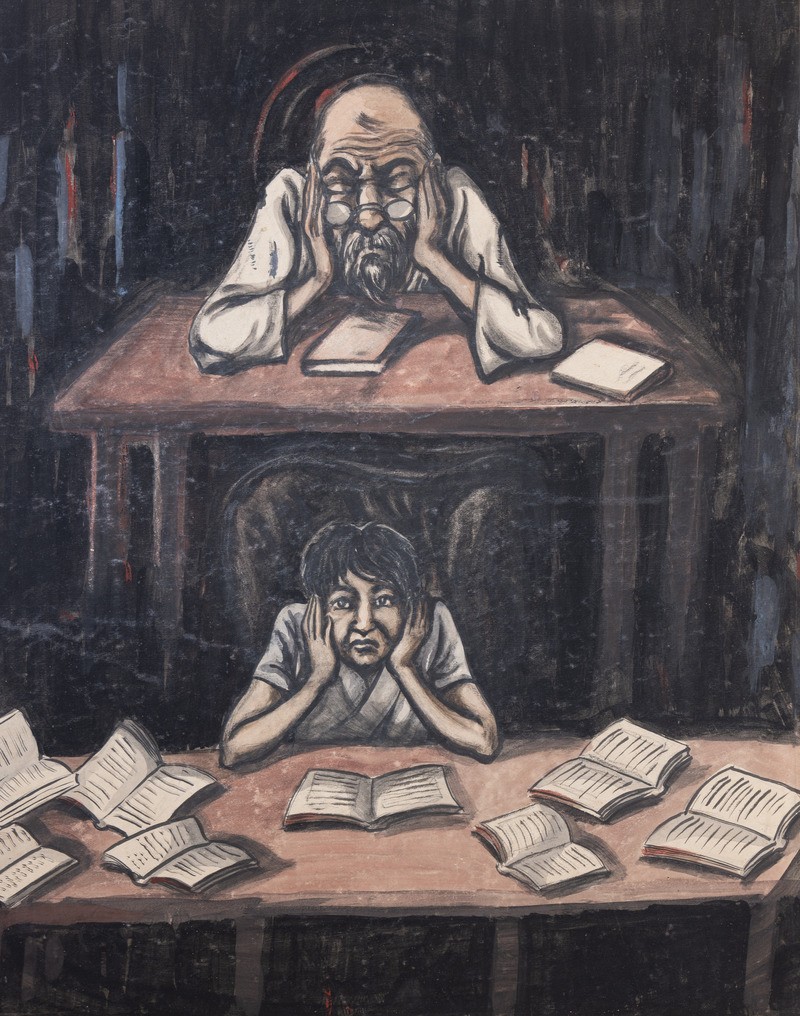 Photo: Dwija Gallery
The top half of the painting depicted an old man (probably a teacher), slightly grotesque, in a gesture of despair, with a couple of closed books in front of him. The bottom half showed a young man (probably a student), also in a dejected posture, looking hopelessly at an array of open books.
Painted by artist G. C. Chakravarty (Gopesh Chandra Chakravarty, 1905-1993), the context could be easily interpreted as a depiction of the present education system, especially the conundrum of leaked public examination papers and the uncertainty faced by the student community.
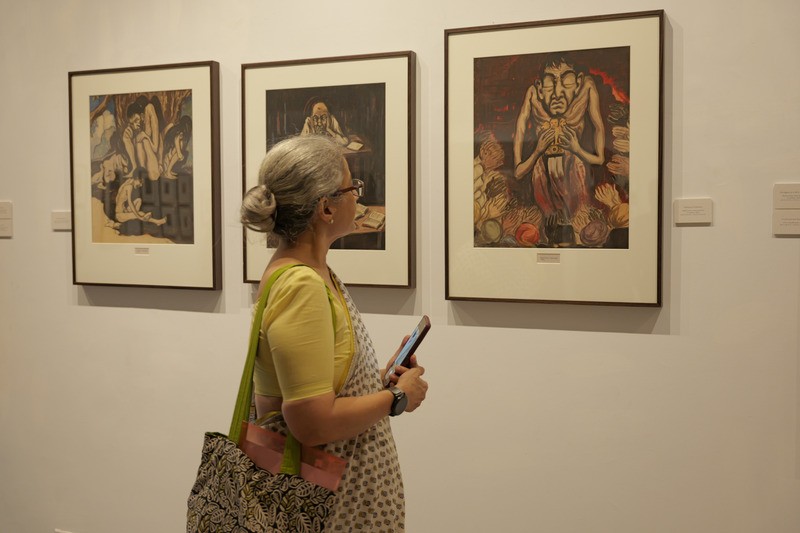
My curiosity aroused, I wended my way to the ongoing exhibition titled ‘Stranger Forms: The Forgotten Art of G. C. Chakravarty’ at the Birla Academy of Art and Culture, Kolkata.
Presented by Dwija Gallery, a Rajkot (Gujarat)-based cultural space managed by the Dwija Conservation Society of Art and Cultural Heritage, the retrospective – consisting of sketches, paintings, and illustrations – was an amazing collection of artworks by an artist who contributed to Bengal Modernism and twentieth-century Indian art yet faded away from public memory.
As Mit Vyas of Dwija Gallery said, “More than a historical recovery, the exhibition reintroduces an artist whose significance extends beyond the established narratives of Indian modernism. During his lifetime, Chakravarty exhibited alongside notable contemporaries such as Jamini Roy, Gopal Ghose, and D. P. Roy Chowdhury, yet his legacy gradually receded from public view.”
Talking about the genesis of the exhibition to IBNS, Vyas said that he was approached by the late artist’s son, Kachi Chakravarty, in 2014, to help place some of his father’s works.
“As I studied the paintings and researched the artist’s life,” said Vyas, “I was deeply impressed by the extraordinary testimonials and recognition he [the artist] had received from eminent personalities such as Dr. Rajendra Prasad, Dr. Sarvepalli Radhakrishnan, O. C. Gangoly, Abanindranath Tagore, and Dr. Kalidas Nag.”
While trying to find buyers for the works, Vyas realised that despite his significant achievements, G.C. Chakravarty had largely faded from public memory over the last 35–40 years. Following his last major exhibition at Lalit Kala Akademi in 1982, his work gradually slipped into obscurity.
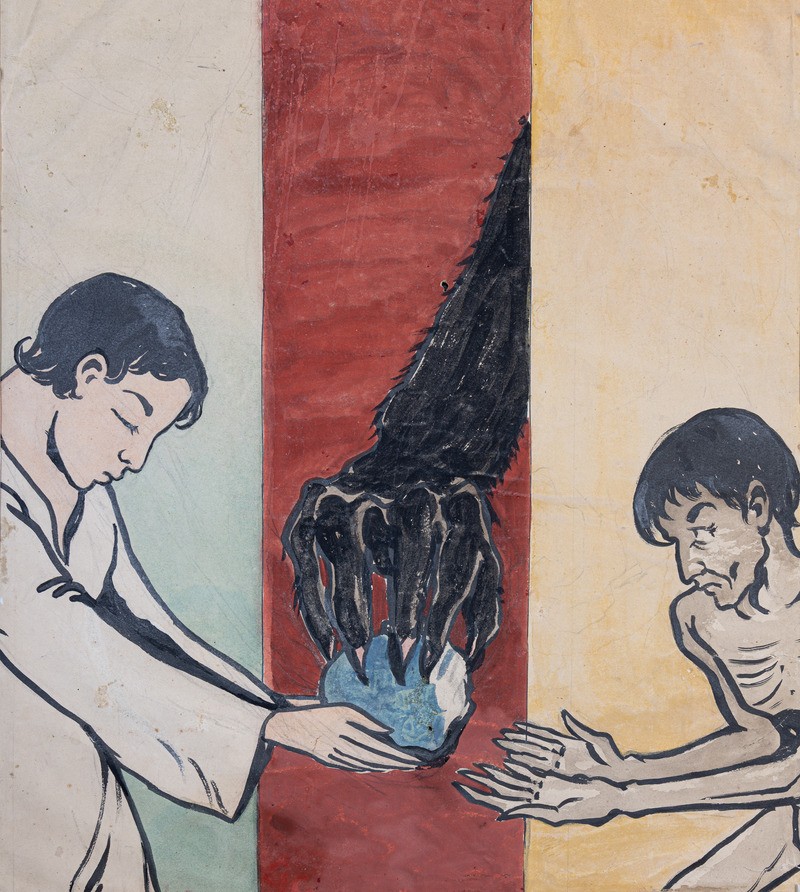 Photo: Dwija Gallery
Born in the Surma Valley at the foot of the Jayanti Hills of Sylhet, in present-day Assam, Chakravarty was largely self-taught after leaving formal training at the Government School of Art in Calcutta. Interestingly, Chakravarty’s world extended beyond his artistic practice. He was an educator and a cultural activist.
Working across diverse regions, including Uttar Pradesh, Assam, Nagaland, and the wider Northeast, he expanded his influence beyond metropolitan art circles through teaching, community engagement, and cultural initiatives, according to Vyas.
Here was an artist who was deeply influenced by the teaching of Ramakrishna Paramhansa and battled his own hardships, even sleeping in the open around Wellington Square or College Street.
Writes Ankan Kazi in his foreword to the catalogue, Chakravarty’s “early fascination with the subconscious developed into a sustained search for the hidden forces and shapes operating behind the veil of appearances.
It shaped his distinctive practice of painting figures that often lack sharply defined outlines … approach [that] partly drew on the Bengal School’s preference for the wash technique...”
"Rather than presenting the inner world as a serene source of the ineffable ideal", writes Kazi, "the artist used it to confront the distorted and even grotesque manifestations of the spirit under conditions of strain and trauma, revealing how easily the search for transcendence could turn dark and disquieting.”
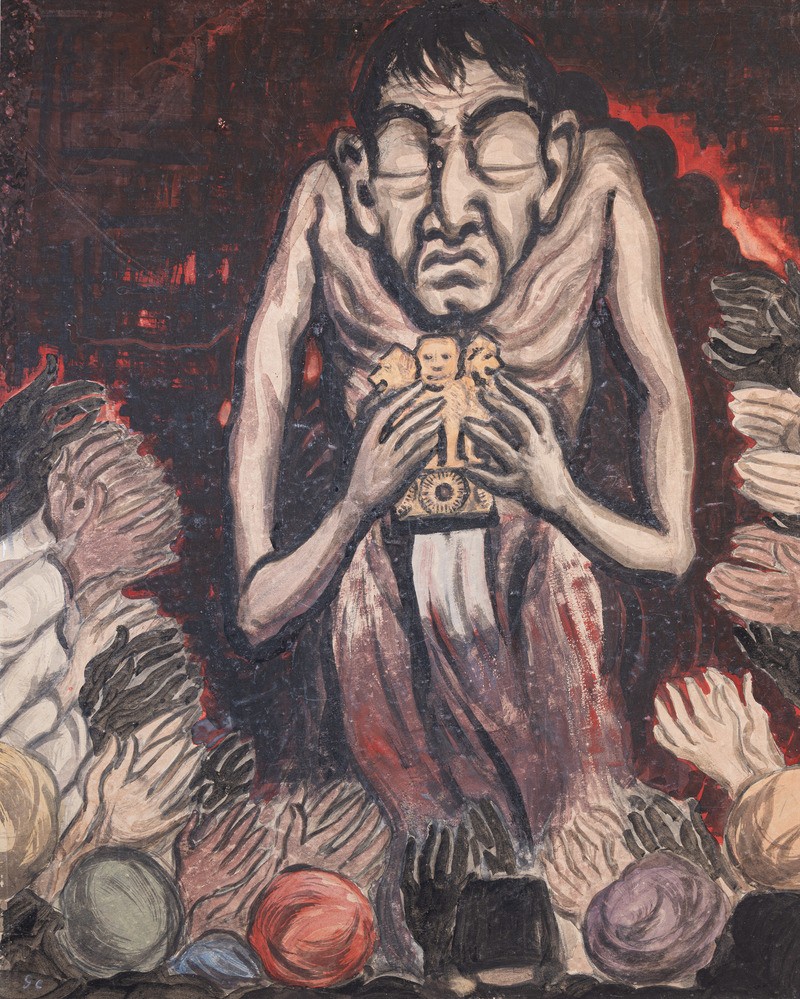 Photo: Dwija Gallery
Chakravarty was acutely observant of the shifting realities as India aimed for freedom from colonial rule and then settled down as an independent nation, or the turbulence faced by South Asia, especially the Bangladesh War of 1971.
The diabolical figure of a black marketeer (‘Black Marketier’) whose activities caused much damage to public resources during the Bengal famine of the 1940s, or the portrayal of Yahya Khan (‘Eyahia Khan Face’), who imposed martial law during his presidency in Pakistan, and similar works chart Chakravarty’s deeply personal yet historically entangled journey expressed through unsettling figuration.
‘Stranger Forms: The Forgotten Art of G. C. Chakravarty’ represents the most comprehensive collections of the late artist’s works assembled by a private gallery,” said Vyas.
“This exhibition is not only about showcasing exceptional artworks; it is an effort to rediscover and reintroduce an important artist whose contribution to Indian art history has been unjustly overlooked, he said.
According to Vyas, the Gallery is also exploring opportunities to present the exhibition in Mumbai and Delhi.
The exhibition in Kolkata is on till June 28, 2026.
Uttara Gangopadhyay is a kolkata based freelance journalist.
Support Our Journalism
We cannot do without you.. your contribution supports unbiased journalism
IBNS is not driven by any ism- not wokeism, not racism, not skewed secularism, not hyper right-wing or left liberal ideals, nor by any hardline religious beliefs or hyper nationalism. We want to serve you good old objective news, as they are. We do not judge or preach. We let people decide for themselves. We only try to present factual and well-sourced news.
Support objective journalism for a small contribution.