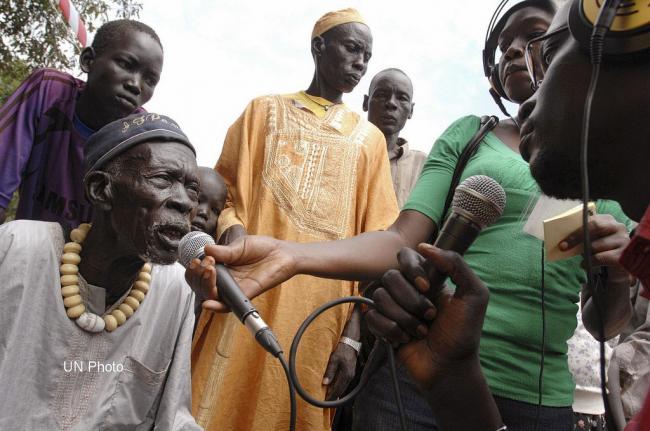
Marking World Radio Day, UN officials urge use of radio as 'lifeline' in human progress
“In times of crisis and emergency, radio can be a lifeline,” said UN Secretary-GeneralBan Ki-moon in a statement on the Day.
“For people in shattered societies, or caught in catastrophe, or desperately seeking news, radio brings lifesaving information,” he added.
Noting that radio can help in emergency response operations, assist with rebuilding and give voice to local people and communities, Ban called on the internationally community to use the time in the lead-up to the World Humanitarian Summit in May to ensure that radio continues to improve in helping people in emergencies.
“On this World Radio Day, let us resolve to prove that radio saves lives,” the UN chief said. “This year, as we start carrying out the Sustainable Development Goals, let us resolve to use radio for human progress.”
In another message for the Day, Irina Bokova, the Director-General of the UN Educational, Scientific and Cultural Organization (UNESCO), emphasized that radio has demonstrated its power in situations of immediate post-disaster, but also in times of preparedness and recovery.
“Amidst the ruins and in the face of an emergency, the radio is often the first medium for survival,” Bokova said. “Its durability is an incomparable advantage, often enabling it to resist shocks and retransmit messages of protection and prevention to as many people as possible, better and faster than other media, saving lives.”
Specifically, radio airs tsunami alerts in Japan and Chile, and messages on how to avoid Ebola transmission in Liberia or Zika contagion in Brazil. The medium, which is accessible and offers real-time coverage and reporting, has the capacity to involve the audience and plays a pivotal role in preventing and mitigating disasters and the associated human costs, Bokova stressed.
In 2011, the UNESCO General Conference proclaimed 13 February as World Radio Day, the day UN Radio was established in 1946. Radio is the most prevalent mass medium, with the ability to reach up to 95 per cent of the world's population.
As a result, World Radio Day, which this year coincides with the 70th anniversary of UN Radio, aims to celebrate radio as a medium; to improve international cooperation between broadcasters; and to encourage major networks and community radio alike to promote access to information, freedom of expression and gender equality over the airwaves.
UN Photo/Tim McKulka
Support Our Journalism
We cannot do without you.. your contribution supports unbiased journalism
IBNS is not driven by any ism- not wokeism, not racism, not skewed secularism, not hyper right-wing or left liberal ideals, nor by any hardline religious beliefs or hyper nationalism. We want to serve you good old objective news, as they are. We do not judge or preach. We let people decide for themselves. We only try to present factual and well-sourced news.
Support objective journalism for a small contribution.