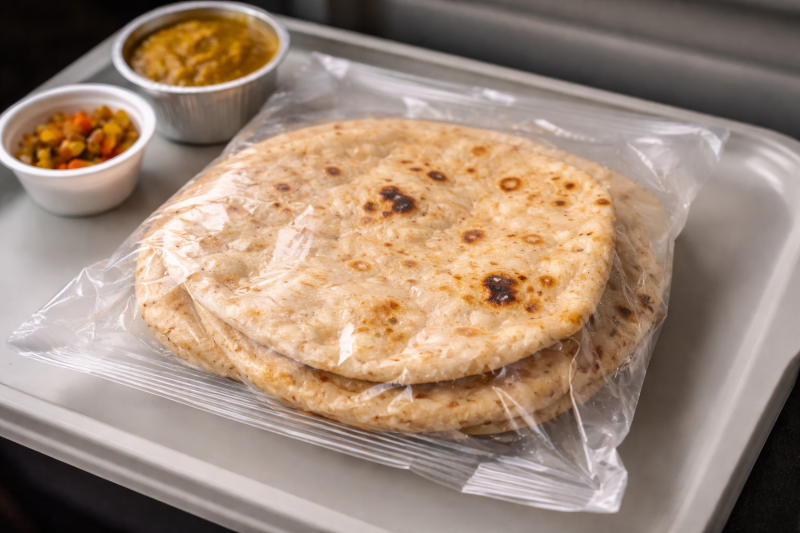
Hot food in plastic packets: Is it safe? Vande Bharat passenger raises concern
A passenger travelling on a Vande Bharat Express from Allahabad to Delhi has raised food safety concerns after being served hot rotis and kachoris that arrived in sealed plastic packets, prompting questions about how the food was reheated and whether the packaging was suitable for high temperatures.
In a post shared on X on February 18 by user @bansalavani, the passenger is seen questioning onboard staff about the reheating process.
When asked whether the food was microwaved inside the plastic packet, a staff member reportedly acknowledged that the packaging did not authorise microwave use but confirmed that the meals were warmed while still sealed.
Public Health Issue Alert 🚨
— Avani Bansal (@bansalavani) February 18, 2026
Travelling on Vande Bharat today (Allahabad → Delhi) and yesterday was travelling on Rajdhani (Delhi → Allahabad), I was served rotis/kachoris heated directly inside sealed plastic packaging. While at Rajdhani, I was hungry and so ate the hot… pic.twitter.com/gIxM4U1d5N
The passenger noted that the packet contained no heat-safety or microwave instructions and only included storage details, raising concerns about potential health risks if food was reheated in unsuitable plastic.
IRCTC responds
Responding to the viral video, the IRCTC apologised and sought details from the passenger.
“Ma'am, our sincere apology for the inconvenience. Please DM your PNR and mobile number to enable us to address this,” IRCTC said in a reply on X.
Ma'am, our sincere apology for the inconvenience. Please DM your PNR and mobile number to enable us to address this.
— IRCTC (@IRCTCofficial) February 18, 2026
https://t.co/jQ5E3ENhNu
Social media reactions
Several users backed the passenger’s concerns, with some alleging wider issues in onboard catering quality and compliance.
One user claimed food items often differ from the official menu in flagship trains, calling it a “bigger scam”. Another criticised IRCTC for allegedly engaging low-quality vendors and demanded branded, hygienic meal options.
Always be cautious while reporting issues like this where food vendors r involvd. In past I hd reportd a case of mere fake bottle & later i hd rcvd threatening calls frm vendor side. Call was from CST I guess owner. He sd we hv ur address & warned me to delete post ASAP else.. pic.twitter.com/J7IXghTmvF
— Shree Manjrekar (@ShreeManjrekar) February 19, 2026
Others debated the plastic issue itself. While some noted that heating food in plastic is generally discouraged, one user argued that unless a packet explicitly states “do not heat”, the practice is not technically prohibited, though not recommended.
Health implications of reheating food in plastic
Consultant nutritionist Rupali Datta warned that reheating food in plastic containers that are not microwave-safe can increase the risk of chemicals such as phthalates and bisphenols leaching into food, NDTV reported.
“These compounds are known endocrine disruptors, and exposure becomes more likely when plastic is heated,” Datta explained.
She added that while microwave reheating itself is safe, food should ideally be transferred to glass or ceramic containers.
Avoiding repeated heating of food in unsuitable plastic, she noted, is a simple way to reduce long-term chemical exposure.
Support Our Journalism
We cannot do without you.. your contribution supports unbiased journalism
IBNS is not driven by any ism- not wokeism, not racism, not skewed secularism, not hyper right-wing or left liberal ideals, nor by any hardline religious beliefs or hyper nationalism. We want to serve you good old objective news, as they are. We do not judge or preach. We let people decide for themselves. We only try to present factual and well-sourced news.
Support objective journalism for a small contribution.