


New Ceres images show bright craters
In its lowest-altitude mapping orbit, at a distance of 240 miles (385 kilometers) from Ceres, Dawn has provided scientists with spectacular views of the dwarf planet.
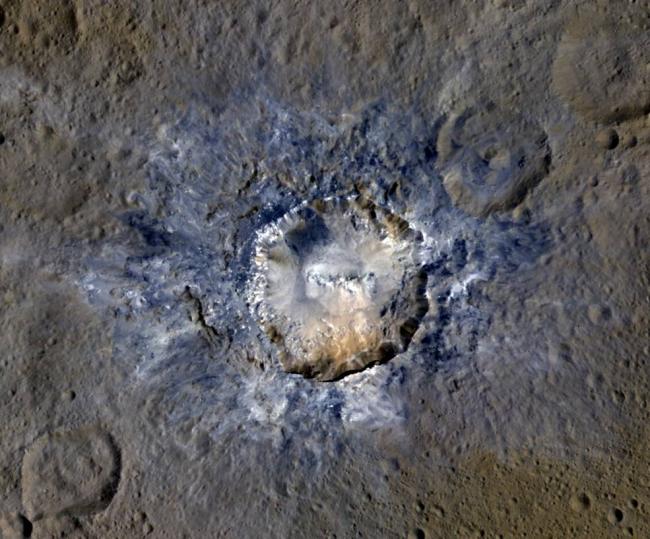
Haulani Crater, with a diameter of 21 miles (34 kilometers), shows evidence of landslides from its crater rim. Smooth material and a central ridge stand out on its floor. An enhanced false-color view allows scientists to gain insight into materials and how they relate to surface morphology. This image shows rays of bluish ejected material. The color blue in such views has been associated with young features on Ceres, read a NASA website.
"Haulani perfectly displays the properties we would expect from a fresh impact into the surface of Ceres. The crater floor is largely free of impacts, and it contrasts sharply in color from older parts of the surface," said Martin Hoffmann, co-investigator on the Dawn framing camera team, based at the Max Planck Institute for Solar System Research, Göttingen, Germany.
The crater's polygonal nature (meaning it resembles a shape made of straight lines) is noteworthy because most craters seen on other planetary bodies, including Earth, are nearly circular. The straight edges of some Cerean craters, including Haulani, result from pre-existing stress patterns and faults beneath the surface.
A hidden treasure on Ceres is the 6-mile-wide (10-kilometer-wide) Oxo Crater, which is the second-brightest feature on Ceres (only Occator's central area is brighter). Oxo lies near the 0 degree meridian that defines the edge of many Ceres maps, making this small feature easy to overlook. Oxo is also unique because of the relatively large "slump" in its crater rim, where a mass of material has dropped below the surface. Dawn science team members are also examining the signatures of minerals on the crater floor, which appear different than elsewhere on Ceres.
"Little Oxo may be poised to make a big contribution to understanding the upper crust of Ceres," said Chris Russell, principal investigator of the mission, based at the University of California, Los Angeles.
Dawn's mission is managed by JPL for NASA's Science Mission Directorate in Washington.
Dawn is a project of the directorate's Discovery Program, managed by NASA's Marshall Space Flight Center in Huntsville, Alabama. UCLA is responsible for overall Dawn mission science. Orbital ATK Inc., in Dulles, Virginia, designed and built the spacecraft.
The German Aerospace Center, Max Planck Institute for Solar System Research, Italian Space Agency and Italian National Astrophysical Institute are international partners on the mission team.
Image Credits: NASA/JPL-Caltech/UCLA/MPS/DLR/IDA
Support Our Journalism
We cannot do without you.. your contribution supports unbiased journalism
IBNS is not driven by any ism- not wokeism, not racism, not skewed secularism, not hyper right-wing or left liberal ideals, nor by any hardline religious beliefs or hyper nationalism. We want to serve you good old objective news, as they are. We do not judge or preach. We let people decide for themselves. We only try to present factual and well-sourced news.
Support objective journalism for a small contribution.


