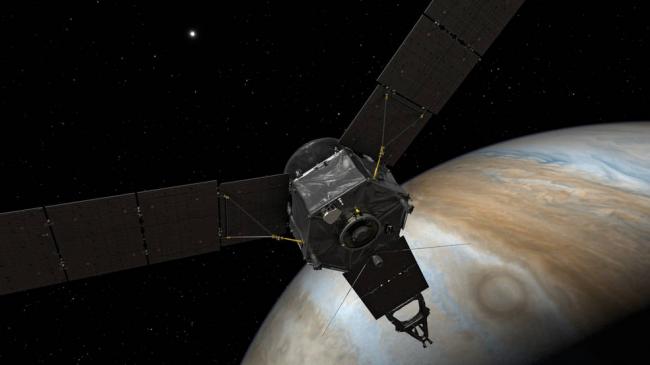
NASA's Juno Spacecraft getting close to Jupiter
During Juno's orbit-insertion phase, or JOI, the spacecraft will perform a series of steps in preparation for a main engine burn that will guide it into orbit. At 6:16 p.m. PDT (9:16 p.m. EDT), Juno will begin to turn slowly away from the sun and toward its orbit-insertion attitude. Then 72 minutes later, it will make a faster turn into the orbit-insertion attitude.
At 7:41 p.m. PDT (10:41 p.m. EDT), Juno switches to its low-gain antenna. Fine-tune adjustments are then made to the spacecraft's attitude. Twenty-two minutes before the main engine burn, at 7:56 p.m. PDT (10:56 p.m. EDT), the spacecraft spins up from 2 to 5 revolutions per minute (RPM) to help stabilize it for the orbit insertion burn.
At 8:18 p.m. PDT (11:18 p.m. EDT), Juno's 35-minute main-engine burn will begin. This will slow it enough to be captured by the giant planet’s gravity. The burn will impart a mean change in velocity of 1,212 mph (542 meters a second) on the spacecraft. It is performed in view of Earth, allowing its progress to be monitored by the mission teams at NASA's Jet Propulsion Laboratory in Pasadena, California, and Lockheed Martin Space Systems in Denver, via signal reception by Deep Space Network antennas in Goldstone, California, and Canberra, Australia.
After the main engine burn, Juno will be in orbit around Jupiter. The spacecraft will spin down from 5 to 2 RPM, turn back toward the sun, and ultimately transmit telemetry via its high-gain antenna.
Juno starts its tour of Jupiter in a 53.5-day orbit. The spacecraft saves fuel by executing a burn that places it in a capture orbit with a 53.5-day orbit instead of going directly for the 14-day orbit that will occur during the mission's primary science collection period. The 14-day science orbit phase will begin after the final burn of the mission for Juno’s main engine on October 19.
JPL manages the Juno mission for NASA. The mission's principal investigator is Scott Bolton of Southwest Research Institute in San Antonio. The mission is part of NASA's New Frontiers Program, managed at the agency's Marshall Space Flight Center in Huntsville, Alabama, for NASA's Science Mission Directorate. Lockheed Martin Space Systems in Denver built the spacecraft.
Image Credits: NASA/JPL-Caltech
Support Our Journalism
We cannot do without you.. your contribution supports unbiased journalism
IBNS is not driven by any ism- not wokeism, not racism, not skewed secularism, not hyper right-wing or left liberal ideals, nor by any hardline religious beliefs or hyper nationalism. We want to serve you good old objective news, as they are. We do not judge or preach. We let people decide for themselves. We only try to present factual and well-sourced news.
Support objective journalism for a small contribution.