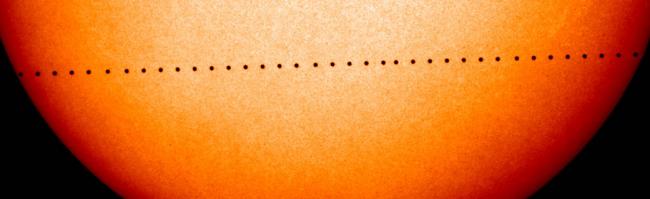
NASA to provide coverage of May 9 Mercury Transit of the Sun
Media may view the event at NASA’s Goddard Space Flight Center in Greenbelt, Maryland, read the NASA website.
Mercury passes between Earth and the sun only about 13 times a century, its last trek taking place in 2006. Due to its diminutive size, viewing this event safely requires a telescope or high-powered binoculars fitted with solar filters made of specially-coated glass or Mylar.
NASA is offering several avenues for the public to view the event without specialized and costly equipment, including images on NASA.gov, a one-hour NASA Television special, and social media coverage.
Mercury will appear as a small black dot as it crosses the edge of the sun and into view at 7:12 a.m. The planet will make a leisurely journey across the face of the sun, reaching mid-point at approximately 10:47 a.m., and exiting the golden disk at 2:42 p.m.
The entire 7.5-hour path across the sun will be visible across the Eastern United States – with magnification and proper solar filters – while those in the West can observe the transit in progress after sunrise.
Support Our Journalism
We cannot do without you.. your contribution supports unbiased journalism
IBNS is not driven by any ism- not wokeism, not racism, not skewed secularism, not hyper right-wing or left liberal ideals, nor by any hardline religious beliefs or hyper nationalism. We want to serve you good old objective news, as they are. We do not judge or preach. We let people decide for themselves. We only try to present factual and well-sourced news.
Support objective journalism for a small contribution.