


NASA tests life-detection drill in earth’s driest place
Researchers at NASA hypothesize that the same may be true if life exists on Mars.
The cold and dry conditions on Mars open the possibility that evidence for life may be found below the surface where negative effects of radiation are mitigated, in the form of organic molecules known as biomarkers.
But until humans set foot on the Red Planet, obtaining samples from below the surface of Mars will require the ability to identify a location of high probability for current or ancient life, place a drill, and control the operation robotically.
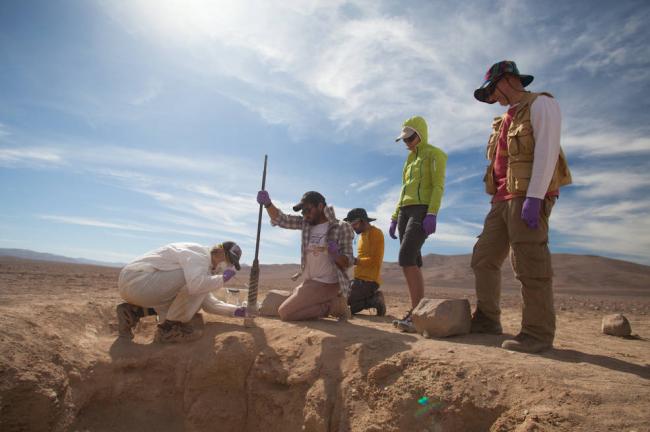
The Atacama Rover Astrobiology Drilling Studies (ARADS) project has just completed its first deployment after one month of fieldwork in the hyperarid core of the Atacama Desert, the “driest place on Earth.” Despite being considerably warmer than Mars, the extreme dryness the soil chemistry in this region are remarkably similar to that of the Red Planet.
This provides scientists with a Mars-like laboratory where they can study the limits of life and test drilling and life-detection technologies that might be sent to Mars in the future.
“Putting life-detection instruments in a difficult, Mars-analog environment will help us figure out the best ways of looking for past or current life on Mars, if it existed,” said Dr. Brian Glass, a NASA Ames space scientist and the principal investigator of the ARADS project. “Having both subsurface reach and surface mobility should greatly increase the number of biomarker and life-target sites we can sample in the Atacama,” Glass added.
More than 20 scientists from the United States, Chile, Spain, and France camped together miles from civilization and worked in extremely dry, 100+ degree heat with high winds during the first ARADS field deployment.
Their work was primarily at Yungay Station, a mining ghost town at one of the driest places in the Atacama, owned by the University of Antofagasta in Chile. Yungay has been a focal point for astrobiology studies in the last two decades. ARADS field scientists also evaluated two other Atacama sites – Salar Grande, an ancient dried-up lake composed of thick beds of salt, and Maria Elena, a similarly extremely dry region – to be considered along with Yungay as the host location for the future ARADS tests in 2017-19.
During this initial deployment, scientists put several technologies through the paces under harsh and unpredictable field conditions: a Mars-prototype drill; a sample transfer arm; the Signs of Life Detector (SOLID) created by Spain’s Centro de Astrobiologia (CAB); and a prototype version of the Wet Chemistry Laboratory (WCL), which flew on the Phoenix Mars mission in 2007, read the NASA website.
Engineers and scientists were successful in accomplishing their primary technology goal of this season—to use the ARADS drill and sample transfer robot arm at Yungay to acquire and feed sample material to the SOLID and WCL instruments under challenging environmental conditions.
The in situ analyses of the drilled samples help set a yardstick for interpreting future results from these two instruments, and will be compared to results obtained from the same samples in some of the best laboratories.
Additionally, researchers from Johns Hopkins University and NASA Ames collected samples for laboratory investigations of the extreme microorganisms living inside salt habitats in the Atacama. These salt habitats could be the last refuge for life in this extremely dry region that is otherwise devoid of plants, animals, and most types of microorganisms.
“We are excited to learn as much as we can about these distinctive, resilient microorganisms, and hope that our studies will improve life-detection technology and strategies for Mars,” said Mary Beth Wilhelm, a NASA Ames researcher and member of the ARADS science team.
Over the next four years, the ARADS project will return to the Atacama to demonstrate the feasibility of integrated roving, drilling and life-detection, with the goal of demonstrating the technical feasibility and scientific value of a mission that searches for evidence of life on Mars.
Image: NASA
Support Our Journalism
We cannot do without you.. your contribution supports unbiased journalism
IBNS is not driven by any ism- not wokeism, not racism, not skewed secularism, not hyper right-wing or left liberal ideals, nor by any hardline religious beliefs or hyper nationalism. We want to serve you good old objective news, as they are. We do not judge or preach. We let people decide for themselves. We only try to present factual and well-sourced news.
Support objective journalism for a small contribution.


