NASA scientist talks on 'Life beyond Earth'
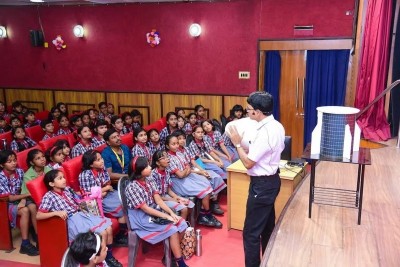
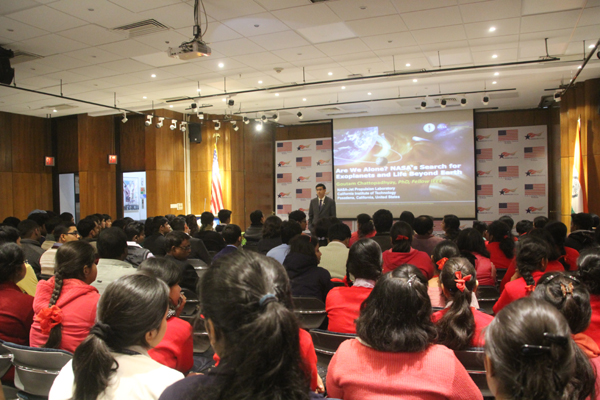
Kolkata, Dec 19 (IBNS): Senior Research Scientist from NASA, Goutam Chattopadhyay, recently delivered a popular lecture on 'Life beyond Earth' in Kolkata.
Chattopadhyay, is a senior research scientist at Jet Propulsion Laboratory (JPL), California Institute of Technology (Caltech) and also a visiting Professor at the Division of Physics, Mathematics, and Astronomy at Caltech.
“Basic science delivers technology but NASA is mandated to do science by trying to answer a fundamental question, such as the origin of life beyond what we are thinking," said Chattopadhyay.
There is ongoing investigation assessing the past habitability potential of Mars, as well as the possibilities of extant life, he said.
In November 2016, NASA reported finding a large amount of underground ice in the Utopia Planitia.
NASA continues to work on its Mars project with the launch of a vehicle expected in 2020; this is called a Mars helicopter.
Enceladus is Saturn’s moon. Enceladus is the only moon in the solar system known to influence the chemical composition of its parental planet. In 2014, NASA found evidence on the large south polar subsurface ocean of liquid water.
“Observation with Herschel-Hifi of water in a young sun-like star reveal high-velocity ‘bullets’ moving at more than 200,000 km/h from star," Chattopadhyay said.
“Velocity of a bullet from an AK47 rifle, which is 2500 km/h or 80 times slower,” he explained.
It is a surprise that water molecules are observed at this high-velocity temperature exceed 100,000 degrees.
Observations have revealed that water very likely reforms rapidly in the hot and dense shocked gas. The conditions are so favorable that approximately 100 million times the amount of the water in the Amazon River is formed every second.
Water plumes sparked a race to Jupiter moon Europa in December, 2014
There are also some exoplanets close to us like Proxima Centauri (half as hot as the sun and 14% as wide) four light years away. It has a planet 1.3 times the mass of earth, it orbits in 11.2 days at 0.05 AU distance.
“Rose 128 is also the 12th closest star. 11 light years away, 16 per cent the sun’s mass; it’s a rocky planet 1.3 Earth Mass 9.9 days orbit and a habitable zone. This star is small and cools the planet receives 50 per cent more light than we do," Chattopadhyay said.
NASA has announced for the first time, eight planets have been found orbiting a distant star, Kepler-90, 2,454 light-years from the earth in Draco constellations and the new planet is dubbed Kepler- 90i few days ago.
“Kepler’s has watched more than 150,000 in one part of the sky to conclude exoplanets aspirant, based on the minor dimming of starts as potential planets,” said Chattopadhyay.
The Kepler-80 is constant, as the previously discovered seven- planet TRAPPIST-1 system has proven to be but still research orbit assumption is going on for life on those planetary bodies.
“Apart from the planetary studies, there are some technology and innovative Ideas which is miniaturization and complex systemized," he said.
“We are producing 1019 transistors per year and most of them worked,” said Chattopadhyay.
Raincube is the other invention by NASA which is used to measure rain and snowfall; CubeSats unit, or 1U, is roughly equivalent to a 4-inch cubic box, or 10*10*10 cubic centimeters. The antenna deploys out of its 1.5U canister.
The lecture was attended by students and faculties of 20 city and suburban schools.
Addressing the students, Chattopadhyay said, "Even if you don’t get great marks, in the long run, you will be successful if you have a basic understanding of the subject."
“The most important thing in life is to be a good human being," was the scientist's parting advice.
(Reporting by Camellia Chatterjee)
Support Our Journalism
We cannot do without you.. your contribution supports unbiased journalism
IBNS is not driven by any ism- not wokeism, not racism, not skewed secularism, not hyper right-wing or left liberal ideals, nor by any hardline religious beliefs or hyper nationalism. We want to serve you good old objective news, as they are. We do not judge or preach. We let people decide for themselves. We only try to present factual and well-sourced news.
Support objective journalism for a small contribution.