


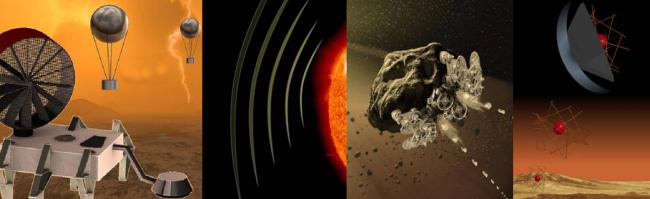
NASA invests in two-dimensional spacecraft, reprogrammable microorganisms
Among the selected are: a concept for reprogramming microorganisms that could use the Martian environment to recycle and print electronics; a two-dimensional spacecraft with ultra-thin subsystems that may wrap around space debris to enable de-orbiting; and a method of computational imaging that leverages extrasolar intensity fluctuations to detect “echoes” from planets and other structures orbiting a distant star.
NIAC Phase I awards are valued at approximately $100,000 for nine months, to support initial definition and analysis of their concepts. If these basic feasibility studies are successful, awardees can apply for Phase II awards, valued up to $500,000 for two additional years of concept development.
“The latest NIAC selections include a number of concepts for planetary and robotic exploration,” said Steve Jurczyk, NASA’s associate administrator for the Space Technology Mission Directorate in Washington. “NASA continues to value early stage concept studies for our future missions.”
The 2016 portfolio of Phase I concepts cover a wide range of innovations selected for their potential to revolutionize future aerospace missions. Such breakthroughs hold the promise of accelerating NASA’s progress toward its goals of exploration beyond low-Earth orbit, missions to an asteroid and Mars, and other priority areas in all of NASA’s mission directorates. NIAC partners with forward-thinking scientists, engineers, and citizen inventors from across the nation to help maintain America’s leadership in air and space.
“The 2016 NIAC Phase I competition was fierce, as usual. All of the final candidates were outstanding, and limiting the choice to what fit in our budget was difficult,” said Jason Derleth, NIAC program executive. “We hope each new study will push boundaries and explore new approaches – that’s what makes NIAC unique.”
Image: NASA
Support Our Journalism
We cannot do without you.. your contribution supports unbiased journalism
IBNS is not driven by any ism- not wokeism, not racism, not skewed secularism, not hyper right-wing or left liberal ideals, nor by any hardline religious beliefs or hyper nationalism. We want to serve you good old objective news, as they are. We do not judge or preach. We let people decide for themselves. We only try to present factual and well-sourced news.
Support objective journalism for a small contribution.


