 L1
L1
Mission to Sun: India's Aditya-L1's HEL1OS captures first glimpse of solar flares
India's first solar exploratory mission spacecraft Aditya-L1, which is continuing its journey to land at the sun-earth L1 point, has captured the first glimpse of solar flares.
ISRO on Wednesday (November 8, 2023) said the solar flares were captured by the L1-Orbiting X-ray spectrometer--HELIOS.
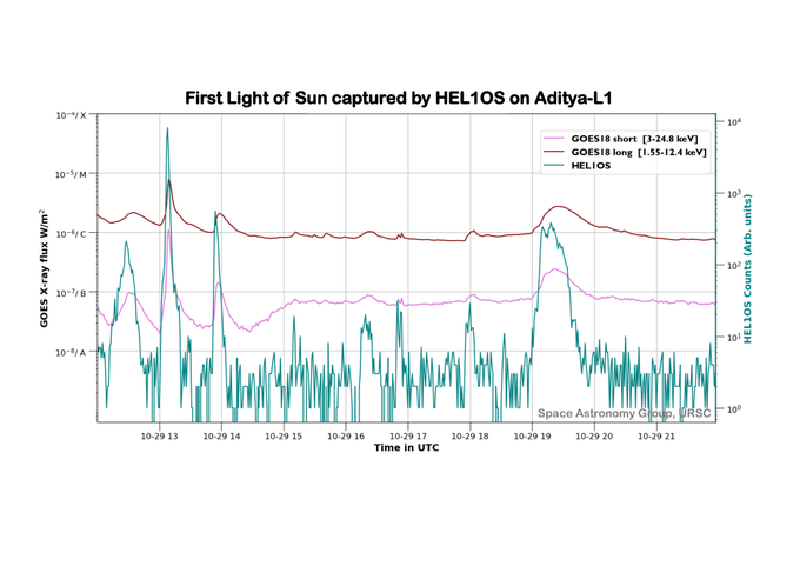
"During its first observation period from approximately 12:00 to 22:00 UT on October 29, 2023, the High Energy L1 Orbiting X-ray Spectrometer (HEL1OS) on board Aditya-L1 has recorded the impulsive phase of solar flares", the Space Agency said in an upadate.
Aditya-L1 Mission:
— ISRO (@isro) November 7, 2023
HEL1OS captures first High-Energy X-ray glimpse of Solar Flares
🔸During its first observation period from approximately 12:00 to 22:00 UT on October 29, 2023, the High Energy L1 Orbiting X-ray Spectrometer (HEL1OS) on board Aditya-L1 has recorded the… pic.twitter.com/X6R9zhdwM5
"The recorded data is consistent with the X-ray light curves provided by NOAA's GOES."
"Commissioned on October 27, 2023, HEL1OS is currently undergoing fine-tuning of thresholds and calibration operations. The instrument is set to monitor the Sun's high-energy X-ray activity with fast timing and high-resolution spectra," ISRO said.
"HEL1OS data enables researchers to study explosive energy release and electron acceleration during impulsive phases of solar flares" it added.
HEL1OS was developed by the Space Astronomy Group of the U. R. Rao Satellite Centre, ISRO, Bengaluru.
The High Energy L1 Orbiting X-ray Spectrometer (HEL1OS), is the hard X-ray spectrometer on Aditya-L1 Solar Mission by ISRO, operating in the wide X-ray energy band of 10 – 150 keV. It is the harbinger of flaring activities on the Sun, with the ability to capture the early impulsive phase of the solar activity.
A solar flare is a sudden brightening of the solar atmosphere, which involves 1027 – 1032 ergs of energy release in tens of minutes.
Flares produce enhanced emission in all wavelengths across the electromagnetic spectrum – radio, optical, UV, soft X-rays, hard X-rays and gamma-rays.
Flare emission consists of emissions from accelerated particles and hot plasma.
Though solar flares have been studied in X-rays and gamma-rays for decades, the initial impulsive emission is very difficult to characterise and understand.
The impulsive hard X-ray emission has multiple spectral components which are highly time variable.
Further, the spectrum is very steep, the emission above 20 keV is typically several orders of magnitude (about a million times) lower than that of the emission below 10 keV. HEL1OS aims to overcome these difficulties by having a set of detectors specifically tuned to cater to different energy ranges and also provides very high spectral and time resolution measurements, ISRO said.
The Science goals of HEL1OS are to study explosive energy release, acceleration and transport of electrons during Solar flares using fast-timing measurements and high-resolution spectra.
Quasi-periodic Pulsations (QPPs) of hard X-rays during Solar flares to understand its connection with particle acceleration mechanisms.
It may be recalled that on September 19, AIDTYA-L1 spacecraft was given a perfect send off from the Earth Orbit, commencing its long voyage to the halo Lagrange-1 LI point, marking its journey lasting next four months to study the outer atmosphere of the most hot planet.
ISRO scientists had performed the Trans-Lagragean Point 1 Insertion (TL1I) manoeuvre of the spacecraft, which has commenced collecting scientific data at a distances greater than 50,0000 km from Earth.
The Trans-Lagrangean Point 1 Insertion (TL1I) maneuvre has been performed successfully and the spacecraft is now on a trajectory that will take it to the Sun-Earth L1 point, it said.
It will be injected into an orbit around L1 through a maneuver after about 110 days.
This is the fifth consecutive time ISRO has successfully transferred an object on a trajectory towards another celestial body or location in space.
The insertion into the Trans-Lagragean Point 1 Insertion (TL1I), signalled its stay in Earth orbit and commenced its voyage to the solar sphere after the successful fifth and final Earth bound orbit raising manouvere was performed at 0200 hrs early on September 19 morning.
From TLI1, the spacecraft will gradually proceed towards its final destination to study solar activities and its effect on space weather after a long voyage, signalling India's second Space Odyssey after the Lunar Mission in a short span of time that made the galaxy of space faring nations to take note of India's furtherance in global space programme.
(With UNI Inputs)
Support Our Journalism
We cannot do without you.. your contribution supports unbiased journalism
IBNS is not driven by any ism- not wokeism, not racism, not skewed secularism, not hyper right-wing or left liberal ideals, nor by any hardline religious beliefs or hyper nationalism. We want to serve you good old objective news, as they are. We do not judge or preach. We let people decide for themselves. We only try to present factual and well-sourced news.
Support objective journalism for a small contribution.