


 ISRO
ISRO
India's ISRO to launch polarimetry mission to study Black Holes today
India will try to begin its New Year journey with an effort to know about one of the biggest mysteries in space- black holes.
The Indian Space Research Organisation or ISRO will mark the first day of the year with the launch of the country's first dedicated polarimetry mission to study various dynamics of bright astronomical X-ray sources in extreme conditions on Monday (January 1, 2024).
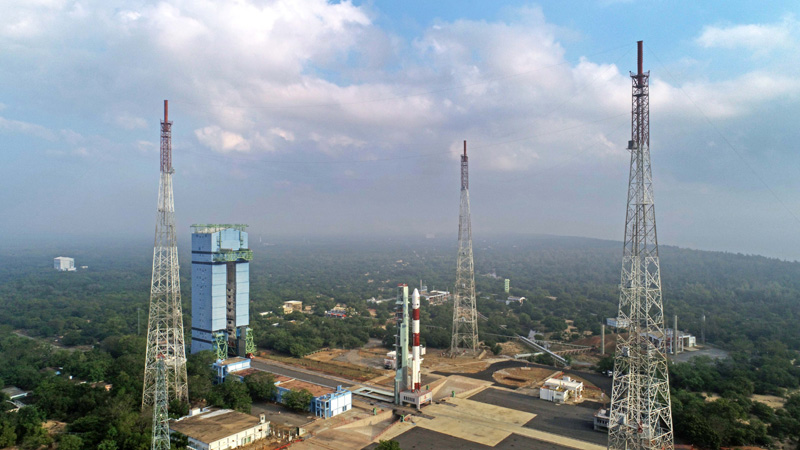
The launch of the X-Ray Polarimeter Satellite (XPoSat) going to take place at 09:10 Hrs. IST from the first launch-pad, SDSC-SHAR, Sriharikota.
"The emission mechanism from various astronomical sources such as blackhole, neutron stars, active galactic nuclei, pulsar wind nebulae etc. originates from complex physical processes and are challenging to understand," read the ISRO website.
🚀 PSLV-C58/ 🛰️ XPoSat Mission:
— ISRO (@isro) December 31, 2023
The launch of the X-Ray Polarimeter Satellite (XPoSat) is set for January 1, 2024, at 09:10 Hrs. IST from the first launch-pad, SDSC-SHAR, Sriharikota.https://t.co/gWMWX8N6Iv
The launch can be viewed LIVE
from 08:40 Hrs. IST on
YouTube:… pic.twitter.com/g4tUArJ0Ea
XPoSat (X-ray Polarimeter Satellite) is India’s first dedicated polarimetry mission.
The spacecraft will carry two scientific payloads in a low earth orbit. The primary payload POLIX (Polarimeter Instrument in X-rays) will measure the polarimetry parameters (degree and angle of polarization) in medium X-ray energy range of 8-30 keV photons of astronomical origin.
The XSPECT (X-ray Spectroscopy and Timing) payload will give spectroscopic information in the energy range of 0.8-15 keV.
"The polarimetric observations along with spectroscopic measurements are expected to break the degeneracy of various theoretical models of astronomical emission processes," the ISOR website said.
XPoSat payloads
POLIX is an X-ray Polarimeter for astronomical observations in the energy band of 8-30 keV.
The payload is being developed by Ramam Research Institute (RRI), Bangalore in collaboration with U R Rao Satellite Centre (URSC).
The instrument is made of a collimator, a scatterer and four X-ray proportional counter detectors that surrounds the scatterer.
The scatterer is made of low atomic mass material which causes anisotropic Thomson scattering of incoming polarised X-rays.
The collimator restricts the field of view to 3 degree x 3 degree so as to have only one bright source in the field of view for most observations.
POLIX is expected to observer about 40 bright astronomical sources of different categories during the planned lifetime of XPoSat mission of about 5 years. This is the first payload in the medium X-ray energy band dedicated for polarimetry measurements.
XSPECT is an X-ray SPECtroscopy and Timing payload onboard XPoSat, which can provide fast timing and good spectroscopic resolution in soft X-rays.
Taking advantage of the long duration observations required by POLIX to measure X-ray polarization, XSPECT can provide long-term monitoring of spectral state changes in continuum emission, changes in their line flux and profile, simultaneous long-term temporal monitoring of soft X-ray emission in the X-ray energy range 0.8-15 keV. An array of Swept Charge Devices (SCDs) provide an effective area >30 cm2 at 6 keV with energy resolution better than 200 eV at 6 keV.
Passive collimators are used to reduce the background by narrowing the field of view of XSPECT. XSPECT would observe several types of sources viz X-ray pulsars, blackhole binaries, low-magnetic field neutron star (NS) in LMXBs, AGNs and Magnetars.
Support Our Journalism
We cannot do without you.. your contribution supports unbiased journalism
IBNS is not driven by any ism- not wokeism, not racism, not skewed secularism, not hyper right-wing or left liberal ideals, nor by any hardline religious beliefs or hyper nationalism. We want to serve you good old objective news, as they are. We do not judge or preach. We let people decide for themselves. We only try to present factual and well-sourced news.
Support objective journalism for a small contribution.


