


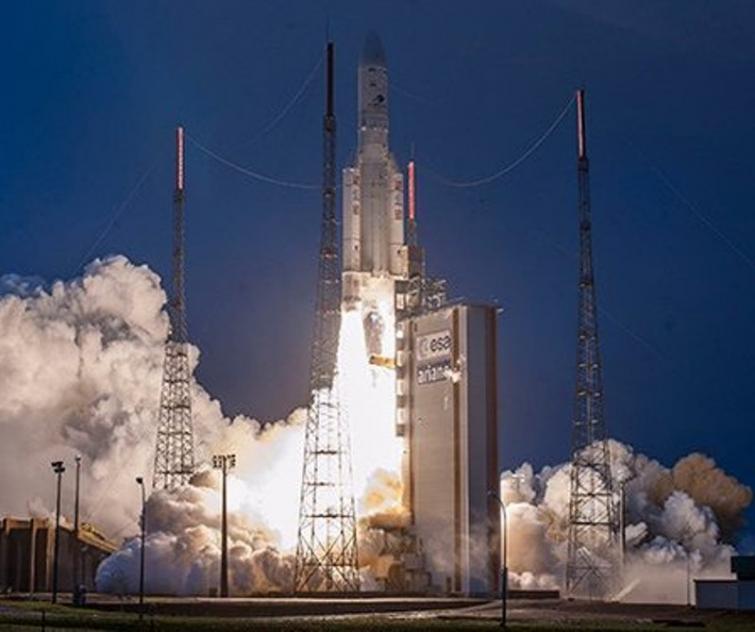
India’s communication satellite GSAT-31 launched successfully from French Guiana
New Delhi, Feb 6 (IBNS): India’s latest communication satellite, GSAT-31 was successfully launched from the Spaceport in French Guiana during the early hours on Wednesday, ISRO said.
The launch vehicle Ariane 5 VA-247 lifted off from Kourou Launch Base, French Guiana at 2:31 am (IST) carrying India’s GSAT-31 and Saudi Geostationary Satellite 1/Hellas Sat 4 satellites, as scheduled.
After a 42-min flight, GSAT-31 separated from the Ariane 5 upper stage in an elliptical Geosynchronous Transfer Orbit with a perigee (nearest point to Earth) of 250 km and an apogee (farthest point to Earth) of 35,850 km, inclined at an angle of 3.0 degree to the equator, ISRO said in a statement.
With a lift-off mass of 2536 kg, GSAT-31 will augment the Ku-band transponder capacity in Geostationary Orbit. The satellite will provide continuity to operational services on some of the in-orbit satellites. GSAT-31 derives its heritage from ISRO’s earlier INSAT/GSAT satellite series.
“GSAT-31 has a unique configuration of providing flexible frequency segments and flexible coverage. The satellite will provide communication services to Indian mainland and islands” ISRO Chairman Dr K Sivan said.
Dr. Sivan also remarked that “GSAT-31 will provide DTH Television Services, connectivity to VSATs for ATM, Stock-exchange, Digital Satellite News Gathering (DSNG) and e-governance applications. The satellite will also be used for bulk data transfer for a host of emerging telecommunication applications.”
After separation from Ariane-5 upper stage, the two solar arrays of GSAT-31 were automatically deployed in quick succession and ISRO's Master Control Facility at Hassan in Karnataka took over the command and control of GSAT-31 and found its health parameters normal.
In the days ahead, scientists will undertake phase-wise orbit-raising manoeuvres to place the satellite in Geostationary Orbit (36,000 km above the equator) using its on-board propulsion system.
During the final stages of its orbit raising operations, the antenna reflector of GSAT-31 will be deployed.
Following this, the satellite will be put in its final orbital configuration. The satellite will be operational after the successful completion of all in-orbit tests.
Image Credit: ISRO Twitter page
Support Our Journalism
We cannot do without you.. your contribution supports unbiased journalism
IBNS is not driven by any ism- not wokeism, not racism, not skewed secularism, not hyper right-wing or left liberal ideals, nor by any hardline religious beliefs or hyper nationalism. We want to serve you good old objective news, as they are. We do not judge or preach. We let people decide for themselves. We only try to present factual and well-sourced news.
Support objective journalism for a small contribution.


