


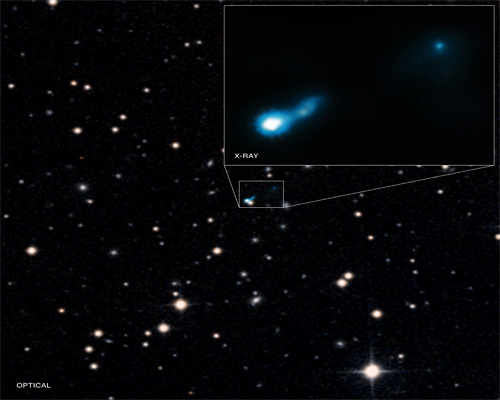
Glow from the Big Bang allows discovery of distant black hole jet
The light detected from this jet was emitted when the Universe was only 2.7 billion years old, a fifth of its present age. At this point, the intensity of the cosmic microwave background radiation, or CMB, left over from the Big Bang was much greater than it is today.
The length of the jet, found in the system known as B3 0727+409, is at least 300,000 light years. Many long jets emitted by supermassive black holes have been detected in the nearby Universe, but exactly how these jets give off X-rays has remained a matter of debate. In B3 0727+409, it appears that the CMB is being boosted to X-ray wavelengths.
“Because we’re seeing this jet when the Universe was less than three billion years old, the jet is about 150 times brighter in X-rays than it would be in the nearby Universe,” said Aurora Simionescu at JAXA’s Institute of Space and Astronautical Studies (ISAS) who led the study.
As the electrons in the jet fly from the black hole at close to the speed of light, they move through the sea of CMB radiation and collide with microwave photons, boosting the energy of the photons up into the X-ray band to be detected by Chandra. This implies that the electrons in the B3 0727+409 jet must keep moving at nearly the speed of light for hundreds of thousands of light years.
Electrons in black hole jets usually emit strongly at radio wavelengths, so typically these systems are found using radio observations. The discovery of the jet in B3 0727+409 is special because so far almost no radio signal has been detected from this object, while it is easily seen in the X-ray image.
“We essentially stumbled onto this remarkable jet because it happened to be in Chandra’s field of view while we were observing something else,” explains co-author Lukasz Stawarz of Jagiellonian University in Poland.
Scientists have so far identified very few jets distant enough that their X-ray brightness is amplified by the CMB as clearly as in the B3 0727+409 system. But, Stawarz adds, “if bright X-ray jets can exist with very faint or undetected radio counterparts, it means that there could be many more of them out there because we haven’t been systematically looking for them.”
“Supermassive black hole activity, including the launching of jets, may be different in the early Universe than what we see later on,” said co-author Teddy Cheung of the Naval Research Laboratory in Washington DC. “By finding and studying more of these distant jets, we can start to grasp how the properties of supermassive black holes might change over billions of years.”
These results were published in the January 1st, 2016 issue of The Astrophysical Journal Letters and appear online. NASA's Marshall Space Flight Center in Huntsville, Alabama, manages the Chandra program for NASA's Science Mission Directorate in Washington. The Smithsonian Astrophysical Observatory in Cambridge, Massachusetts, controls Chandra's science and flight operations.
Image credits: X-ray: NASA/CXC/ISAS/A. Simionescu et al, Optical: DSS
Support Our Journalism
We cannot do without you.. your contribution supports unbiased journalism
IBNS is not driven by any ism- not wokeism, not racism, not skewed secularism, not hyper right-wing or left liberal ideals, nor by any hardline religious beliefs or hyper nationalism. We want to serve you good old objective news, as they are. We do not judge or preach. We let people decide for themselves. We only try to present factual and well-sourced news.
Support objective journalism for a small contribution.


