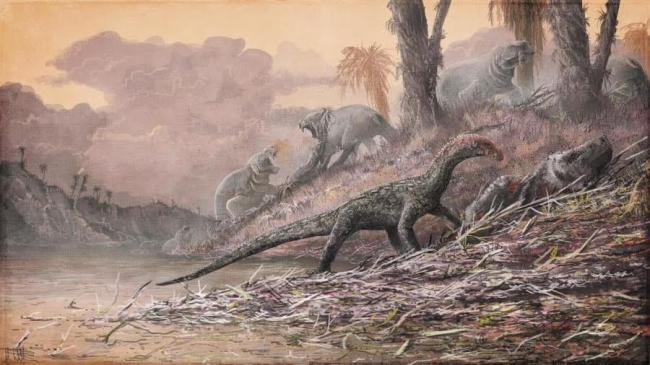
Discovery of early, 'croc-like' reptile sheds new light on evolution of dinosaurs
Described in a paper published today in Nature, the carnivorous reptile, Teleocrater rhadinus, was approximately 7- 10 feet in length, had a long neck and tail, and walked on four crocodile-like legs.
It roamed the Earth during the Triassic Period more than 245 million years ago – pre-dating the first true dinosaurs by around ten million years – and appears in the fossil record just after a large group of reptiles, known as archosaurs, split into a bird branch (leading to dinosaurs and eventually birds) and a crocodile branch (eventually leading to today’s alligators and crocodiles). Teleocrater and its kin are the earliest known members of the bird branch of the archosaurs.
The discovery overturns widely-held preconceptions by palaeontologists about the morphology of early dinosaur relatives, with many scientists anticipating that such creatures would be smaller, bipedal and more ‘dinosaur-like’.
"Teleocrater fundamentally challenges our models of what the close relatives of dinosaurs would have looked like," said Professor Richard Butler from the University of Birmingham.
"Dinosaurs were amazingly successful animals. It’s natural to want to know where they came from, and how they became so dominant. Teleocrater is hugely exciting because it blows holes in many of our classic ideas of dinosaur origins," Butler said.
All the specimens used to describe Teleocrater were collected from a rock unit called the Manda Beds, in the Ruhuhu Basin of southern Tanzania, Africa.
Teleocrater fossils were first discovered in the region in 1933 by palaeontologist F. Rex Parrington, and subsequently studied by Alan J. Charig, former Curator of Fossil Reptiles, Amphibians and Birds at the Natural History Museum, in the 1950s.
However, due to a lack of crucial bones, such as the ankle bones, Charig could not determine whether Teleocrater was more closely related to crocodylians or to dinosaurs. Unfortunately, he died before he was able to complete his studies.
Re-examination of Charig’s specimens by Butler and colleagues, combined with the discovery of additional fossils by a US-led team in Tanzania in 2015, has finally allowed the surprising relationship between Teleocrater and its dinosaur cousins to be revealed.
"It’s astonishing to think that it’s taken more than 80 years for the true scientific importance of these fossils to be understood and published," said Professor Butler.
Professor Paul Barrett from the Natural History Museum, one of the other main authors of the work on Teleocrater, said: "My colleague Alan Charig would have been thrilled to see one of ‘his’ animals finally being named and occupying such an interesting position in the Tree of Life."
"Our discovery shows the value of maintaining and re-assessing historical collections: many new discoveries, like this one, can be made by looking through museum collections with fresh eyes," he added.
Support Our Journalism
We cannot do without you.. your contribution supports unbiased journalism
IBNS is not driven by any ism- not wokeism, not racism, not skewed secularism, not hyper right-wing or left liberal ideals, nor by any hardline religious beliefs or hyper nationalism. We want to serve you good old objective news, as they are. We do not judge or preach. We let people decide for themselves. We only try to present factual and well-sourced news.
Support objective journalism for a small contribution.