


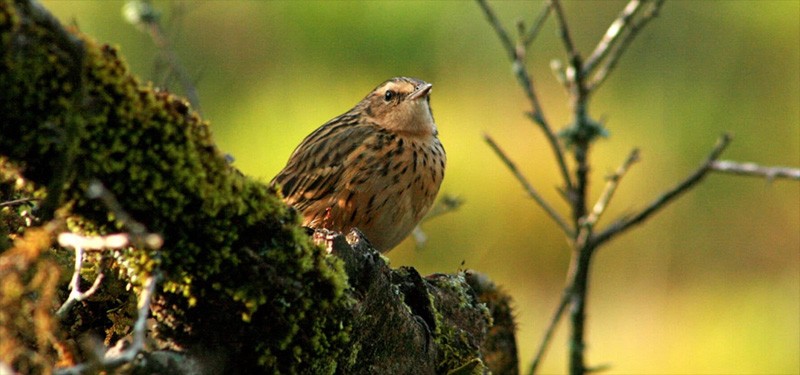
Disappearing Nilgiri grasslands impact bird populations
A study of the shola sky islands in the southern Western Ghats finds that land-use changes are reshaping bird movements, with both forest and grassland species avoiding human-dominated areas. Forest specialists were less affected in woodlands invaded by woody plants, while the Nilgiri pipit, the study’s only grassland specialist, faced the greatest movement constraints from woody invasions and human activity. Mongabay India correspondent Simrin Sirur reports
The shola sky islands are unique montane forests separated by rolling grasslands. They’re biologically significant because they host a large number of species whose global distributions are concentrated here.
But changes in land use dynamics have caused a steady decline in the populations of certain birds in the region. Colonial-era plantations of exotic tree species like Acacia, Eucalyptus and Pinus, which are not native to this region, have invaded several parts of the sky islands. Between 1973 and 2017, the islands lost 516 sq km of grasslands and 63 sq km of forests.
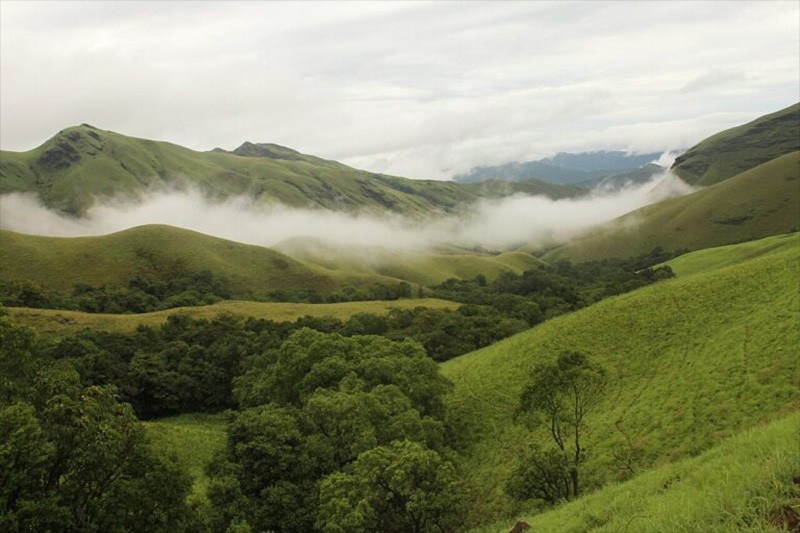 Shola forests and grasslands in the Nilgiris. Image by Davidvraju via Wikimedia Commons (CC BY-SA 4.0).
Gains and losses
The study covered approximately 2,900 sq km across the two largest sky islands — in the Nilgiris and Palani-Anamalais — at elevations higher than 1400 metres above sea level. The objective was to observe how habitat fragmentation impacted the movements of the seven most commonly found species endemic to the region.
These species comprised both forest and grassland specialists, whose requirements differ despite occupying the same spaces. While grassland species require open spaces to forage, nest, and roost, forest specialists are better adapted to woody habitats.
The six forest specialists were the white-bellied sholakili, Palani laughingthrush, the Nilgiri sholakili, the Nilgiri laughingthrush the black-and-orange flycatcher and the Nilgiri flycatcher. Only one grassland specialist was included, the Nilgiri pipit, because it was the only endemic species found at that elevation for which there was sufficient data.
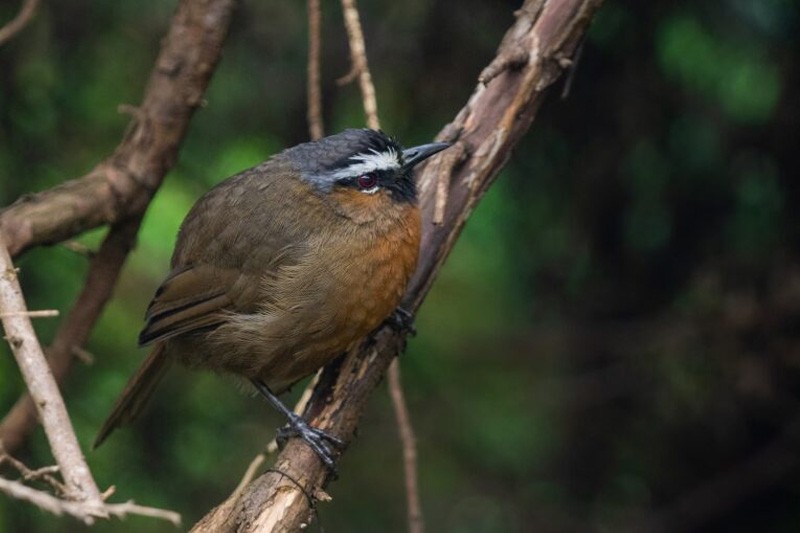 A Nilgiri laughingthrush spotted in Kotagiri, Tamil Nadu. Image by Sidharth Srinivasan via Wikimedia Commons (CC BY-SA 4.0).
In the absence of detailed and historical field data, the researchers quantified species behaviour and built 126 models which predicted the movement patterns of each of the seven species across various scenarios. They found that while both forest and grassland species tended to avoid human-dominated landscapes (such as agriculture, tea plantations, and settlements), their behaviours diverged when it came to areas invaded by woodlands.
“Since the Shola landscape alternates between forests/woodlands and grasslands, an increase in woodland cover implies a corresponding decrease in grassland, resulting in more fragmented natural grassland habitat and a subsequent decrease in connectivity for grassland species,” said Arunima Jain, Project Student at IISER Tirupati who also contributed to the research.
Compared to the forest specialists, the Nilgiri pipit’s movements were hindered across most of the study area, regardless of location. Separate studies have found the Nilgiri pipit’s population to have suffered the steepest declines in recent decades.
The prolonged isolation of this species could impact its genetic diversity in the future due to inbreeding. “Future studies examining genetic connectivity across populations of these species are needed to determine whether these habitat changes have actually reduced gene flow and whether there is a risk of isolation,” said Arvind.
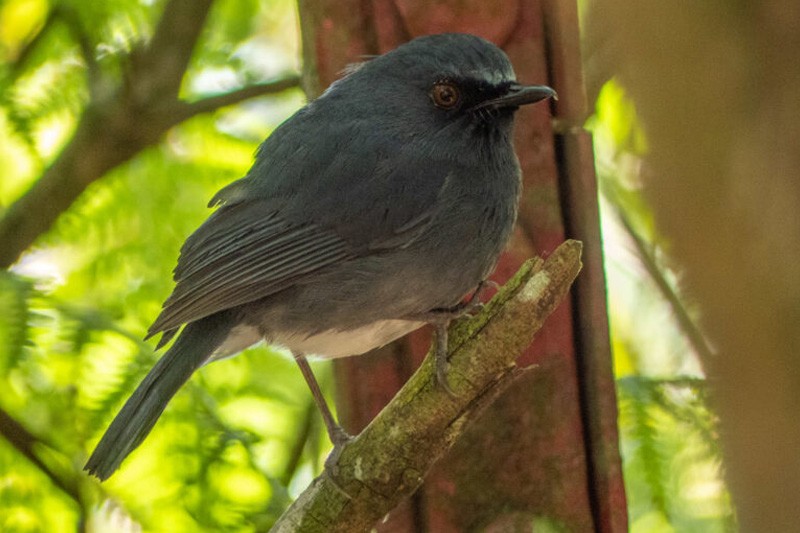 A white-bellied sholakili spotted in the Western Ghats. Image by Mike Prince via Flickr (CC BY 2.0).
A pattern seen beyond the Nilgiris
Although the study does not attribute the isolation of the Nilgiri pipit solely to woody invasions, it joins a growing body of evidence that shows the potential fallouts of plantation activity on native biodiversity.
In Maharashtra, for example, researchers found similar results of how afforestation on grasslands changed the composition of species occupying the landscape. Because woody tree plantations changed the level of understorey required for grassland birds to roost, nest, and forage, their populations inadvertently declined. Forest specialists, on the other hand, populated the landscape instead.
Birds are also significant bioindicators of the health of a habitat. The forest and grassland mosaic structure of the sky islands has made it a rich reservoir of water which replenishes streams. The loss of grasslands, however, has diminished soil quality and reduced its water retention capacity.
“Different species occupying the same spaces can have vastly different survival and movement requirements. We also emphasise the need to restore and preserve vanishing native grassland habitat specifically in the Shola Sky Islands of the Western Ghats. The results of our study, along with those of many others conducted in this landscape, can be used to identify priority areas for restoration,” said V.V. Robin, Associate Professor at IISER Tirupati.
Support Our Journalism
We cannot do without you.. your contribution supports unbiased journalism
IBNS is not driven by any ism- not wokeism, not racism, not skewed secularism, not hyper right-wing or left liberal ideals, nor by any hardline religious beliefs or hyper nationalism. We want to serve you good old objective news, as they are. We do not judge or preach. We let people decide for themselves. We only try to present factual and well-sourced news.
Support objective journalism for a small contribution.


