

 Cheetah
Botswana-brought Cheetah gives birth to four cubs in wild, India's Cheetah population rises to 62
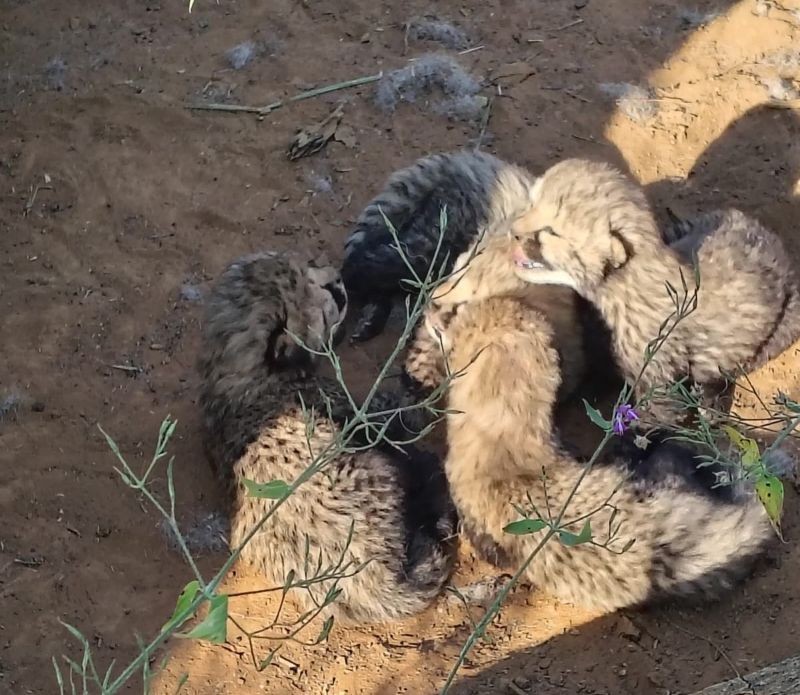
A two-and-a-half-year-old female cheetah, KOMG 3, brought to India from Botswana, has given birth to four healthy cubs in the wild, marking a significant milestone for Project Cheetah and the country's efforts to establish a viable cheetah population.
Union Minister for Environment, Forest and Climate Change Bhupender Yadav announced the development in a social media post, stating that KOMG 3 is the first female cheetah from Botswana to give birth.
KOMG 3, a two-and-a-half-year-old female cheetah from Botswana, gave birth to four healthy cubs in the wild today. Notably, she is the first female cheetah from Botswana to give birth. This is a landmark moment for Project Cheetah and a proud milestone in India’s journey towards restoring a viable cheetah population. Having spent more than four months in the wild, KOMG 3 has now given birth under natural conditions. This is the second recorded birth in the wild since the reintroduction programme began in 2022. With these four new arrivals, India's cheetah population has risen to 62, including 43 Indian-born individuals. Every such birth strengthens our hope, deepens our commitment and reminds us that conservation is a journey of patience, perseverance and collective effort. Behind this milestone lie countless hours of dedication, commitment and hard work by the managers, veterinarians, frontline forest staff and everyone working tirelessly for the success of Project Cheetah.
— Bhupender Yadav (@byadavbjp) November 20, 2026
The minister highlighted that the cheetah had spent more than four months in the wild before giving birth under natural conditions. This is the second recorded instance of cheetah cubs being born in the wild since the reintroduction programme began in 2022.
With the birth of the four cubs, India's cheetah population has increased to 62, including 43 individuals born in the country, Yadav said.
Describing the development as a landmark moment for Project Cheetah, the minister said the birth marked a proud milestone in India's efforts to restore a viable cheetah population.
He added that every such birth strengthens hopes for the programme and reinforces the commitment to conservation, emphasising that such efforts require patience, perseverance and collective action.
Yadav also acknowledged the dedication and hard work of project managers, veterinarians, frontline forest staff and others working towards the success of Project Cheetah.
What Is Project Cheetah?
Project Cheetah is a pioneering initiative aimed at reintroducing cheetahs in India after the species became extinct in the country.
The programme began with the translocation of a founder population of 20 cheetahs from Namibia and South Africa. It was subsequently supplemented by nine cheetahs from Botswana through international cooperation and scientific planning.
Kuno National Park in Madhya Pradesh has been developed as the primary site for establishing the cheetah population, while Gandhisagar Wildlife Sanctuary has been prepared as an additional habitat to support the programme's expansion.
Preparatory work is also underway to extend the project to other landscapes, including the Banni grasslands in Gujarat, where habitat development and prey augmentation measures have reportedly reached satisfactory levels.
Scientific monitoring indicates that cheetahs are adapting to Indian conditions, with stable ranging behaviour and effective prey utilisation. No significant physiological stress has been observed across different management settings, according to the project assessment.
The next phase of Project Cheetah will focus on consolidating and expanding the population through additional translocations and the development of new habitats, including Nauradehi Wildlife Sanctuary in Madhya Pradesh.
The programme also aims to strengthen a metapopulation framework across identified landscapes. Continued sourcing of cheetahs from African countries is envisaged to maintain genetic diversity and support the long-term growth of the population.
Support Our Journalism
We cannot do without you.. your contribution supports unbiased journalism
IBNS is not driven by any ism- not wokeism, not racism, not skewed secularism, not hyper right-wing or left liberal ideals, nor by any hardline religious beliefs or hyper nationalism. We want to serve you good old objective news, as they are. We do not judge or preach. We let people decide for themselves. We only try to present factual and well-sourced news.
Support objective journalism for a small contribution.