 Ebola
Ebola
Deadly Ebola outbreak spreads in DRC — over 500 suspected cases, WHO sounds alarm
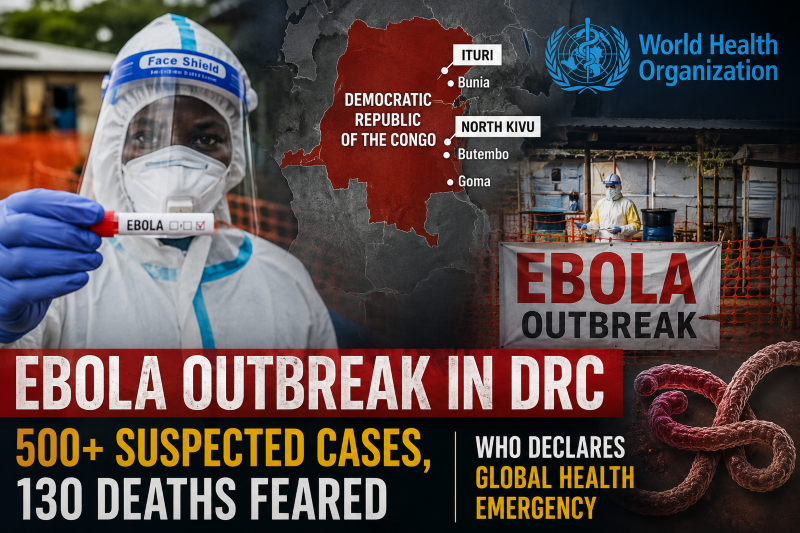
The World Health Organization (WHO) representative in the Democratic Republic of the Congo (DRC), Dr Anne Ancia, said there are more than 500 suspected Ebola cases, including around 130 suspected deaths, while only 30 cases have been confirmed so far.
Amid a rapidly spreading outbreak, health workers are racing to contain transmission, with the rollout of any potential vaccine still months away, the UN health agency said on Tuesday.
The WHO is working closely with national authorities and is urgently dispatching additional testing kits to eastern DRC to help identify infections linked to the Bundibugyo virus, a strain of Ebola for which no approved vaccines or treatments currently exist.
DRC #Ebola outbreak: @WHO is working closely with the authorities and rushing more testing kits to eastern DRC to identify cases of infection of Bundibugyo virus. https://t.co/X52gEKZaS0 pic.twitter.com/YKZxpcnv5q
— UN News (@UN_News_Centre) May 19, 2026
“We have significant uncertainty about the number of infections and how far the virus has spread,” Dr Ancia said.
Speaking from Bunia in Ituri province, where the outbreak was first detected, she said cases have now also been confirmed in North Kivu, including in Butembo and Goma. Uganda has reported two imported cases as well.
WHO Director-General Tedros Adhanom Ghebreyesus has already declared the outbreak a Public Health Emergency of International Concern (PHEIC) and expressed concern over the “scale and speed” of the epidemic.
Authorities are still uncertain about the exact origin of the outbreak.
“I don't think that we have the ‘patient zero’ for now,” Dr Ancia said, adding that the earliest known case dates back to 5 May in Bunia, after which traditional funeral practices may have contributed to further transmission.
She explained that initial local testing in Bunia failed to detect the Bundibugyo strain, as results came back negative for the more common Zaire strain of Ebola, delaying identification of the outbreak.
The wide range of symptoms—including fever, fatigue, diarrhoea and vomiting—also complicated early diagnosis. A characteristic symptom, nosebleeds, typically appeared only after several days, further hindering detection, she noted.
The outbreak was eventually confirmed through advanced testing in Kinshasa, which identified the Bundibugyo virus.
Dr Ancia said international discussions are underway on potential vaccines and treatments. A WHO technical advisory group was expected to meet to determine which vaccine candidates, if any, should be prioritised.
The Ervebo vaccine, which protects against the Zaire strain of Ebola, is under consideration, but officials noted it would take at least two months to become available.
Meanwhile, the UN refugee agency (UNHCR) has raised concerns over the vulnerability of displaced populations in affected provinces. Ituri and North Kivu host more than two million internally displaced persons and returnees, while healthcare systems remain strained due to ongoing conflict.
In Ituri, around 11,000 South Sudanese refugees require preventive support, while in North Kivu’s capital Goma—controlled by rebel forces—over 2,000 Rwandan and Burundian refugees also require sanitation assistance.
The most recent Ebola Zaire outbreak in the DRC ended in December 2025, and the memory of the devastating 2018–19 epidemic in North Kivu and Ituri continues to affect public response.
Dr Ancia stressed that although a vaccine may take two months to become available, “it is not two months before the outbreak will be over.”
Support Our Journalism
We cannot do without you.. your contribution supports unbiased journalism
IBNS is not driven by any ism- not wokeism, not racism, not skewed secularism, not hyper right-wing or left liberal ideals, nor by any hardline religious beliefs or hyper nationalism. We want to serve you good old objective news, as they are. We do not judge or preach. We let people decide for themselves. We only try to present factual and well-sourced news.
Support objective journalism for a small contribution.