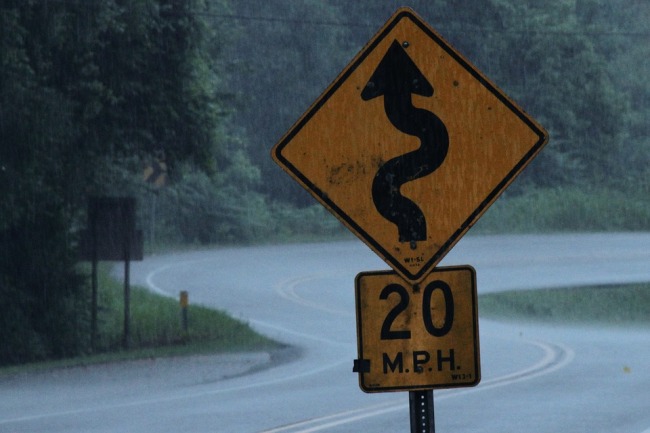
Crashes increase when speed limits dip far below engineering recommendation: Study
New York, Dec 26 (IBNS): Speed limits set only five miles per hour below engineering recommendations produce a statistically significant decrease in total, fatal and injury crashes, and property-damage-only crashes, according to a group of Penn State researchers.
"If (however) you lower the speed limit by 10, 15, 25 miles per hour, or more, drivers stop paying attention," said Vikash Gayah, assistant professor of civil engineering. "We found there was an increase in fatal and injury crashes at locations with posted speed limits set 10 miles per hour or more below engineering recommendations."
Speed limits are normally set based on results from engineering studies that collect free-flow traffic data and then select an appropriate speed using a statistical model. However, factors such as school zones, citizen or political pressure, and perceived safety issues contribute to the fairly common practice of lowering speed limits below engineering guidelines, the researchers report in Accident Analysis and Prevention.
"When doing speed research, we are looking at free-flow speeds — the speed that drivers select based on geometric and prevailing weather conditions," said Gayah.
The team of researchers collected speed data on three different occasions from 12 roadway segments in Montana, a state that posts speed limits lower than engineers advise. Eight of the 12 sites had posted speed limits changed below engineering recommendations either by 5 mph, 10 mph, 15 mph, or 25 mph. The other four sites had posted speed limits set equal to engineering recommendations and served as comparison locations.
Each period of data collection considered either the presence of no law enforcement, light law enforcement, or heavy law enforcement.
Speed data was collected in daylight hours and in fair weather conditions using hidden pavement sensors. Large vehicles, such as trucks, and cars traveling too close together were excluded. Cars traveling less than 10 mph of the posted speed or greater than 20 mph of the posted speed limit, known as speed outliers, were also excluded. Crash history data from a four-year period before and after speed limits changed was also used in the analysis.
The researchers found that vehicles were two times more likely to obey the speed limit at locations with higher posted speed limits set at 50 mph or 55 mph compared to the base case of less than 50 mph, and four times more likely to obey when the posted speed limit was between 60 and 70 mph.
The presence of heavy law enforcement in zones with low posted speed limits showed an average reduced speed of 4 mph and greater speed-limit compliance.
"The practice of setting speed limits lower than what would be recommended from an engineering study is okay if it's only by a little — by five miles per hour," said Gayah.
Such a difference showed an increase in speed-limit compliance, a decrease in property damage only, and total, fatal and injury crashes. Larger differences between the posted and engineering-recommended speed-limit values were found to increase crash frequency and reduce speed limit compliance.
Other researchers included Eric T. Donnell, professor of civil engineering and director of the Larson Transportation Institute at Penn State; and Zhengyao Yu and Lingyu Li, graduate students in civil engineering.
The Montana Department of Transportation and the Federal Highway Administration supported this work.
Support Our Journalism
We cannot do without you.. your contribution supports unbiased journalism
IBNS is not driven by any ism- not wokeism, not racism, not skewed secularism, not hyper right-wing or left liberal ideals, nor by any hardline religious beliefs or hyper nationalism. We want to serve you good old objective news, as they are. We do not judge or preach. We let people decide for themselves. We only try to present factual and well-sourced news.
Support objective journalism for a small contribution.