


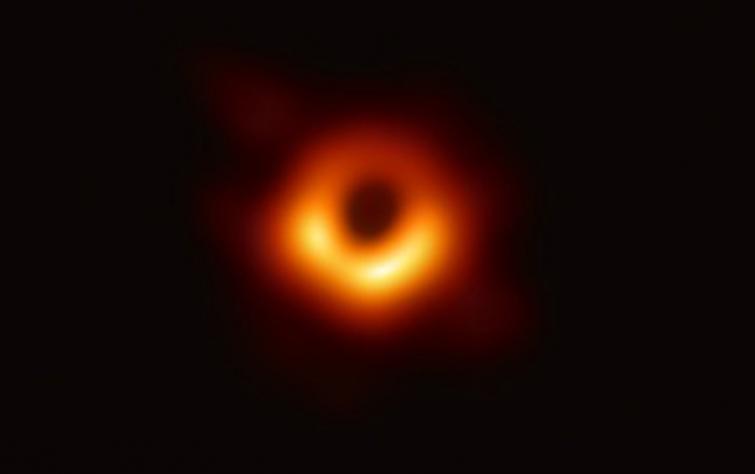
Canada: NASA astronomers capture first image of black hole in Messier 87
New York, Apr 10 (IBNS): The National Aeronautics and Space Administration (NASA) researchers on Wednesday revealed in coordinated press conferences across the globe, their success in unveiling the first direct visual evidence of a supermassive black hole and its shadow in Messier 87, NASA reports said.
Supermassive black holes have masses ranging from millions to billions of solar masses and appear to be in the center of almost all galaxies.
This breakthrough was announced in a series of six papers published in a special issue of The Astrophysical Journal Letters. The image reveals the black hole at the center of Messier 87, a massive galaxy in the nearby Virgo galaxy cluster.
This black hole resides 55 million light-years from Earth and has a mass 6.5-billion times that of the Sun.
"This is a huge day in astrophysics," said NSF Director France Córdova. "We're seeing the unseeable. Black holes have sparked imaginations for decades. They have exotic properties and are mysterious to us. Yet with more observations like this one they are yielding their secrets. This is why NSF exists. We enable scientists and engineers to illuminate the unknown, to reveal the subtle and complex majesty of our universe."
Key funding was provided by the US National Science Foundation (NSF) -- funded more than $28 million in EHT research -- the EU's European Research Council (ERC), and funding agencies in East Asia.
The presence of these black holes -- extraordinary cosmic objects -- affects their environment in extreme ways, warping spacetime and super-heating any surrounding material.
"This shadow, caused by the gravitational bending and capture of light by the event horizon, reveals a lot about the nature of these fascinating objects and allowed us to measure the enormous mass of M87's black hole," said Heino Falcke, chair of the EHT Science Council.
The Event Horizon Telescope (EHT) -- a planet-scale array of eight ground-based radio telescopes forged through international collaboration -- was designed to capture images of a black hole.
Challenging work of creating the EHT represent the culmination of decades of observational, technical, and theoretical work and required upgrading and connecting a worldwide network of eight pre-existing telescopes deployed at a variety of high-altitude sites which included volcanoes in Hawai`i and Mexico, mountains in Arizona and the Spanish Sierra Nevada, the Chilean Atacama Desert, and Antarctica.
"Many of the features of the observed image match our theoretical understanding surprisingly well," said Paul T.P. Ho, EHT Board member and Director of the East Asian Observatory. "This makes us confident about the interpretation of our observations, including our estimation of the black hole's mass."
"We have achieved something presumed to be impossible just a generation ago," concluded Doeleman. "Breakthroughs in technology, connections between the world's best radio observatories, and innovative algorithms all came together to open an entirely new window on black holes and the event horizon."
Scientists have obtained the first image of a black hole, using Event Horizon Telescope observations of the center of the galaxy M87. The image shows a bright ring formed as light bends in the intense gravity around a black hole that is 6.5 billion times more massive than the Sun pic.twitter.com/AymXilKhKe
— Event Horizon 'Scope (@ehtelescope) April 10, 2019
“We’ve been studying black holes so long, sometimes it’s easy to forget that none of us have actually seen one,” France Cordova, director of the National Science Foundation, said in the Washington, D.C., news conference. Seeing one “is a Herculean... https://t.co/why1PXiWAb
— FacebookNewseXchange (@FNX_PH) April 10, 2019
"We have achieved something presumed to be impossible just a generation ago," concluded EHT project director Sheperd S. Doeleman. #RealBlackHole 1/2
— ESO (@ESO) April 10, 2019
"What we see is larger than the size of our entire Solar System," Prof Heino Falcke says. He had the idea for the project when he was a PhD student in 1993. At the time, no-one thought it was possible. https://t.co/lSvE4NcYlH
— Henrik Hindby (@HenrikHindby) April 10, 2019
Many of the features of the observed image match our theoretical understanding surprisingly well," remarks Paul T.P. Ho, EHT Board member... "This makes us confident about the interpretation of our observations, including our estimation of the BH’s mass." https://t.co/q0rc4RVtlj
— cédric bardot (@bardot_cedric) April 10, 2019
(Reporting by Asha Bajaj)
Image: Black Hole/NASA
Support Our Journalism
We cannot do without you.. your contribution supports unbiased journalism
IBNS is not driven by any ism- not wokeism, not racism, not skewed secularism, not hyper right-wing or left liberal ideals, nor by any hardline religious beliefs or hyper nationalism. We want to serve you good old objective news, as they are. We do not judge or preach. We let people decide for themselves. We only try to present factual and well-sourced news.
Support objective journalism for a small contribution.


