


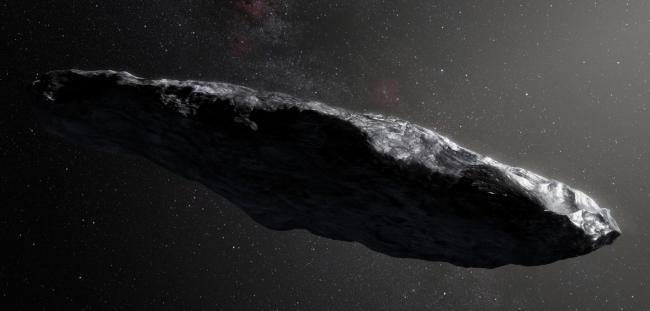
Alien object 'oumuamua' was a natural body visiting from another solar system-Queen's scientist
Washington, Dec 19 (IBNS): Scientists at Queen’s have led worldwide investigations into a mysterious object that passed close to Earth after arriving from deep interstellar space.
Since the object was spotted in October, Professor Alan Fitzsimmons and Dr Michele Bannister from the School of Mathematics and Physics at Queen’s University have led an international team of astronomers to piece together a profile of the strange visitor, which has been named `Oumuamua.
The team was made up of researchers from elsewhere in the UK, the US, Canada, Taiwan and Chile and in total seven researchers from Queen’s were involved.
Professor Alan Fitzsimmons headed up a team which measured the way that `Oumuamua, reflects sunlight, and found it similar to icy objects covered with a dry crust. This is because `Oumuamua has been exposed to cosmic rays for millions, or even billions, of years, creating an insulating organic-rich layer on its surface.
The research, which has been published this week in Nature Astronomy, suggests that `Oumuamua’s dry crust could have protected its icy interior from being vaporised – even though the object was just 23 million miles from our sun in September when it zipped past.
Professor Alan Fitzsimmons commented: “We have discovered that the surface of `Oumuamua is similar to small solar system bodies that are covered in carbon-rich ices, whose structure is modified by exposure to cosmic rays.
“We have also found that a half-metre thick coating of organic-rich material could have protected a water-ice-rich comet-like interior from vaporizing when the object was heated by the sun, even though it was heated to over 300 degrees centigrade.”
Dr Michele Bannister and her team observed `Oumuamua while it was still within reach of the largest telescopes in the world and their findings are being published in Astrophysical Journal Letters today.They found the object was the same colour as some of the icy minor planets they had been studying in the outskirts of our solar system. This implies that different planetary systems in our galaxy contain minor planets like our own.
Working together, the researchers have been able to uncover some very important facts about `Oumuamua.
Dr Michele Bannister said: “We’ve discovered that this is a planetesimal with a well-baked crust that looks a lot like the tiniest worlds in the outer regions of our solar system, has a greyish/red surface and is highly elongated, probably about the size and shape of the Gherkin skyscraper in London.
“It’s fascinating that the first interstellar object discovered looks so much like a tiny world from our own home system. This suggests that the way our planets and asteroids formed has a lot of kinship to the systems around other stars.”
She added: “We are continuing our research into `Oumuamua and are hopeful that we will make more discoveries in the near future. Discoveries like this really help to give a little more insight into what’s out there and encourages people to look up and wonder.”
Image: Queen’s University website
Support Our Journalism
We cannot do without you.. your contribution supports unbiased journalism
IBNS is not driven by any ism- not wokeism, not racism, not skewed secularism, not hyper right-wing or left liberal ideals, nor by any hardline religious beliefs or hyper nationalism. We want to serve you good old objective news, as they are. We do not judge or preach. We let people decide for themselves. We only try to present factual and well-sourced news.
Support objective journalism for a small contribution.


