'Words must never be met with violence' urges UN, following Taliban threat to journalists
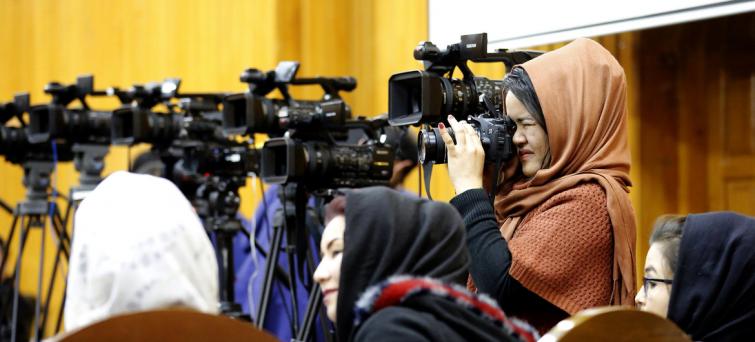
New York, June 28 (IBNS): Following last week’s public threats by Taliban militants to deliberately target media outlets in Afghanistan, the United Nations mission chief in the country reiterated his call on Thursday for journalists’ rights to be protected, underlining the power of press freedom to advance peace, justice and human rights.
Noting that “words must never be met with violence”, Tadamichi Yamamoto, Special Representative for Afghanistan and head of the UN Assistance Mission in Afghanistan (UNAMA), called on the threat to be rescinded, adding that “the only acceptable challenge to words is to advance a better argument”.
Yamamoto underlined that “international humanitarian law - which applies to all parties to the conflict in Afghanistan, including the Taliban - prohibits attacks against civilians at any time and in any place”.
And affirming that media workers are also civilians, he highlighted the importance of protecting their “fundamental rights to operate in an environment free from any threat, intimidation or undue pressure by any outside entity, including governments”.
The UNAMA’s chief’s statement, in response to the public threats by Taliban to turn media outlets into military targets, highlighted two fundamental principles: that freedom of the press is critical, and that civilians should never be deliberately targeted with violence.
In the context of repeated threats by the Taliban, Yamamoto said that “press freedom in Afghanistan is earned at an unbearable cost”. The United Nations recognizes that Afghanistan is one of the most dangerous places for journalists to work. Official figures from cultural agency UNESCO’s observatory of killed journalists, shows that 16 died last year, and four so far this year.
The most recent UN report on protection of civilians during conflict in Afghanistan, shows that over 3,800 civilian women, children and men were killed over the 12-month reporting period.
Congratulating Afghanistan’s media workers for their reporting and continuing with their duties in the face of escalating threats, Yamamoto added that the UN “remains steadfast in collaborating with national and international partners to protect journalists and to fight against impunity”.
He also reiterated the UN’s support to the Afghan government, “consistent with its international human rights obligations, to implement measures that improve journalist safety and that foster an open media, where no voice is silenced through fear.”
A new presidential election is scheduled for 28 September, which will be a “key moment to reaffirm the legitimacy of Afghanistan’s democratic political structure”, Yamamoto told the Security Council last week.
Last Wednesday, UNAMA’s chief told the UN Security Council he was “encouraged” by signs of progress during international mediation efforts which could lead to a lasting political settlement between the Afghan Government and the fundamentalist Taliban movement, which controlled the country prior to the 2001 invasion by coalition forces.  
UNAMA/Fardin Waezi
Support Our Journalism
We cannot do without you.. your contribution supports unbiased journalism
IBNS is not driven by any ism- not wokeism, not racism, not skewed secularism, not hyper right-wing or left liberal ideals, nor by any hardline religious beliefs or hyper nationalism. We want to serve you good old objective news, as they are. We do not judge or preach. We let people decide for themselves. We only try to present factual and well-sourced news.
Support objective journalism for a small contribution.