


Venezuela: Competing US, Russia resolutions fail to pass in Security Council
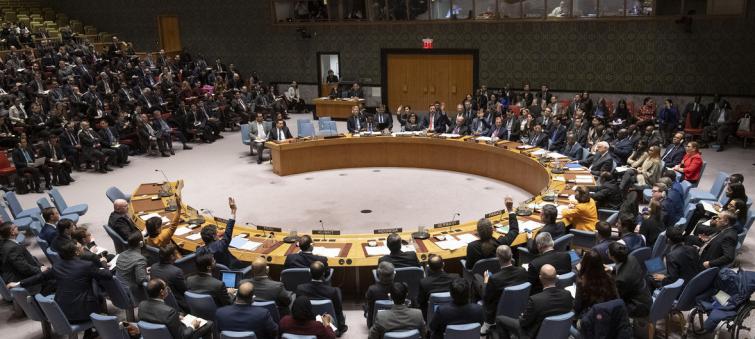
New York, Mar 1 (IBNS): The second meeting of the week on the situation in Venezuela, took place in the UN Security Council on Thursday, during which competing resolutions produced by the United States and by Russia were presented. Neither text was adopted as the US draft was vetoed and the Russian draft failing to secure enough votes in favor.
It was the third Council meeting seeking solutions to Venezuela’s “protracted crisis” since tensions started escalating in January, when Juan Guaidó, head of the country’s National Assembly, challenged the legitimacy of the sitting President, Nicolás Maduro, who has been in power since 2013 and who was sworn in again for a second term, on 10 January.
The 15 members of the Council have been divided between those who are firmly supporting Maduro arguing that he is the legitimate elected president and those who support Mr. Guaidó’s claim, backed by calls for a fresh round of voting.
The US draft resolution called for the holding of new elections and a recognition of self-proclaimed interim President Guaidó. Nine voted in favour (Germany, Poland, Peru, US, United Kingdom, France, Belgium, Dominican Republic, Kuwait), three against (Russia, China, South Africa) and there were three abstentions (Equatorial Guinea, Indonesia, Côte d’Ivoire).
“The Situation in Venezuela demands our action now,” the United States Special Representative for Venezuela, Elliot Abrams, told the Council. “The time for a peaceful transition to democracy is now…We look forward to genuine free and fair elections and to a Government that reflects the will and aspirations of the Venezuelan people”.
Russia’s draft called for a dialogue between the Government and the opposition, in line with the Montevideo mechanism – a forum for talks, launched by Mexico and Uruguay earlier this February. The text produced four votes in favour (Russia, China, South Africa, Equatorial Guinea), seven against (Germany, Poland, Peru, US, United Kingdom, France, Belgium) and four abstentions (Côte d’Ivoire, Dominican Republic, Indonesia, Kuwait).
“We drafted an alternative draft resolution, the aim of which is not to incite political intrigues and regime change but rather to genuinely help the Venezuelan people in efforts to normalize the situation in the country,” said Russian Ambassador, Vassily Nebenzia.
On Tuesday, the UN’s political and peacebuilding chief, Rosemary DiCarlo, briefed the Security Council, describing the “grim reality” facing the country.
As tensions continue to escalate, the UN humanitarian coordination office (OCHA) has been documenting the humanitarian crisis in the country: infant mortality has increased by more than 50 per cent since 2017; four in five hospitals lack the necessary medicines and staff to be operational. To date, the UN refugee and migration agencies (UNHCR and IOM, respectively), estimate that the number of Venezuelans to have fled their country stands at 3.4 million.
Following recent violence by Government forces during demonstrations at border crossings with Brazil and Colombia and other parts of the country, the UN human rights office (OHCHR) denounced excessive use of force which led to the death of several civilians.
Image Credit: UN Photo/Evan Schneider
Support Our Journalism
We cannot do without you.. your contribution supports unbiased journalism
IBNS is not driven by any ism- not wokeism, not racism, not skewed secularism, not hyper right-wing or left liberal ideals, nor by any hardline religious beliefs or hyper nationalism. We want to serve you good old objective news, as they are. We do not judge or preach. We let people decide for themselves. We only try to present factual and well-sourced news.
Support objective journalism for a small contribution.


