US, three other allies target China over Hong Kong national security law
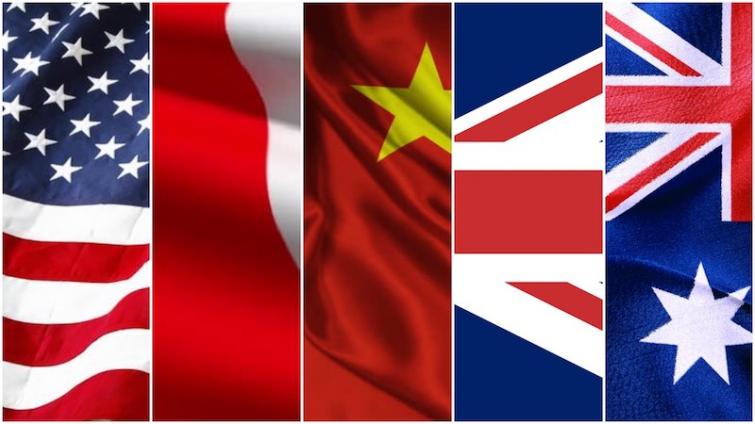
Washington: China's decision to impose the new national security law on Hong Kong has earned criticisms from the United States and its three major allies.
In a joint statement, the US, UK, Canada and Australia, said: "Direct imposition of national security legislation on Hong Kong by the Beijing authorities, rather than through Hong Kong’s own institutions as provided for under Article 23 of the Basic Law, would curtail the Hong Kong people’s liberties, and in doing so, dramatically erode Hong Kong’s autonomy and the system that made it so prosperous."
"China’s decision to impose the new national security law on Hong Kong lies in direct conflict with its international obligations under the principles of the legally-binding, UN-registered Sino-British Joint Declaration," read the statement.
The countries said the proposed law would undermine the 'One Country, Two Systems' framework.
"It also raises the prospect of prosecution in Hong Kong for political crimes, and undermines existing commitments to protect the rights of Hong Kong people – including those set out in the International Covenant on Civil and Political Rights and the International Covenant on Economic, Social and Cultural Rights," read the statement.

The statement further said: "As Hong Kong’s stability and prosperity are jeopardised by the new imposition, we call on the Government of China to work with the Hong Kong SAR Government and the people of Hong Kong to find a mutually acceptable accommodation that will honour China’s international obligations under the UN-filed Sino-British Joint Declaration."
China's parliament on Thursday backed a new security bill meant to bring about tighter control over Hong Kong, which underlines that anyone who undermines Beijing's authority in the territory will be treated as a criminal and his/her action will be deemed crime against the state.
The new bill has caused deep concern among those who say it could end Hong Kong's unique status.
It could also see China installing its own security agencies in the region for the first time, the BBC reported.
The move has already sparked a new wave of anti-mainland protest.
Clashes broke out on Wednesday as Hong Kong's parliament debated a different proposed law, which would make it a crime to disrespect the Chinese national anthem. Hundreds of people were arrested in protests over that and the security law.
The new law means that Hong Kong no longer merited being treated differently from the mainland under US law.
The declaration could have major implications for Hong Kong's trade hub status as well.
The United States-Hong Kong Policy Act, or more commonly known as the Hong Kong Policy Act or Hong Kong Relations Act, is a 1992 act formulated by the United States Congress that allows the United States to continue to treat Hong Kong separately from Mainland China for matters concerning trade export and economics control after the 1997 handover.
The Act was amended on Nov 27, 2019 by the Hong Kong Human Rights and Democracy Act.
On May 27, 2020, US Secretary of State Mike Pompeo declared Hong Kong "no longer autonomous", putting its special designation into uncertainty.
Support Our Journalism
We cannot do without you.. your contribution supports unbiased journalism
IBNS is not driven by any ism- not wokeism, not racism, not skewed secularism, not hyper right-wing or left liberal ideals, nor by any hardline religious beliefs or hyper nationalism. We want to serve you good old objective news, as they are. We do not judge or preach. We let people decide for themselves. We only try to present factual and well-sourced news.
Support objective journalism for a small contribution.