


 US
US immigration crackdown leaves 1,389 unaccompanied Indian children in custody since 2023
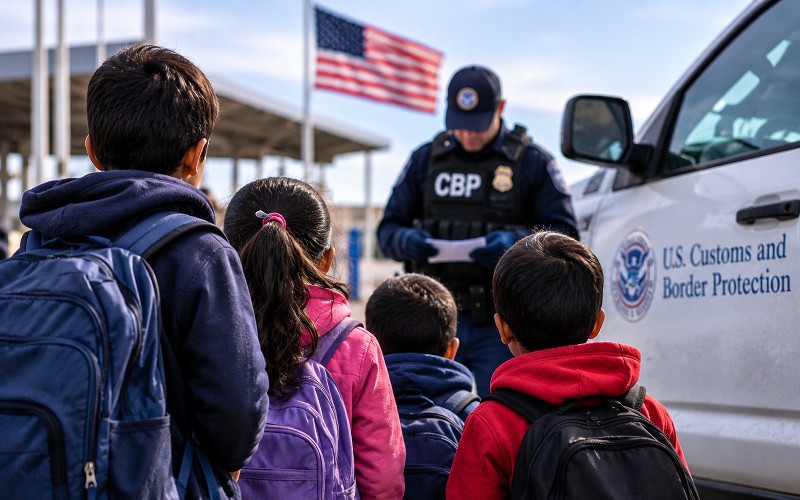
The United States has taken 1,389 unaccompanied Indian children into custody since the beginning of the 2023 financial year, as the country’s increasingly stringent immigration enforcement has coincided with a sharp decline in the number of minors arriving without parents or legal guardians.
None of the 1,389 children has been repatriated to India, according to the figures cited in the report.
Data from US Customs and Border Protection (CBP) show that the number of unaccompanied Indian children encountered by American authorities has fallen significantly over the past four financial years.
The agency recorded 730 such children in FY23, followed by 517 in FY24, 91 in FY25 and 51 in FY26.
Only two unaccompanied Indian children were recorded in October 2026, the first month of the US financial year 2027.
Sharp decline in child arrivals
The decline in the number of Indian minors mirrors a broader reduction in unaccompanied children entering US custody, regardless of nationality.
American authorities recorded approximately 110,000 unaccompanied children in FY24.
The figure dropped to 29,584 in FY25 and fell further to 9,190 in FY26. In October 2026, authorities encountered 722 unaccompanied children of all nationalities.
The figures indicate a substantial fall in the number of minors reaching the US without parents or legal guardians during a period of intensified immigration enforcement.
People familiar with immigration networks in the US said stricter border controls and faster deportation procedures could partly explain the decline.
They also pointed to changing patterns in the use of minors by migrant families seeking to establish a foothold in the country.
Concerns over use of minors
According to people familiar with the networks, some parents or relatives had allegedly relied on children entering the US alone to strengthen their prospects of securing legal immigration status.
Minors were sometimes described as 'green card bringers' because their presence could potentially help family members pursue legal residency through immigration provisions.
However, the practice is reportedly becoming less common as US authorities intensify enforcement and move more quickly against people found entering or staying in the country unlawfully.
The reported shift has also heightened anxiety among some Indian families whose children are already living in the US without legal immigration status.
Indian teenager fears deportation
A businessman from Kadi in Gujarat, who was deported from the US in 2012, said his 17-year-old son was increasingly afraid of attending asylum hearings.
The teenager has reportedly been living in Texas since he was 12.
His father said the boy feared that appearing before immigration authorities could lead to his detention and deportation to India.
“He thinks he will be caught and deported to India. He has been secretly working at a gas station and living with members of a religious sect,” the businessman said.
The account illustrates the uncertainty faced by some Indian minors who remain in the US while their immigration cases are pending.
Indians among top nationalities
The fall in the number of unaccompanied Indian children comes even as Indian nationals continue to account for a significant share of people encountered while attempting to enter the US unlawfully.
CBP recorded 30,528 encounters involving Indian nationals in FY26, placing India third among 21 countries in the reported ranking.
Mexico and Canada were ahead of India.
The figures cover encounters with Indian nationals and are distinct from the data on unaccompanied minors.
They underline the continued presence of Indian migrants in US border enforcement statistics even as the number of children arriving without accompanying adults has fallen sharply.
Support Our Journalism
We cannot do without you.. your contribution supports unbiased journalism
IBNS is not driven by any ism- not wokeism, not racism, not skewed secularism, not hyper right-wing or left liberal ideals, nor by any hardline religious beliefs or hyper nationalism. We want to serve you good old objective news, as they are. We do not judge or preach. We let people decide for themselves. We only try to present factual and well-sourced news.
Support objective journalism for a small contribution.