UN Member States overwhelmingly support end of US embargo against Cuba
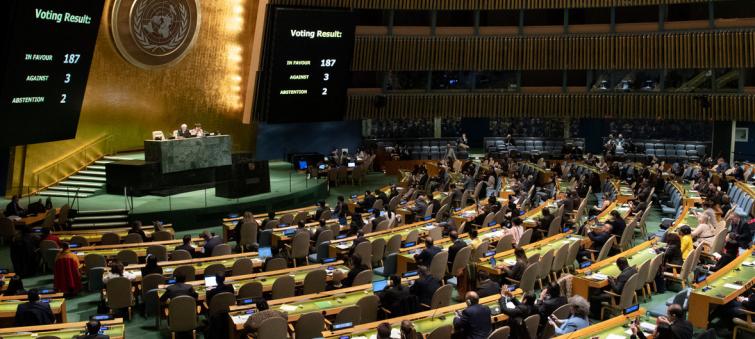
New York/IBNS: For the 28th consecutive year, the UN General Assembly has adopted a resolution calling for an end to the economic, commercial and financial embargo imposed by the United States against Cuba.
During a vote held on Wednesday, 187 Member States underlined their support for the resolution while Brazil and Israel joined the US in voting no.
Two countries—Colombia and Ukraine—abstained.
“Like all nations, we get to choose which countries we trade with. This is our sovereign right,” Kelly Craft, the US Ambassador to the UN, said prior to the vote.
“So, it is worrying that the international community, in the name of protecting sovereignty, continues to challenge this right.”
Blockade ‘an act of genocide’: Cuban Foreign Minister
The embargo is rooted in the Cold War, when Fidel Castro and his revolutionaries seized power.
Tensions only eased more than a half-century later when the Obama administration established diplomatic relations with Cuba, modifying several aspects of the embargo such as lifting some travel restrictions.
As the resolution states, these policies “contrast” with measures implemented by the current President, Donald Trump, in 2017.
Cuba’s Foreign Minister, Bruno Rodríguez Parrilla, reported that in recent months Washington has begun to “escalate aggression”, including by preventing international fuel shipments to the island, scaling down consular services, and attacking national programmes that support other developing countries.
“The blockade has caused incalculable humanitarian damages. It is a flagrant, massive and systematic violation of human rights,” he charged. “It qualifies as an act of genocide under Articles II (b) and (c) of the Convention on the Prevention and Punishment of the Crime of Genocide, adopted in 1948. There is not one single Cuban family that has not suffered the consequences of this.”
The vote was preceded by presentations, which began on Tuesday.
Palestine, speaking on behalf of the developing countries’ bloc the Group of 77 and China, regretted that the US has strengthened the embargo.
“From April 2018 to March this year, the impact of the US embargo on Cuba’s foreign trade amounts to more than $4 billion,” Ambassador Riyad Mansour said. “Limited foreign investment and difficult access to development credits translate directly into economic hardship and humanitarian impacts for the people Cuba. The country’s socio-economic reforms have also been hampered by the embargo.”
Embargo threatens our development: Caribbean countries
The 15 members of the Caribbean Community (CARICOM) highlighted Havana’s support to the region. Cuba has deployed medical professionals to distressed areas, including those affected by natural disasters, among other initiatives.
Keisha McGuire, Grenada’s Ambassador to the UN, recalled that the country was among the first to assist The Bahamas in the aftermath of Hurricane Dorian in September.
She characterized the embargo as “an anachronism and aberration” in an era when global cooperation is critical to address common challenges such as climate change.
“It is in this broader context that we view the embargo—not just as a punitive act against Cuba but as an impediment to Caribbean regional development as a whole,” she told the General Assembly.
Photo caption and credit:
UN Photo/Evan Schneider
UN General Assembly votes on the necessity of ending the economic, commercial and financial embargo imposed by the United States against Cuba.
Support Our Journalism
We cannot do without you.. your contribution supports unbiased journalism
IBNS is not driven by any ism- not wokeism, not racism, not skewed secularism, not hyper right-wing or left liberal ideals, nor by any hardline religious beliefs or hyper nationalism. We want to serve you good old objective news, as they are. We do not judge or preach. We let people decide for themselves. We only try to present factual and well-sourced news.
Support objective journalism for a small contribution.