


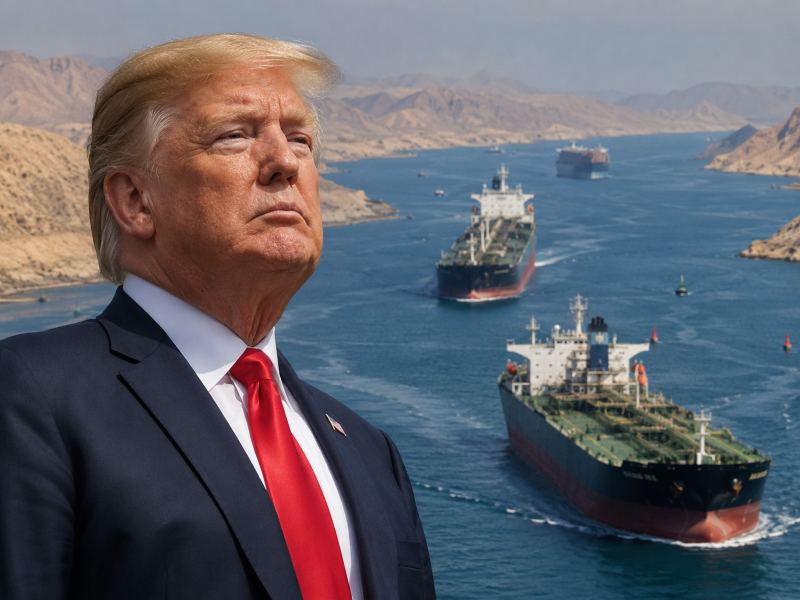
Trump drops 20% Hormuz cargo fee plan, bets on Gulf investment deals instead
US President Donald Trump on Tuesday scrapped his proposal to impose a 20 per cent reimbursement fee on all cargo passing through the Strait of Hormuz, saying it would instead be replaced by trade and investment agreements with Gulf nations.
In a post on Truth Social, Trump said the decision followed "highly productive conversations" with leaders in the Middle East.
"Based on highly productive conversations with Middle East leadership, I have decided to replace the 20% United States Reimbursement Fee with Trade and Investment Deals that the various Gulf States will be making into the United States," Trump wrote.
He added that the investments would be "massive" and the agreements would be "extraordinarily good" for the Gulf countries, while boosting the US economy through new factories, industrial plants and equipment that would create high-paying jobs.
From cargo levy to investment strategy
The announcement marks a sharp reversal from Trump's statement a day earlier, when he declared that the United States would charge a 20 per cent fee on all cargo transiting the Strait of Hormuz.
Calling the US the "Guardian of the Hormuz Strait", Trump had argued that Washington deserved compensation for ensuring the security of one of the world's busiest maritime routes.
He had also said the US would reinstate a blockade aimed at preventing Iranian vessels from entering or leaving the country.
The Strait of Hormuz is one of the world's most strategically important shipping lanes, carrying roughly one-fifth of global oil and liquefied natural gas supplies.
The waterway has remained at the centre of heightened tensions since Iran imposed a blockade following the US-Israeli strikes on Tehran on February 28, which killed then-Supreme Leader Ali Khamenei and escalated the regional conflict.
Iran rejects Trump's claim
Iran swiftly rejected Trump's assertion that the US is the protector of the Strait of Hormuz.
Foreign Minister Seyed Abbas Araghchi said Tehran—not Washington—has historically ensured the security of the strategic waterway.
Posting on X, Araghchi wrote that while commercial vessels should be compensated for safe passage, "Iran has always been the GUARDIAN of the Strait and will remain so FOREVER."
POTUS is absolutely right. Whoever provides secure and safe passage of commercial vessels through the Strait of Hormuz should be compensated for this service.
— Seyed Abbas Araghchi (@araghchi) July 13, 2026
Iran has always been the GUARDIAN of the Strait and will remain so FOREVER.
20% is of course too much. We will be fair
In a pointed swipe at Trump's earlier proposal, he added that a 20 per cent fee was excessive, saying, "20 per cent is of course too much. We will be fair."
Regional tensions remain high
Trump's latest announcement signals a shift from imposing direct shipping charges to pursuing economic partnerships with Gulf states.
However, the dispute over who controls and secures the Strait of Hormuz underscores the continuing geopolitical tensions surrounding one of the world's most critical energy corridors.
Support Our Journalism
We cannot do without you.. your contribution supports unbiased journalism
IBNS is not driven by any ism- not wokeism, not racism, not skewed secularism, not hyper right-wing or left liberal ideals, nor by any hardline religious beliefs or hyper nationalism. We want to serve you good old objective news, as they are. We do not judge or preach. We let people decide for themselves. We only try to present factual and well-sourced news.
Support objective journalism for a small contribution.


