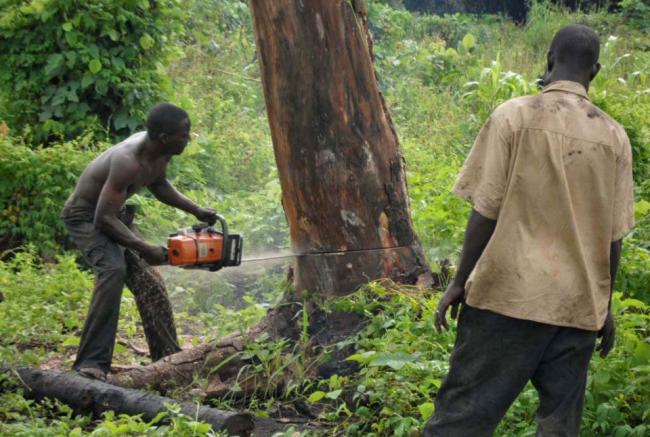
Trees contribute to reducing carbon footprints even after being cut down – UN report
“Forests are at the heart of the transition to low-carbon economies, not only because of their double role as sink and source of emissions, but also through the wider use of wood products to displace more fossil fuel intense products,” the Assistant Director-General for Forestry at the UN Food and Agriculture Organization (FAO), René Castro-Salazar, said from Rome, where she is participating in the UN agency's World Forest Week.
According to FAO, the report – Forestry for a Low-carbon Future: Integrating forests and wood products in climate change strategies – is aimed at highlighting a “virtuous cycle” that exploits the life-cycle of wood products to boost the ability of forests to remove and store carbon from the atmosphere.
Trees lock carbon in their leaves, branches and soils, while deforestation and forest degradation account for up to 12 per cent of worldwide gas emissions.
Promoting wood as a renewable energy source may seem counter-intuitive, but 1.86 billion cubic metres of wood – more than half the world's wood output – is already used for that purpose, according to the report.
More directly, when wood is transformed into furniture, floors, doorways or beams to be used in construction, it does not instantly oxidize but continues to store the carbon it took in as a tree.
So the framing in a house might store carbon for up to 100 years, a dining room table less than 30, and paper a few years. The carbon is only released back into the atmosphere when the wood product is burnt or decays.
The report – the end result of collaboration among more than 100 experts – was designed primarily for policy-makers and experts, but is also tailored for architects and the energy industry.
Its guiding message is that optimal engineering of the carbon life-cycle of trees and wood products allows over the long-term – through technological advances and cleaner, greener methods of processing, the industrial use of wood – for sustainably harvested forests to complement and even enhance the climate mitigation benefits provided by conserved forests.
Photo: IRIN/Charles Akena
Source: www.justearthnews.com
Support Our Journalism
We cannot do without you.. your contribution supports unbiased journalism
IBNS is not driven by any ism- not wokeism, not racism, not skewed secularism, not hyper right-wing or left liberal ideals, nor by any hardline religious beliefs or hyper nationalism. We want to serve you good old objective news, as they are. We do not judge or preach. We let people decide for themselves. We only try to present factual and well-sourced news.
Support objective journalism for a small contribution.