Support stepped up for Rohingya camps as first COVID-19 infections are confirmed
New York/IBNS: After confirmation that the first cases of COVID-19 infection have been identified in a vast and overcrowded refugee camp in Bangladesh, UN humanitarians on Friday announced additional measures and appealed for funds to prevent the disease from spreading.
In Geneva, UN refugee agency (UNHCR) spokesperson Andrej Mahecic relayed Government confirmation that one Rohingya refugee had tested positive for the new coronavirus, in the Kutapalong settlement in Cox’s Bazar, along with an individual from the local Bangladeshi host community.
“There are serious concerns about the potentially severe impact of the virus in a densely populated refugee settlement, sheltering some 860,000 Rohingya refugees”, he said, speaking via videconference. “Another 400,000 Bangladeshis live in the surrounding host communities. These populations are considered to be among the most at risk globally in this pandemic.”
Concerted UN action
UN agencies have already put in place a series of concerted COVID-19 contingency measures in Cox’s Bazar, including the International Organization for Migration (IOM).
It has provided upgraded triage areas in 35 primary care facilities along with three isolation and treatment centres. Also nearing completion is a quarantine centre, large enough to accommodate 465 people and 250 beds for people suffering from severe acute respiratory infection.
Although the arrival of the pandemic was expected, it adds further pressure on extremely vulnerable individuals preparing for the approaching monsoon season.
Grim anniversary for Rohingya
This coming August marks three years since the mainly ethnic Rohingya in Cox’s Bazar fled violent persecution in neighbouring Myanmar’s Rakhine state.
Last year, 16,000 people were affected in a single 24-hour period during one of the heaviest downpours.
To help, the World Food Programme (WFP) is busy clearing drains and stabilising slopes that have the potential to give way in heavy rain.
The agency has warned that COVID-19 threatens to reverse development gains made by Bangladesh in the last 50 years and has appealed for $320 million to help the most vulnerable.
$320 million needed for Rohingya, struggling Bangladeshis
Some $200 million of this funding is required for the agency’s COVID-19 response in Bangladesh and the remaining $120 million is needed to help the mainly-Muslim ethnic Rohingya for the next six months.
“Lockdowns and restrictions in movement are affecting livelihoods of millions across Bangladesh, especially daily wage earners like rickshaw drivers, day labourers who now find themselves unable to meet their basic needs”, said WFP spokesperson Elisabeth Byrs.
Under WFP’s scheme, the funding will ensure food security for families in rural areas and urban slums, as well as day labourers.
In the meantime, the agency has maintained national distributions of fortified rice, cash transfers and nutrition programmes, to complement Government assistance.
It has also begun building storage areas for food and non-food items necessary for the COVID-19 response, including personal protective equipment, and is helping other humanitarian agencies by moving supplies into and around Bangladesh.
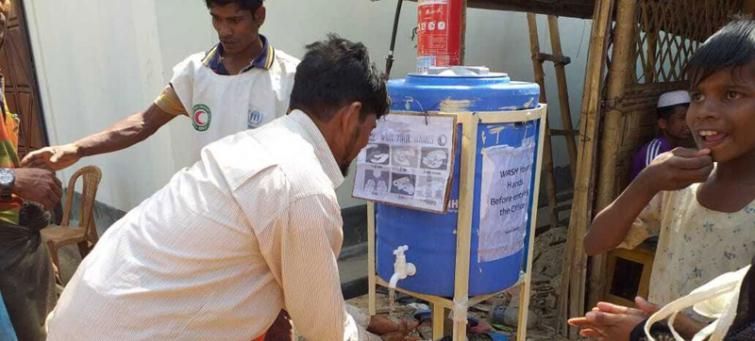
Photo caption and credit: UNHCR Rohingya refugees use a handwashing station, installed to help combat the spread of COVID-19 at a settlement in Cox's Bazar, Bangladesh.
Support Our Journalism
We cannot do without you.. your contribution supports unbiased journalism
IBNS is not driven by any ism- not wokeism, not racism, not skewed secularism, not hyper right-wing or left liberal ideals, nor by any hardline religious beliefs or hyper nationalism. We want to serve you good old objective news, as they are. We do not judge or preach. We let people decide for themselves. We only try to present factual and well-sourced news.
Support objective journalism for a small contribution.