


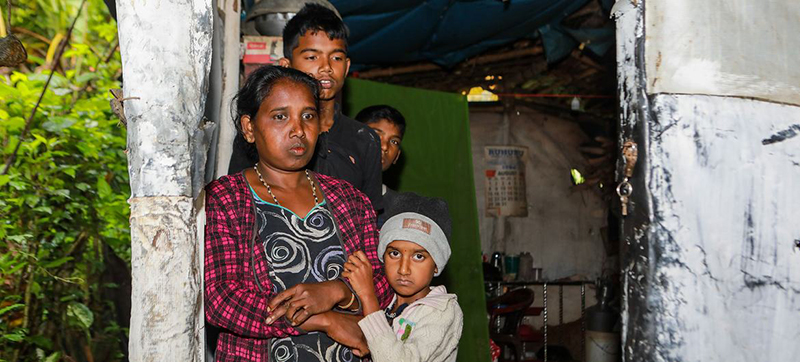
 Sri Lankan Children
Sri Lanka: Devastating crisis for children, a ‘cautionary tale’ for South Asia
New York: Staple foods have become unaffordable, warned UNICEF Regional Director for South Asia, George Laryea-Adjei on Friday, who pointed out that severe malnutrition in crisis-wracked Sri Lanka was already among the highest in the region.
The alert from the UN Children’s Fund, comes as Sri Lanka continues to suffer its worst financial slump since independence in 1948.
Mr. Laryea-Adjei reports that, “families are skipping regular meals as staple foods become unaffordable. Children are going to bed hungry, unsure of where their next meal will come from.”
Mass food insecurity will only further promote malnutrition, poverty, disease and death in the region, he added.
Nascent food insecurity has compounded the social issues already plaguing the nation. The UN estimates that half of children in Sri Lanka already require some form of emergency assistance.
Education, one sector slammed by the economic crisis, has seen decreased student enrollment and a deficit in resources, in addition to commutes made dangerous by outdated infrastructure.
Increase in abuse
Mr. Laryea-Adjei further revealed that, “reports are already emerging of an increase in abuse, exploitation and violence against children due to the mounting economic pressure.”
Similarly, in Sri Lanka, there are already over 10,000 children in institutional care, mainly as a result of poverty. These institutions do not provide the key familial support that is essential for childhood development.
Unfortunately, the current crisis is pushing more and more families to place their children in institutions, as they are no longer able to care for them.
Progress ‘erased permanently’
“If the current trend continues, hard-earned progress for children in Sri Lanka is at risk of being reversed and in some cases, erased permanently,” Mr. Laryea-Adjei said.
UNICEF has been active in Sri Lanka for over 50 years. With the support of global partners, UNICEF has distributed education supplies, provided meals to pre-school children and badly needed cash transfers to pregnant and breastfeeding mothers.
However, the current economic crisis has revealed the vulnerability at heart of Sri Lankan social infrastructure, he noted.
Solutions for children
In reflecting further on the steps UNICEF should take to help Sri Lankan children affected by the economic crisis, Mr. Laryea-Adjei said, “children need to be placed squarely at the heart of the solution as the country works to resolve the crisis.
“Continuity of learning must be ensured for girls and boys of all ages, so they can prepare for their future and are shielded from the threats of child labour, exploitation and gender-based violence. Central and primary health services must be prioritized, to protect women and children against life-threatening diseases and malnutrition.”
If actions are not immediately taken to protect children against the worst effects of the global economic downturn, vulnerable children will be plunged further into poverty - and their health, nutrition, learning and safety compromised.
It therefore should be a priority of the international community to invest in the resilience of local communities as a bulwark against crisis. UNICEF said that Sri Lanka’s emergency is a warning to other South Asian countries of the risk of not preparing for economic hardship.
Mr. Laryea-Adjei concluded, “we cannot let children pay the price for crises not of their making. We must act today to secure their futures tomorrow.”
Support Our Journalism
We cannot do without you.. your contribution supports unbiased journalism
IBNS is not driven by any ism- not wokeism, not racism, not skewed secularism, not hyper right-wing or left liberal ideals, nor by any hardline religious beliefs or hyper nationalism. We want to serve you good old objective news, as they are. We do not judge or preach. We let people decide for themselves. We only try to present factual and well-sourced news.
Support objective journalism for a small contribution.


