


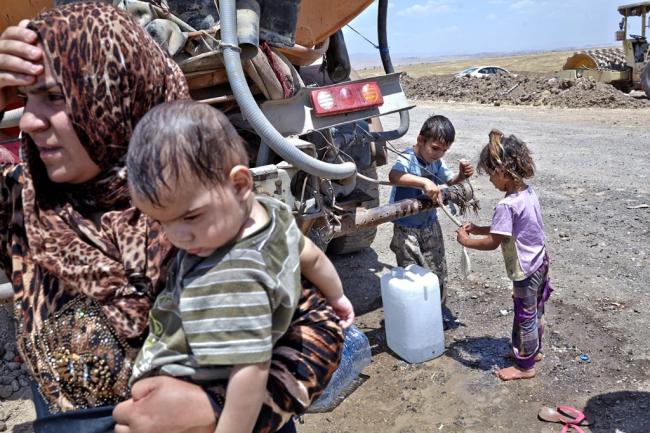
Security 'number one concern' of displaced Iraqis seeking to return home – UN study
The study, titled Obstacles to Return in Retaken Areas of Iraq, commissioned by the International Organization for Migration (IOM), has surveyed more than 1.7 million Iraqis who opted to return, posing questions as to the factors that motivate, or inhibit, Iraqis from returning to their areas of origin.
The qualitative and quantitative data collection was carried out in eight sub-districts the Government has recently retaken from the Islamic State in Iraq and the Levant (ISIL/Da'esh).
Security in the areas of origin topped all other factors in influencing the decision to return home or remain displaced, with proximity to the frontline – and perceived instability in the place of origin – remaining the most relevant obstacle for return, according to the study.
Speaking to reporters at the regular bi-weekly news briefing in Geneva, IOM spokesperson Joel Millman said security is the “number one concern. If they feel fighting is still going on or that the people who had destroyed their homes are still at large in the community – that is a major deterrent.”
Feelings of trust towards the security actors in control of the areas of origin promotes a higher number of returns, while fear of security actors in the place origin is a strong drawback and reinforces the perceived advantage of staying in displacement, the study finds.
Fear of reprisal back home is a concern for more than 30 per cent of all internally displaced persons (IDPs) interviewed. However, that perception is much lower among interviewed returnees, at 10 per cent.
The data suggest that damage to housing does not constitute an obstacle to return, although the presence of actors whom IDPs hold responsible for the damage inflicted in a given location is, noted IOM.
Livelihood options and previous or current employment status also play an important role in influencing the decision to return. IDPs who have jobs in the location of displacement are less inclined to return home. By contrast, those who are unemployed appear to be more likely to return to seek new opportunities.
The study shows that almost a quarter of interviewed IDPs who decided to return were prevented from doing so, mostly by delays in processing their documentation, or by being stopped at checkpoints on the way back to their place of origin.
Credit: UNHCR/S. Baldwin (file)
Source: www.justearthnews.com
Support Our Journalism
We cannot do without you.. your contribution supports unbiased journalism
IBNS is not driven by any ism- not wokeism, not racism, not skewed secularism, not hyper right-wing or left liberal ideals, nor by any hardline religious beliefs or hyper nationalism. We want to serve you good old objective news, as they are. We do not judge or preach. We let people decide for themselves. We only try to present factual and well-sourced news.
Support objective journalism for a small contribution.


