 Human Rights
Power of sport to counter violent extremism amplified at UN
New York: Sport can change the world, famous footballers and grassroots gamechangers alike said at a roundtable discussion on Monday, highlighting a new UN podcast series to mark the first International Day for the Prevention of Violent Extremism, as and when Conducive to Terrorism.
“Sport has the power to convey essential values of respect, inclusion, and solidarity,” said Mauro Miedico, deputy director and chief of the special projects and innovation branch at the UN Office of Counter-Terrorism (UNOCT). “When applied in tandem with wider preventing violent extremism (PVE) strategies, it can work against the drivers of radicalization which lead to violent extremism.”
Speakers at the roundtable demonstrated the power of sport in overcoming the devastating impact of war, displacement and strife facing millions at a time when such terrorist groups such as ISIL (or Dae’sh), Al-Qaida and Boko Haram are still spreading messages of religious, cultural and social intolerance.
The International Day, observed on 12 February through a General Assembly resolution, and the importance of raising awareness among youth, shaped the roundtable discussion.
Isabella Echeverri, Colombia football player and ambassador for the Save the Dream movement, said athletes are role models on and off the pitch.
“In sports, it is important to respect your opponents, to be loyal to your team, to show integrity by managing a tough loss, and courage and humility when you win a game,” she said. “When we leave the pitch, we can use our platforms to inspire and help young people, for instance, to show respect, love their bodies, be kind to other people, be aware of mental health issues, eat better, and exercise.”
Podcast highlights progress
The new UNOCT Power of the Pitch podcast, is a seven-part series examining how behavioural insights are being applied to sport when addressing violent extremism factors that may swell the ranks of terrorist groups.
Episodes highlight progress on the ground in conversations with athletes, experts and local actors, as well as the work of the UN global sport and security programme, launched in 2020, to focuses on the security of major sporting events and promoting sport and its values as a tool to prevent violent extremism.
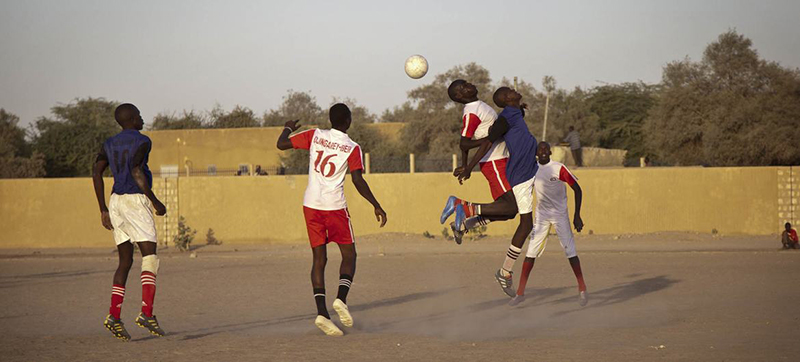
The podcast shows that across battlefields, deserts and communities in conflict, sports clubs are opening safe spaces for young people to play and learn.
New digital strategy needed
What that looks like on the pitch is communities coming together to build resilience. Jessica Hutting, a programme manager at Kampus Diakoneia Modern Foundation in Indonesia, said kicking a ball across a field or shooting it into a basket, offers young people a chance to mingle and overcome differences.
“Sport can be a unifying medium,” she said. “People might speak in many different languages, but sport can be a connecting language that melts those differences.”
As the COVID-19 pandemic and its related restrictions saw young people ever more attached to mobile phones and gadgets, she highlighted a need for a new strategy to reach out to them on digital platforms and encourage them to be more active in sports.
Peacebuilding on the pitch
Masereka Wilber, of the Integrated Community Development Initiative, explained that the stress and mental disorders he faced after the war in the Democratic Republic of the Congo had led him to hate people. But, football changed that, teaching him teamwork and tolerance.
“When you’re on the pitch, you play as a team,” he said. A UN grant is funding efforts to reach more youth like himself, he said, adding that new efforts are reaching out to train refugee communities.
Afghan women play ball
Former captain and founder of Afghanistan’s Women’s Football Team Khalida Popal, explained how being a refugee herself presents challenges, from prejudice to exclusion.
“As a refugee, what I heard is that ‘refugees are coming to get our money’,” she said. “I don’t want money; I want to contribute equally to society.”
To showcase good examples of minorities, including refugees, who are making a positive impact, she founded the Girl Power Organization as a bridge from Europe to the Middle East to provide ways women and girls can connect and thrive through sport and education.
The first woman to win the European football body’s (UEFA) Equal Game Award, she said sport helped her find confidence to be a voice for the voiceless. Growing up in a male-dominated warzone, she said sport can create a safe space among women to discuss some of these challenges.
“Football has always been a powerful tool,” she said. “We are trying to use sport as a tool to bring people together to raise awareness.”
Promoting unity
On football fields across the world, local groups are rolling out a range of other innovative projects with grants from the UN global programme, which engages with youth to ensure policymakers consider their unique skills and perspectives and with Member States to provide technical assistance on how to incorporate these initiatives in national strategies to prevent violent extremism.
“We try to promote unity,” said Kwaku Ofosu-Asare, executive chair of the thirteenth African Games, to be held in August in Ghana. Large sports competitions like the African Games can be a platform to send messages of peace, representing another opportunity to motivate youth.
“Sports is one of the best tools we can use,” he said, reflecting on current conflicts across Africa. “Why? Because it brings everyone together.”
Sport drives peace
Bram Van Haver, speaking on behalf of the UNAOC High Representative, said sport transcends borders, is “a key tool” to prevent violent extremism, and has the potential to break down walls between people. It can also have a positive impact through diversity, he added.
Leif Villadsen, of UNICRI, said building resilience is essential, especially for young people who are marginalized and vulnerable.
“Through supporting sport and preventing violent extremism, we can help young people reach their full potential,” he said, emphasizing that more analysis on preventing violence extremism is needed to gauge how sport is playing a role.
UN a ‘precious ally’
Massimiliano Montanari, executive director of Save the Dream, said sports can build more fair and inclusive societies. Highlighting projects to promote reconciliation in Somalia, Sudan and other countries, he said the UN programme represents a “precious ally” for activists who aim at building societies where violent extremism cannot take hold.
“By experiencing a friendship through sport, when children play together, this is a celebration of the International Day, every day,” he said.
As many speakers at the roundtable discussion agreed, that is the goal.
Support Our Journalism
We cannot do without you.. your contribution supports unbiased journalism
IBNS is not driven by any ism- not wokeism, not racism, not skewed secularism, not hyper right-wing or left liberal ideals, nor by any hardline religious beliefs or hyper nationalism. We want to serve you good old objective news, as they are. We do not judge or preach. We let people decide for themselves. We only try to present factual and well-sourced news.
Support objective journalism for a small contribution.