 Iran Conflict
Pakistan's double-game exposed: Islamabad opens up road trade routes into Iran amid Trump's Hormuz blockade
Pakistan has activated multiple overland trade corridors linking its ports to Iran, introducing a significant development in regional trade dynamics amid ongoing tensions over maritime restrictions.
The move comes as the United States continues to enforce a blockade strategy in the Strait of Hormuz, a key artery for global energy shipments.
Six trade corridors opened
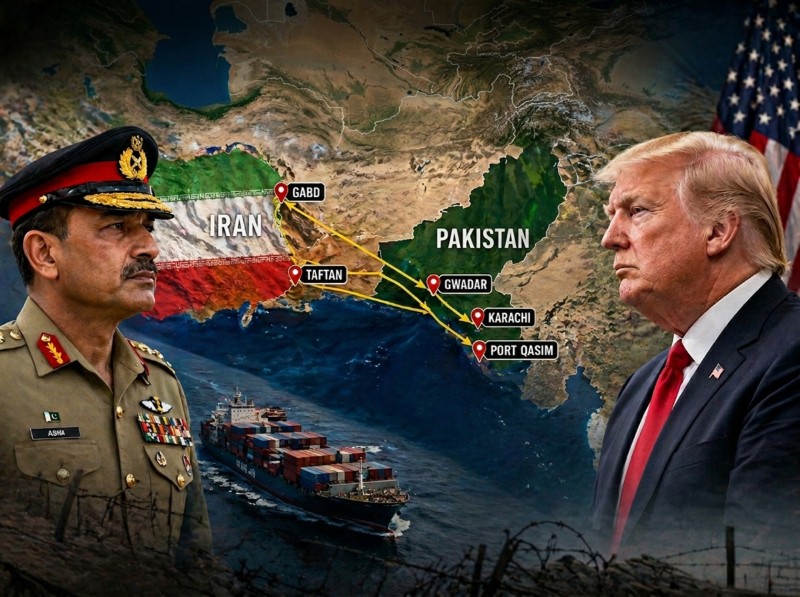
Under a newly implemented framework titled the Transit of Goods through Territory of Pakistan Order 2026, Islamabad has formalised the movement of goods from third countries to Iran through its territory.
The corridors connect major ports such as Gwadar, Karachi and Port Qasim with border crossings including Taftan and Gabd.
These routes combine coastal highways with inland transport networks, allowing cargo to be transferred under customs supervision and regulatory compliance.
Alternative to disrupted maritime routes
The activation of these land corridors coincides with increased restrictions on maritime trade linked to Iran.
Since mid-April, vessels associated with Iranian ports have faced limitations under the US-led blockade.
The overland routes provide an alternative channel for goods movement, helping maintain trade flows despite disruptions at sea.
Thousands of containers destined for Iran had reportedly been held at Pakistani ports due to uncertainties in maritime transit.
The new system allows these consignments to continue via land.
Strategic timing amid regional tensions
The development has occurred during a period of heightened geopolitical friction involving Iran and the United States.
The blockade measures have focused on limiting Tehran’s access to global trade through maritime chokepoints.
The opening of land-based routes alters the logistics landscape by reducing reliance on sea lanes affected by restrictions.
Observations from analysts
The move has drawn attention from geopolitical observers, who note its implications for regional strategy.
Analysts have highlighted that the corridors provide Iran with an additional pathway to sustain trade flows under constrained conditions.
The development has also been discussed in the context of Pakistan’s broader diplomatic positioning, where it maintains engagement with multiple global and regional stakeholders.
Pakistan’s role in regional connectivity
Pakistan has positioned the initiative as part of its transit and trade facilitation framework, enabling the regulated movement of goods across borders.
The system includes provisions for multimodal cargo transfer and financial guarantees to ensure adherence to customs protocols.
The activation of these routes introduces a new variable in the ongoing economic and geopolitical environment surrounding Iran.
By offering an alternative to maritime transport, Pakistan has expanded regional connectivity while influencing the broader dynamics of trade and logistics in the region.
The development comes as global energy and trade networks continue to adjust to shifting geopolitical realities, particularly around critical corridors such as the Strait of Hormuz.
Support Our Journalism
We cannot do without you.. your contribution supports unbiased journalism
IBNS is not driven by any ism- not wokeism, not racism, not skewed secularism, not hyper right-wing or left liberal ideals, nor by any hardline religious beliefs or hyper nationalism. We want to serve you good old objective news, as they are. We do not judge or preach. We let people decide for themselves. We only try to present factual and well-sourced news.
Support objective journalism for a small contribution.