


OECD-UN forum on strengthening collection and use of migration data kicks off in Paris
New York, Jan 16 (JEN): International organizations, policy experts, statisticians and civil society came together on Monday at a United Nations-supported forum in Paris to answer the global call for more accurate and timely information on migration flows and examine how improved data collection can feed into better policymaking.
Organized jointly by the Organisation for Economic Co-operation and Development (OECD), the United Nations International Organization for Migration (IOM) and the UN Department of Economic and Social Affairs, the first International Forum on Migration Statistics will also explore innovations in data collection and strengthening capacity in developing countries to produce and improve migration statistics.
“It is important that we speak on Monday about the fundamental need for better migration data,” said William Lacy Swing, the Director-General of the UN International Organization for Migration (IOM), at the Forum.
“We also need urgently, however, to engage a dialogue on a Global Action Plan – a plan to ensure the availability to policymakers and others comprehensive national, regional and global data and statistical analysis of trends in migration – a phenomenon as old as humankind and, on Monday, one of the defining phenomena of our time.”
Running through Tuesday, the Forum will explore improvements the production and use of migration data and overcoming challenges in the sector, as well as also delve deep into specific themes.
Also on the agenda is a specific plenary session is devoted to exploring how public opinions on migration and migrants are formed, and how these can change by facing well-communicated facts.
Other topics include use Big Data for migration, as well as building the capacity for emerging economies and developing countries to produce migration statistics.
According to IOM, the Forum aims to become a bi-annual event for producers and users of migration-related data to share their views, identify gaps and highlight needs for training and capacity building.
Policies concerning migration must be grounded in data
In a related statement, Swing also underscored that accurate and complete migration data is critical for sound policies concerning it.
“We are finding that without access to reliable, comprehensive and global data, managing migration policy becomes a game of blind man’s bluff,” he stressed. in a recent statement, underscoring the importance of data for sound policies.
However, he added, despite efforts by Governments and the international community, “significant gaps” in migration data remain globally.
National population censuses – traditionally the main source of data on migration – are infrequent and cannot therefore provide timely information. Furthermore, migrants, especially those on irregular status, often are absent from household surveys, or are hard to track through administrative data sources.
In the statement, Swing noted the that the volume of data available on Monday is larger than at any point in human history. While there are incredible possibilities of the use of this so called “Big Data” – data generated, often inadvertently, by users on digital devices, web-platforms or other “smart” sources – there are also significant challenges, in particular those over privacy, ethical and human rights given the way they are generated or collected.
“Concerns over the use of Big Data for any purpose, including research, need to be identified and adequately addressed by policy-makers, for instance through the creation of a regulatory system setting out conditions and limits to access to and use of certain kinds of data,” suggested Swing.
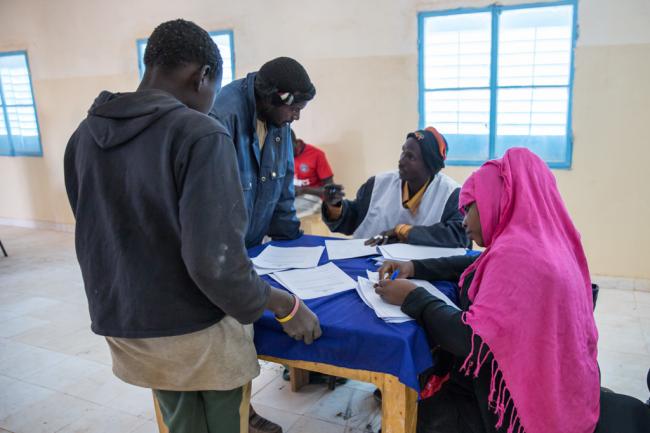
Photo: IOM
Support Our Journalism
We cannot do without you.. your contribution supports unbiased journalism
IBNS is not driven by any ism- not wokeism, not racism, not skewed secularism, not hyper right-wing or left liberal ideals, nor by any hardline religious beliefs or hyper nationalism. We want to serve you good old objective news, as they are. We do not judge or preach. We let people decide for themselves. We only try to present factual and well-sourced news.
Support objective journalism for a small contribution.


