 Nepal Polls
Nepal votes for first time since Gen Z uprising; turnout hits 18% by noon, spotlight on rapper-turned-politician Balendra Shah
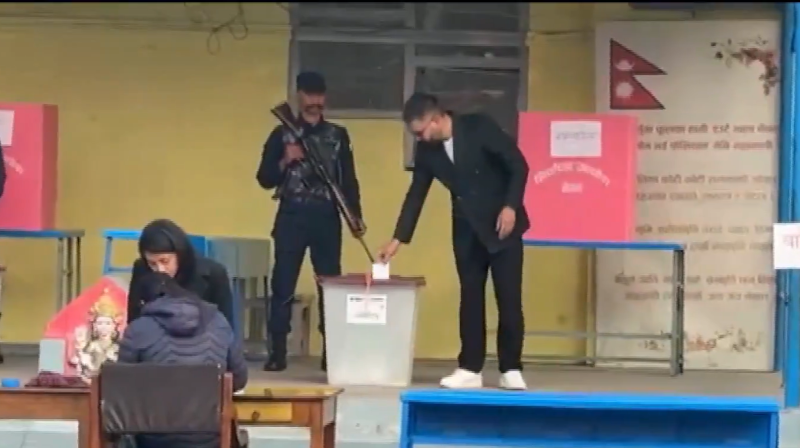
Kathmandu/IBNS: Around 18 percent of voters cast their ballots by noon on Thursday as Nepal held its first national elections since the Gen Z–led protests toppled the government of former Prime Minister K. P. Sharma Oli last year, media reports said.
Voting began at 7 am on Thursday, and the Election Commission said that roughly 18 percent of eligible voters had exercised their franchise by midday.
Out of Nepal’s 30 million population, nearly 19 million people are eligible to vote in the polls.
The 275-member legislature will see 165 members elected directly, while the remaining 110 seats will be filled through proportional representation.
Major political forces contesting the elections include Communist Party of Nepal (Unified Marxist–Leninist) led by K. P. Sharma Oli, the Nepali Congress headed by Sher Bahadur Deuba, and Communist Party of Nepal (Maoist Centre) led by Pushpa Kamal Dahal.
Meanwhile, 35-year-old rapper-turned-politician Balendra Shah has emerged as a surprise frontrunner, with analysts suggesting his Rashtriya Swatantra Party could perform strongly in the polls.
The elections come after dramatic political developments last year when widespread protests led to the fall of Oli’s government.
Following the regime change, former Chief Justice Sushila Karki was appointed interim Prime Minister, marking a historic moment as she became the country’s first woman Prime Minister.
The decision reportedly followed a rare consensus among Gen Z protest leaders, President Ram Chandra Paudel, and Army Chief Ashok Raj Sigdel.
Nepal’s Gen-Z revolt: How a social media ban shook the nation
It began with silence. One September morning, young Nepalis woke to find their phones suddenly quieter: Facebook, YouTube, WhatsApp, X, and two dozen other apps had gone dark.
The government’s explanation was dry—these platforms had “failed to register” under new rules. But to a generation that lives, learns, and organizes online, it felt like something else entirely: censorship.
Within hours, the streets of Kathmandu were alive. University students, job-seekers, artists, and influencers poured into public squares, chanting against corruption, nepotism, and a political class they accused of living in luxury while ordinary citizens struggled.
What started as an angry pushback against a ban quickly swelled into something larger.
“Enough is enough!” became the rallying cry. Videos, ironically recorded before the blackout and later shared when access was restored, showed crowds marching through the capital, waving placards that read “Gen-Z for Change”.
The violence shocked the country. The very platforms the government tried to suppress turned into channels of outrage, as VPNs and backdoors allowed images of injured protesters to spread globally. International condemnation poured in.
Cornered, the previous government backtracked. Within three days, the social media ban was lifted, a rare victory wrested by youth power. Yet, the protests had already outgrown their original spark.
Calls grew louder for deeper change: an end to corruption, accountability from leaders, and new elections.
Political elites, long accustomed to horse-trading and fragile coalitions, suddenly seemed powerless before an angry, mobilized generation.
The protest compelled former Prime Minister KP Sharma Oli to resign.
Support Our Journalism
We cannot do without you.. your contribution supports unbiased journalism
IBNS is not driven by any ism- not wokeism, not racism, not skewed secularism, not hyper right-wing or left liberal ideals, nor by any hardline religious beliefs or hyper nationalism. We want to serve you good old objective news, as they are. We do not judge or preach. We let people decide for themselves. We only try to present factual and well-sourced news.
Support objective journalism for a small contribution.