


Monsoon destroys Rohingya shelters, sparking record UN emergency food agency response in Bangladesh
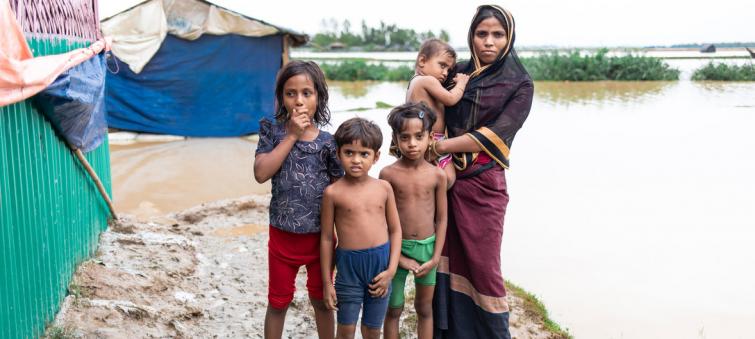
New York: Unusually heavy monsoon rains have inundated shelters in refugee camps in southern Bangladesh creating “havoc”, the World Food Programme (WFP) said on Friday, as it launched its biggest emergency response of the year for displaced Rohingya families.
At a regular briefing in Geneva, WFP spokesperson Hervé Verhoosel said that 16,000 people had received food assistance in just 24 hours - more than all those reached since the monsoon season began in June.
The flooding was “much bigger” than usual, Mr. Verhoosel insisted, adding that the area of Teknaf was worst-affected, thanks to record rainfall this week.
Relaying information from colleagues in Cox’s Bazar – a series of camps that have been home to hundreds of thousands of mainly Rohingya refugees since they fled a military operation led by the Myanmar military in the summer of 2017 – Mr. Verhoosel said that some families had lost everything.
Host communities have also been badly affected, with more than 800 people temporarily displaced by flooding receiving food assistance.
“All that was in the house was basically washed away; what they use as a bed or what they use to cook, or everything was basically lost,” Mr. Verhoosel insisted. “They have nothing to cook (with), they have nothing to sleep (on), most of the clothes have been lost. Basically, the little things that they’ve rebuilt since they arrived in the camp was lost in one night of rain.”
Situation ‘could deteriorate’ without more funding
In an appeal for funding, the WFP official explained that it costs $16 million every month to feed almost 900,000 refugees in Cox’s Bazar.
For the time being, the agency has supplies prepositioned at strategic locations around the camps which can be distributed quickly.
But without the continued support of the international community, their situation could deteriorate rapidly, Mr. Verhoosel maintained.
One of the problems Bangladesh faces is that it is a low-lying country which is prone to flooding during the monsoon season, which usually lasts until October.
The country has also had more erratic monsoons and downpours in recent years as a result of climate change which WFP has sought to counter, by planting 100,000 trees in the camps and host communities to mitigate landslides and flooding.
In addition, engineering and disaster risk reduction work has been ongoing for more than a year and the camps “are significantly safer than they were earlier”, Mr. Verhoosel insisted, citing slope stabilization works and better road and drainage systems.
Security restrictions ‘should not impact on refugees’
In a related development, and in response to journalists’ questions about reported telecommunications restrictions in Cox’s Bazar following protests there, the UN Refugee Agency (UNHCR) insisted that those seeking shelter should not be prevented from contacting relatives or friends living elsewhere.
“The Government of Bangladesh does have an overall responsibility for ensuring security and safety of the Rohingya who are sheltered in Cox’s Bazar,” UNCHR spokesperson Andrej Mahecic said. “Given the humanitarian nature of the Rohingya refugee settlements, we would recommend the adoption of security measures that do not impact upon the ability of refugees to access basic services and rights and live safely.”
Highlighting how useful technology is for refugees wishing to communicate with “family and friends and humanitarian agencies”, Mahecic insisted that this was especially the case in emergency situations, like the one happening now.
Photo credit and caption:
WFP/Nihab Rahman
The UN World Food Programme launched its biggest rapid food response following heavy rains and flash flooding in the Cox’s Bazar refugee camps and host communities.WFP/Nihab Rahman
Support Our Journalism
We cannot do without you.. your contribution supports unbiased journalism
IBNS is not driven by any ism- not wokeism, not racism, not skewed secularism, not hyper right-wing or left liberal ideals, nor by any hardline religious beliefs or hyper nationalism. We want to serve you good old objective news, as they are. We do not judge or preach. We let people decide for themselves. We only try to present factual and well-sourced news.
Support objective journalism for a small contribution.


